

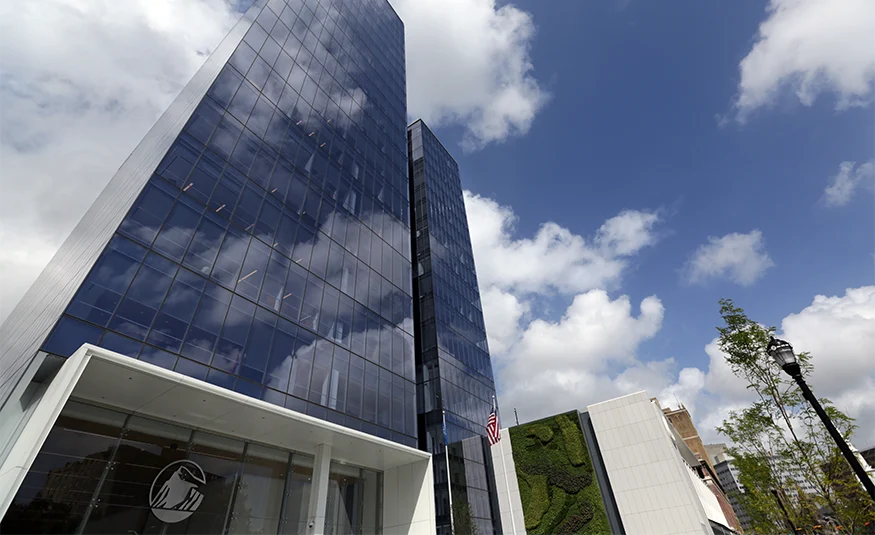
In a move that signals both a transformation of the modern workplace and an enduring loyalty to its historic roots, Prudential Financial has announced a significant restructuring of its real estate portfolio in Newark, New Jersey. The insurance giant, which has called Newark home for more than 150 years, revealed plans to divest two of its three major office buildings in the city, consolidating its operations into the iconic Prudential Tower.
The announcement, spearheaded by CEO Andrew Sullivan, is more than a mere real estate transaction; it is a calculated effort to optimize resources, embrace hybrid work modalities, and double down on a long-term vision for the “Brick City.” Despite the downsizing of its physical footprint, the company maintains that its commitment to the Newark community remains as robust as ever, backed by a staggering $1.2 billion in local investments over the past decade.
The Strategic Real Estate Pivot
The decision to sell two of its Newark properties represents a pragmatic response to the post-pandemic shifts in corporate culture. As the global business landscape pivots toward hybrid models—where employees balance remote work with in-person collaboration—large, underutilized office spaces have become a drain on capital and operational efficiency.
By consolidating its workforce into the 20-story, 740,000-square-foot Prudential Tower at 655 Broad St., the firm aims to create a more dynamic and connected environment. The tower, which debuted in 2015 to mark the company’s 140th anniversary, will serve as the consolidated global headquarters.
"We are aligning our real estate footprint with our strategy and future ways of working," CEO Andrew Sullivan stated. "Establishing the Tower Building as Prudential’s global headquarters will create a more connected workplace and enable more efficient use of resources. Newark remains Prudential’s home, and we are proud to remain part of the community."
While the company has not yet identified the specific brokers for the sales or the exact timeline for vacating the properties, officials confirmed that the transition will occur over several years. Crucially, there will be no immediate changes for employees, ensuring a smooth transition for the firm’s thousands of staff members.
A Chronology of Commitment
Prudential’s relationship with Newark is foundational. The company was born in the city in 1875, and its growth has mirrored the city’s own industrial and economic trajectory. To understand the gravity of this decision, one must look at the timeline of the company’s evolution within the city:
- 1875: The Prudential Friendly Society is founded in Newark, setting the stage for what would become a global insurance powerhouse.
- 2013: The company receives a $210 million state tax credit, a pivotal incentive that solidified its decision to anchor its future in downtown Newark.
- 2015: Prudential celebrates its 140th anniversary by opening the Prudential Tower at 655 Broad St., a state-of-the-art facility developed by SJP Properties and designed by Kohn Pedersen Fox. At the time, the project was seen as a cornerstone of Newark’s urban renaissance.
- 2025–2026: Recognizing the shift in office occupancy trends, leadership begins a comprehensive review of its real estate holdings.
- September 2026: CEO Andrew Sullivan pens an op-ed outlining "the next chapter" for the company, formally announcing the intent to sell two satellite buildings while reaffirming the company’s status as a Newark anchor.
Supporting Data: Why Now?
The financial rationale behind this move is tied to a broader corporate strategy of capital efficiency. With $1.6 trillion in assets under management, Prudential is navigating a complex global market. In the second quarter of 2026, the company reported a net income of $985 million, a significant increase from the $533 million reported in the same period in 2025.
However, management identified the maintenance of underutilized real estate as a drag on the company’s ability to innovate. Sullivan’s argument is clear: the capital tied up in empty square footage is capital that could be better deployed toward technology, talent acquisition, and digital capabilities.
"By putting those resources to work elsewhere, we can invest more in the people, technology, and capabilities that help us serve customers and meet their changing needs," Sullivan explained. The consolidation is not about cost-cutting in the traditional sense of austerity; it is about "re-investment" in the future of the firm’s service offerings.
Official Responses and Corporate Philosophy
The messaging from the top of the firm is uniform: the move is an evolution, not a withdrawal. In his public comments, Sullivan has gone to great lengths to emphasize that the company is not leaving Newark.

The emphasis on "modern, collaborative environments" is a direct nod to the changing needs of the workforce. Prudential believes that by centralizing teams, it can break down departmental silos that often persist in sprawling, multi-building campuses. By forcing a more intimate, high-density, and intentional office design, the firm hopes to spark the kind of spontaneous collaboration that drives insurance innovation.
Community leaders and local observers have largely reacted with measured optimism. Given the firm’s $1.2 billion contribution to local initiatives, organizations, and infrastructure over the last ten years, there is a level of trust between the corporation and the city government. Prudential has been a primary driver of Newark’s economic development, and its continued presence in the iconic tower is viewed as a vote of confidence in the city’s downtown business district.
The Implications for Newark and the Office Sector
The broader implication of Prudential’s move is a clear indicator of the "new normal" for commercial real estate in urban centers. Newark, like many major U.S. cities, has been grappling with the surplus of office space left behind by the hybrid work revolution.
1. The Impact on Commercial Real Estate
Prudential’s move will likely trigger a ripple effect in the Newark commercial market. As two major office properties hit the market, the city will face the challenge of repurposing or re-tenanting these spaces. This could open doors for residential conversion, educational facilities, or the attraction of new tech firms looking for premium, transit-oriented office space.
2. The Future of the Workplace
For employees, the transition is expected to foster a more "connected" experience. The shift away from siloed buildings toward a unified headquarters is designed to boost employee engagement and corporate identity—two things that often suffer in a distributed, hybrid work environment.
3. Economic Stability
While the sale of the buildings marks a change in the physical landscape, the core of the business remains tethered to Newark. By keeping its headquarters in the heart of the city, Prudential ensures it remains a significant taxpayer and employer, continuing to anchor the downtown economy.
A Balanced Path Forward
The narrative of Prudential Financial in 2026 is one of intentionality. By pruning its physical assets, the company is positioning itself to be leaner, faster, and more responsive to the needs of its policyholders.
The transition will not be overnight. It will require careful management of the properties being vacated and a thoughtful design process to ensure the remaining tower can accommodate the necessary collaborative culture. However, the firm’s leadership remains steadfast.
As Sullivan noted in his address to the company and the city, this is about ensuring that Prudential remains a leader for the next 150 years. The company’s roots in Newark are deep, but its branches are reaching toward a digital-first, agile future. For the "Brick City," having a partner like Prudential—a company that is willing to adapt to survive—is the best possible insurance for a prosperous future.
As the calendar turns toward 2027 and beyond, the eyes of the commercial real estate world will remain fixed on Newark. The story of how one of America’s oldest financial institutions navigates the modern office landscape will serve as a template for other legacy firms looking to balance tradition with the realities of a changing global economy. Through this transition, Prudential proves that while the office itself may change, its role as a bedrock of the Newark community remains unshakeable.
