

Main Facts: A Sonic Intervention at the Armory
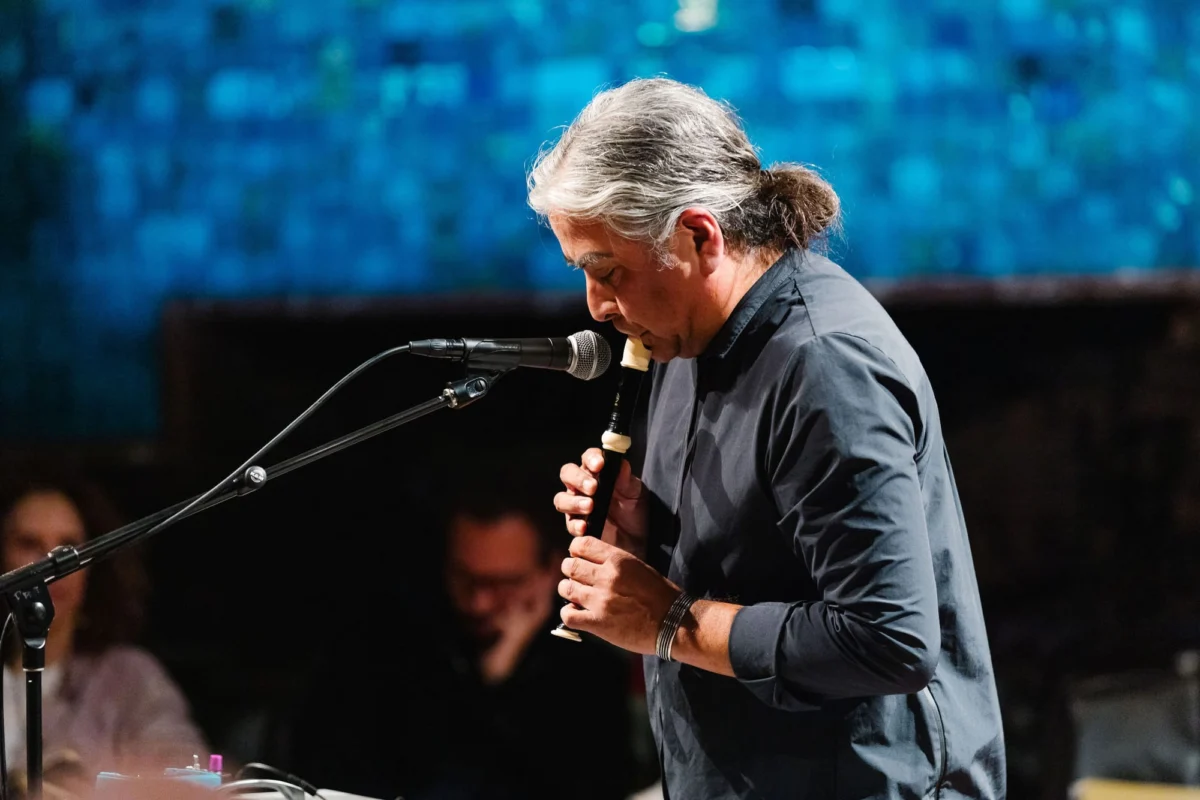
Within the opulent, history-laden walls of the Veterans Room at Manhattan’s Park Avenue Armory, the air was recently charged with something far more volatile than Gilded Age luxury. On the evenings of October 7 and 8, 2026, the Pulitzer Prize-winning Diné (Navajo) artist and composer Raven Chacon took center stage as part of the Armory’s prestigious "Artists Studio" series.
Chacon, renowned for his ability to weave political critique into avant-garde soundscapes, presented an hour-long improvisation that defied traditional performance constraints. His workspace was a modest, unassuming table laden with a disparate collection of objects: synthesizers, signal processors, pedals, whistles, a traditional ceramic horn, and even a turkey call. Throughout the performance, Chacon acted as a conduit between the mechanical and the natural, using these tools to construct an immersive sonic environment that challenged the audience to reconsider their relationship with the spaces they inhabit—and the histories buried beneath them.
Chronology: The Anatomy of an Improvisation
The performance on October 8 functioned as a masterclass in tension and release. Chacon began with sparse, calculated movements, manipulating electronic loops that transformed simple breath into complex, layered drone textures.
- The Initial Phase: Chacon began by looping the sharp, piercing sound of a whistle, layering it against deep, sub-bass frequencies. The juxtaposition of the whistle’s agility against the immovable drone created a sensation of claustrophobia, mimicking the encroachment of urban development.
- The Mid-Performance Evolution: As the set progressed, the sound palette shifted toward the industrial and the extraterrestrial. By feeding electronic signals through various processors, Chacon conjured metallic, oscillating screeches that felt ripped from the soundtrack of a high-concept science fiction film. These sounds were periodically punctured by the organic resonance of a ceramic horn, grounding the abstract digital noise in a tangible, earth-born reality.
- The Closing Sequence: In the final act, Chacon utilized a hyperdirectional speaker to circulate recordings of wind from the American Southwest. By physically moving the speaker in a slow, deliberate circle around his position, he effectively "swept" the landscape of his homeland across the Veterans Room, creating a profound contrast between the serene, wide-open geography of the desert and the harsh, aggressive cacophony of Park Avenue traffic pulsing just outside the building’s heavy doors.
Supporting Data and Context: The Politics of Field Recording
Raven Chacon’s work is rarely just about "sound." It is an interrogation of land, sovereignty, and the colonial legacy embedded in the American landscape.
The choice to bring recordings from New Mexico into the heart of Manhattan is a deliberate act of displacement and re-territorialization. When asked about the site-specificity of his work, Chacon noted that his performances often serve as a dialogue between the interiority of the performance space and the external, often hostile, environment of the city.

"When I’m playing in the city, I tend to bring in more field recordings of the outdoors," Chacon explained. "It’s unavoidable that we might hear sirens and traffic outside, and those usually become part of the soundtrack. I find myself incorporating those sounds, amongst the other things that encroach upon the interior of the space."
This philosophy mirrors his broader career. From his Pulitzer-winning Voiceless Mass—a work designed for pipe organ that utilizes the instrument’s immense power to reclaim space—to his contributions to group exhibitions at the Hammer Museum, Chacon consistently links sound to the physical properties of the earth. At the Hammer, his work was noted for its ability to mimic geological instability, specifically the tremor of a California earthquake, grounding the abstract audio in the literal shifting of soil.
Official Perspectives: The Philosophy of Deep Listening
In the wake of the performances, the discourse surrounding Chacon’s work has centered on the "privilege of deep listening." In an era of constant auditory saturation, Chacon’s work forces a slowing down of perception.
For the artist, the act of performance is an invitation to engage with what he calls the "geography of alternative worlds." These are spaces that exist in the interstices of the contemporary landscape—places that are quieter, more ancient, and less prone to the violence of modern industrial progress. His reliance on tools that have historically been associated with hunting or signalling—the turkey call, the whistle—is a calculated subversion. He takes instruments of conquest and turns them into tools of meditation and memory.
The Park Avenue Armory’s Artists Studio series, which curates intimate engagements between creators and their public, provided the ideal crucible for this approach. By stripping away the spectacle of a large-scale concert hall, the Armory allowed for a vulnerability that is essential to Chacon’s process. The audience was not just watching a performance; they were observing an artist "at play," experimenting with the potential for sound to act as a bridge between disparate realities.
Implications: The Future of Sonic Cartography
The implications of Chacon’s current trajectory are significant for both the contemporary art world and the broader cultural conversation regarding Indigenous visibility. As he prepares for an upcoming exhibition at the San Francisco Museum of Modern Art (SFMOMA), it is clear that his focus is shifting toward the intersection of speculative futures and indigenous knowledge.
The Science Fiction Turn
Chacon’s upcoming work is set to lean heavily into science fiction—a genre he views as a legitimate vehicle for expressing the historical and future traumas of Indigenous peoples. By blending the organic sounds of the land with the synthetic, futuristic textures of his electronics, he is effectively creating a new sonic cartography. This is not merely an aesthetic choice; it is a political one. It suggests that the "future" is not a blank slate, but a continuation of the land’s history, and that those who have been most marginalized by modernity are often the most adept at imagining what lies beyond it.
A Call to Action
Ultimately, the success of Chacon’s residency at the Armory serves as a reminder that sound is never neutral. Every frequency is a choice; every silence is a political stance. As he continues to explore these themes, the challenge he poses to his audience remains the same: the world outside may be blaring with the noise of commerce and conflict, but an alternative world—one of endurance and deep, ancestral memory—exists just beneath the surface, waiting for us to choose to listen.
"The continued existence of these places depends upon our choosing to listen," Chacon suggests. Through his work, he does not just play music; he creates the space for that listening to occur, ensuring that the history of the land is not silenced by the sirens of the city.
As Chacon moves toward his next chapter at SFMOMA, the cultural establishment will continue to grapple with his work’s intensity. He remains one of the few artists capable of navigating the high-art sphere of the Armory while simultaneously maintaining a raw, uncompromising connection to the roots of his Diné heritage, proving that the most profound revolutions in art often happen when we stop looking and start paying attention to the resonance of the ground beneath our feet.
