

By Chinyere Erondu
In the hallowed, light-filled halls of the National Museum of the American Indian in Washington, DC, a transformation is taking place. It is not merely the shifting of light or the movement of visitors, but a fundamental alteration in how we perceive the intersection of nature, ancestry, and time. Water’s Edge: The Art of Truman Lowe, the first major retrospective of the late Hoocąk (Ho-Chunk) artist, serves as a poignant reminder that sculpture can be as fluid as a river and as enduring as a cultural memory.
Lowe’s work, which often utilizes organic materials like willow, pine, and birch, defies the rigidity typically associated with wood. Instead, he breathes life into saplings, bending and weaving them into forms that mimic the rhythmic pulses of the rivers that shaped his childhood. For Lowe, wood was never a static medium; it was a conduit for water—a living, breathing witness to history.
The Architecture of the Current: Main Facts and Artistic Philosophy
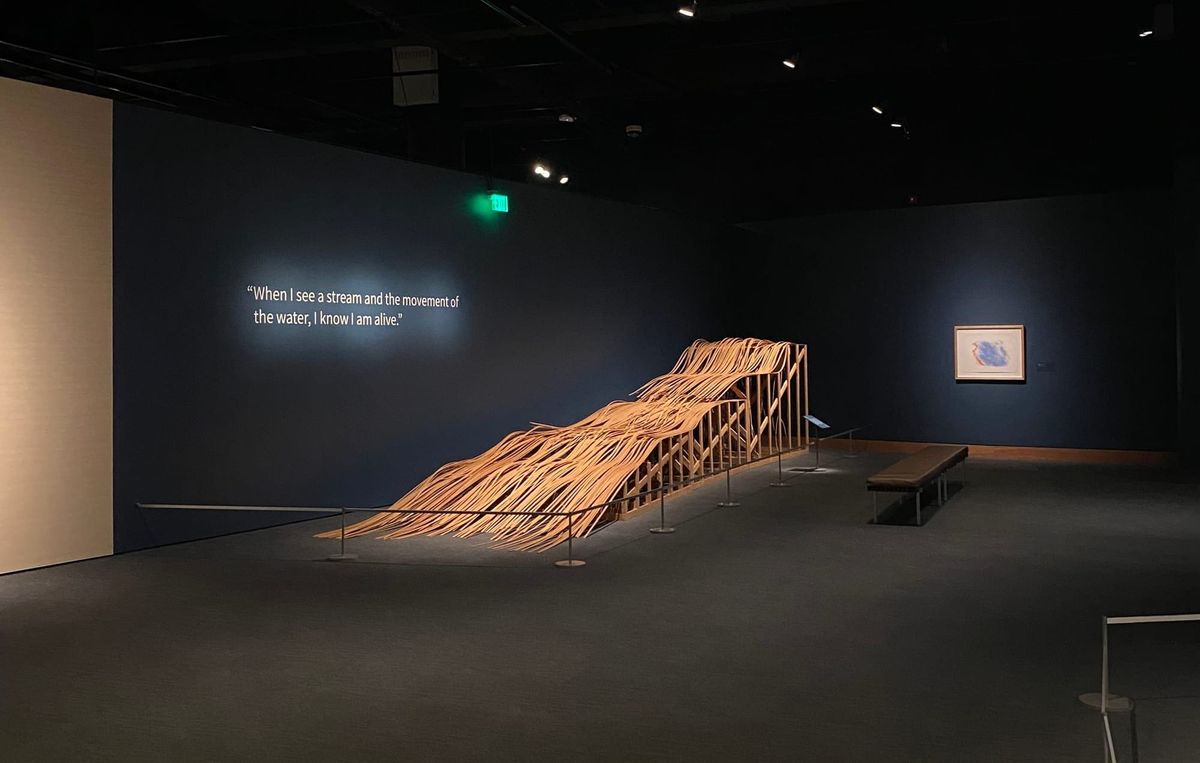
The exhibition opens with a powerful statement: “Ottawa” (1992). A monumental installation of pine and peeled wood saplings, the piece billows through the gallery space, evoking the tributary currents of the rivers that marked the aquatic landscapes of Lowe’s youth. The sculpture ripples with an audacious disregard for the material’s inherent fixed state, embodying Lowe’s foundational artistic ethos: that wood is water.
Water’s Edge is meticulously organized around four primary thematic pillars: Landscape and Place, Woodland Structures, Memory, and Shared Knowledge. These themes do not exist in isolation but rather coalesce to form a narrative of Indigenous resilience.
In Hoocąk tradition, the number four is imbued with profound spiritual significance. It represents the cardinal directions, the seasons, and the cyclical nature of life. This numerical reverence permeates Lowe’s oeuvre. For instance, in the 1979 sculpture “Mimi,” Lowe utilizes four peeled willow branches, four distinct groupings of blue jay feathers, and red beads arranged in sequences of four, all cocooning four strips of leather. This repetition is not merely aesthetic; it is a ritualistic assertion of permanence and survival.
A Chronological Journey: From Traditional Roots to Contemporary Form
To understand the trajectory of Truman Lowe’s career, one must look at his evolution as both a craftsman and a conceptualist. Born in 1944 in Black River Falls, Wisconsin, Lowe grew up surrounded by the landscape of the Ho-Chunk people. His early work was deeply informed by the traditional basketry and woodworking techniques passed down through generations of his family.
The Formative Years (1960s–1970s)
Lowe’s early career was defined by a reverence for the natural world. He did not seek to impose his will upon the wood; rather, he engaged in a dialogue with it. By the late 1970s, he began to move away from strictly functional objects toward more abstract, sculptural expressions. The “Mimi” piece serves as a bridge between these eras, blending the sacred significance of traditional motifs with a modern, minimalist sculptural sensibility.
The Middle Period (1980s–1990s)
It was during the 1990s that Lowe achieved his most recognizable style—the “billowing” wood installations. Works like “Ottawa” became emblematic of his ability to make hard, harvested wood appear as fluid as a rushing stream. He treated the wood as if it were liquid, capturing the tension between the stability of the shore and the movement of the water.
The Later Works (2000s–2019)
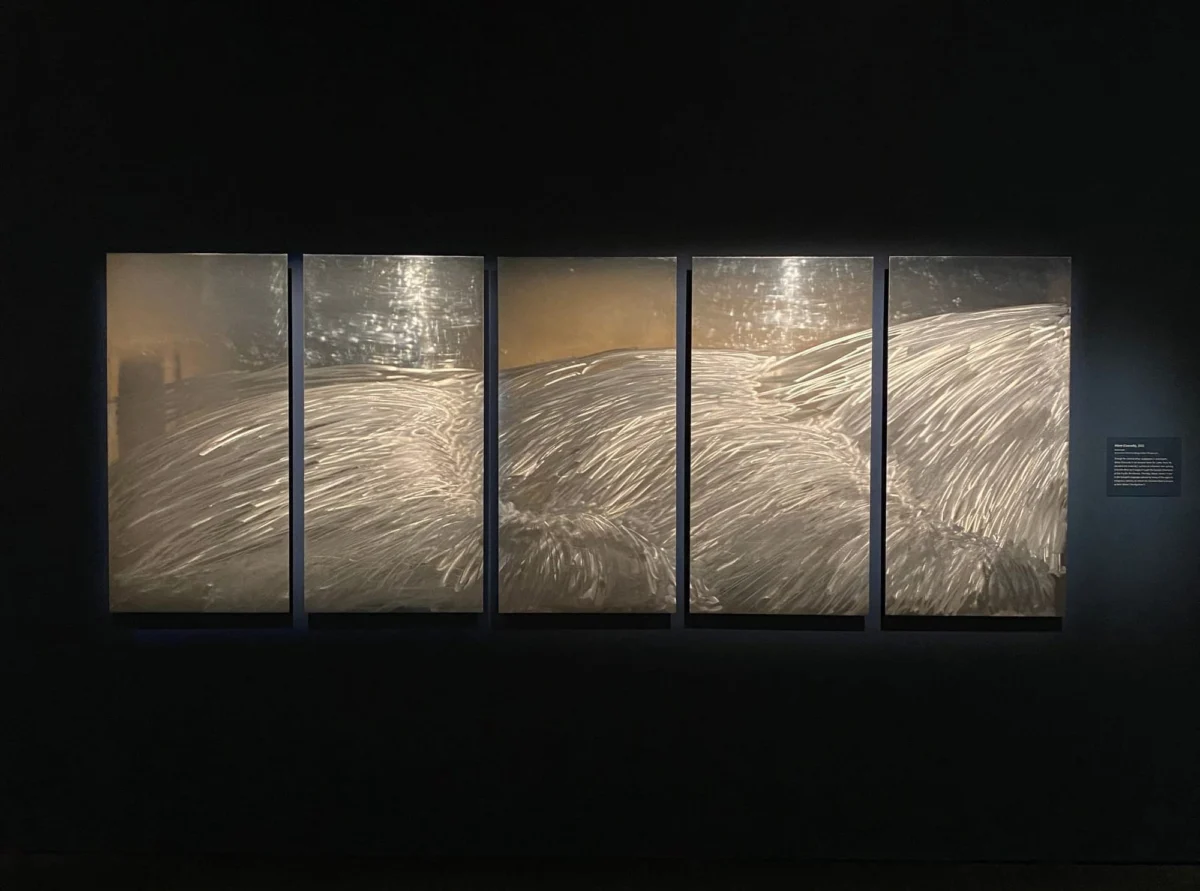
As his career matured, Lowe began experimenting with industrial materials. The inclusion of “Wá:na (Cascade)” (2002) in the exhibition showcases this transition. Constructed from aluminum, the piece maintains the fluid, cascading aesthetic of his earlier wooden works while introducing a sleek, metallic permanence. This shift challenged viewers to consider the impact of modernity on the natural world, even as the artist continued to draw inspiration from the ancient, rushing waters of his heritage.
The Science of Sustainability: Supporting Data and Cultural Significance
The significance of Lowe’s work extends beyond the aesthetic; it serves as a form of cultural mapping. The Hoocąk people have a deeply rooted connection to the rivers and woodlands of the Great Lakes region. For decades, researchers and cultural anthropologists have noted that the displacement of Indigenous peoples often involves a systematic erasure of their relationship to the land.
Lowe’s sculptures act as a corrective to this erasure. By utilizing materials harvested from the very environments his ancestors called home, he re-establishes a physical and symbolic link to the land.
Data from the Smithsonian’s curatorial department suggests that the wood utilized in many of Lowe’s installations is specifically chosen for its flexibility and ability to retain its form over time. The “peeled willow” technique, for instance, allows the artist to remove the outer bark—a process that reveals the smooth, inner layer that catches the light in a way that mimics the surface of a river. This technical mastery is supported by a deep knowledge of botany and environmental science, skills that were integral to the survival and cultural continuity of the Hoocąk.
Official Responses and Curatorial Intent
The National Museum of the American Indian (NMAI) has framed this retrospective as a critical intervention in the contemporary art world. Museum curators noted that while Lowe was a prominent educator—serving as a professor at the University of Wisconsin-Madison for over 30 years—his influence as a sculptor has often been overshadowed by his administrative and academic achievements.
“Truman Lowe’s work forces us to rethink the boundaries of sculpture,” said one lead curator during the opening press briefing. “He wasn’t just building structures; he was translating the memory of water into a physical language. To walk through this exhibition is to be submerged in the history of the Hoocąk people.”
The museum’s initiative to host this retrospective is part of a broader effort to highlight Indigenous artists who utilize traditional ecological knowledge to inform contemporary practices. By centering the exhibit on the theme of “water,” the NMAI draws a parallel between the physical survival of the Hoocąk and the fluid, adaptive nature of their cultural identity.

Implications: The Legacy of Memory
The ultimate implication of Water’s Edge is a challenge to the viewer: how do we remember what is fluid? Toni Morrison once famously remarked, “All water has a perfect memory and is forever trying to get back to where it was.” Lowe’s work operates on this exact premise.
His sculptures do not seek to capture a moment in time, but rather the process of time. When we look at a sculpture like “Ottawa,” we are seeing the river as it was in 1992, but also as it was for Lowe’s ancestors centuries prior. The sculpture is a container for that memory.
Cultural Survival as Art
The exhibition poses profound questions about cultural survival in the 21st century. In an era of climate change and environmental degradation, the rivers that Lowe loved are themselves under threat. His work, therefore, acts as both a memorial to what has been lost and a blueprint for how we might maintain our connection to the land in an increasingly digital and disconnected age.
Lowe’s legacy is not just in the objects he left behind, but in the methodology he championed. He taught generations of students that art is not a detached intellectual exercise, but an embodied experience rooted in place, ancestry, and the natural world.
Conclusion
Water’s Edge: The Art of Truman Lowe is a profound, meditative experience that demands our attention. It invites us to slow down, to listen to the "currents" of the art, and to recognize that the materials of the earth hold stories that we are only just beginning to learn how to read.
As visitors exit the gallery, they are left with a lingering sense of the fluidity of life. Truman Lowe has successfully turned the rigid into the rhythmic, proving that memory—much like water—is never truly still. It is always moving, always returning, and in the hands of an artist like Lowe, it is always capable of carrying us back to where we began.
Exhibition Details:
- Venue: National Museum of the American Indian, Washington, DC
- Artist: Truman Lowe (Hoocąk)
- Key Themes: Landscape, Memory, Sustainability, Indigenous Knowledge
- Recommendation: Highly recommended for those interested in the intersection of sculpture, environmental ethics, and Indigenous history.
