

The Assassination: A Targeted Strike in Biała Podlaska
On the morning of June 16, the quiet streets of Biała Podlaska, a Polish city near the Belarusian border, became the scene of a brutal execution that has sent shockwaves through the international intelligence community. Robert Kuzovkov, a 44-year-old Russian artist and political dissident known globally by his alias, Semyon Skrepetsky, was gunned down outside his residence.
According to preliminary reports from local law enforcement, the attack was calculated and swift. A representative for the district prosecutor in Lublin confirmed that Kuzovkov was struck by five bullets. The precision of the shooting, coupled with the victim’s high-profile status as a vocal critic of the Kremlin, has led Polish authorities to treat the incident not as a random act of violence, but as a potential targeted assassination.
A Life of Provocation: The Art of Dissent
Kuzovkov had been living in political exile in Poland since 2021, having fled Russia as the domestic environment became increasingly hostile toward independent creative expression. His work was characterized by a biting, surrealist aesthetic that targeted the moral foundations of the current Russian regime.
His portraits were more than simple caricatures; they were visceral critiques of power. By deconstructing the images of Vladimir Putin, Chechen leader Ramzan Kadyrov, and their inner circles, Skrepetsky occupied a dangerous niche in the world of protest art. He did not merely critique policies; he mocked the cult of personality surrounding these figures, a transgression that many observers believe made him a marked man.
The Final Days: A Provocation in Berlin
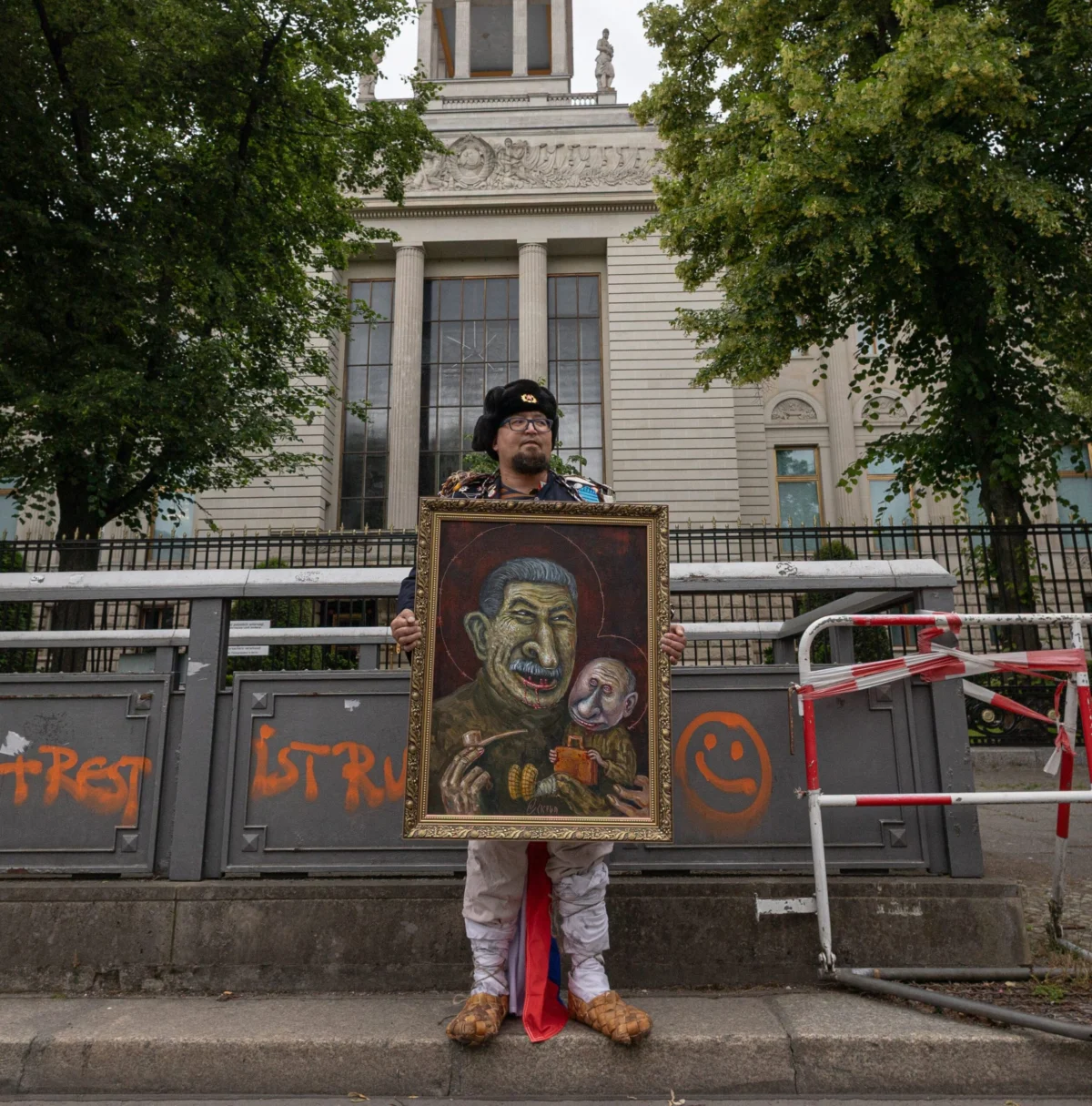
The timeline of events leading up to the murder suggests that Kuzovkov may have been under surveillance. On June 12, marking Russia Day, he staged a provocative performance outside the Russian embassy in Berlin. The centerpiece of the demonstration was a painting depicting Joseph Stalin cradling an infant Vladimir Putin—a striking visual metaphor that challenged the ideological continuity between the Soviet past and the modern Russian state.
Following this performance, Kuzovkov returned to his home in Poland. Just days before his death, he posted his final work to his online platforms: a painting that depicted Ramzan Kadyrov and his son, Adam, as pigs. The audacity of the piece, combined with the timing of his arrival in Biała Podlaska, has fueled speculation that the murder was a retaliatory strike orchestrated by entities aligned with the figures he depicted.
Chronology of the Investigation
The investigation into the death of Robert Kuzovkov has been rapid, marked by both intense scrutiny and significant legal setbacks.
- June 16, 2026: Robert Kuzovkov is shot five times outside his home in Biała Podlaska. Polish police launch an immediate investigation.
- June 17, 2026: Two Belarusian nationals, aged 33 and 37, are apprehended by Polish authorities near the border. They are initially considered primary suspects due to their proximity to the scene and their nationality.
- June 18–19, 2026: Intensive interrogation and forensic analysis follow. Despite the initial arrests, Polish investigators find insufficient physical evidence to link the two detainees directly to the trigger-pulling. Both are subsequently released.
- June 20, 2026: The investigation enters a "cold" phase as police broaden their search for surveillance footage and digital breadcrumbs that might identify the actual shooters.
The release of the two Belarusian suspects highlights the difficulty of prosecuting political assassinations that likely involve state-sponsored professional operatives who leave behind little in the way of forensic evidence.
Official Responses and Diplomatic Tensions
The response from the Polish government has been uncharacteristically blunt. In a high-stakes briefing held in Warsaw, Prime Minister Donald Tusk addressed the nation with a gravity that underscores the geopolitical stakes of the murder.
"Everything points to this being a political murder," Tusk stated. "But we must wait for evidence or more concrete indications. Because if that was the case—if it was ordered by Russia—then it is an extremely serious matter internationally. It would constitute state terrorism."
Tusk’s framing of the event as "state terrorism" is a significant escalation in rhetoric. It signals that Poland is not merely looking at a murder investigation, but at a violation of its national sovereignty. By labeling the potential involvement of the Russian state as an act of terror, Tusk is preparing the ground for a firm European Union response, should the evidence substantiate his suspicions.
Conversely, the Russian embassy in Warsaw has maintained a wall of silence. Requests for comment from the Russian diplomatic mission regarding the death of a prominent critic have been met with total non-responsiveness, a posture that many analysts view as a tacit acknowledgment of the regime’s long-standing policy toward "traitors" abroad.
The Broader Implications: A Pattern of Transnational Repression
The death of Robert Kuzovkov does not occur in a vacuum. It sits at the intersection of a growing pattern of transnational repression—the practice of governments reaching across borders to harass, silence, or eliminate dissidents who have fled to safer jurisdictions.
The New Reality for Exiles
For the thousands of Russian dissidents currently living in Poland, Germany, and the Baltic states, the murder of Kuzovkov is a chilling reminder of their vulnerability. Many activists have operated under the assumption that moving to an EU member state provided a safety net. This belief is now being systemically dismantled. If a dissident can be tracked, targeted, and executed in the heart of a NATO member country, the concept of "asylum" takes on a much more precarious definition.
Intelligence and Security Challenges
The failure to secure a conviction in the immediate aftermath of the shooting poses a significant challenge for Polish intelligence services. If, as many suspect, the killers were professional operatives who managed to exit the country or vanish into the local population, the security apparatus of Poland will need to undergo a rapid reassessment of how it protects high-risk political refugees.
Intelligence analysts suggest that the "Skrepetsky murder" may signal a shift in tactics. Where previously regimes might have relied on poisoning or intimidation, the use of a public shooting in a quiet residential area represents a shift toward overt displays of power. Such an act is intended not only to silence the individual but to instill a paralyzing fear in the broader community of critics.
Conclusion: The Price of Truth
Robert Kuzovkov’s life as Semyon Skrepetsky was dedicated to the belief that art could pierce the veil of propaganda. His death has now become his final, most enduring work—a stark, violent testament to the lengths to which authoritarian regimes will go to stifle dissent.
As the investigation continues, the international community remains in a state of heightened alert. The question is no longer just "who killed Robert Kuzovkov," but what the international cost of such an act will be. If the trail of evidence eventually leads back to Moscow, it will force a confrontation between the Kremlin and the West that goes far beyond traditional sanctions. It will force a re-evaluation of the rules of engagement in a world where the borders of the battlefield have been erased, and where a paintbrush can, in the eyes of a dictator, be as dangerous as a weapon.
For now, the painting of Kadyrov and his son remains online—a digital ghost of a man who refused to be silenced, even at the ultimate cost. The world watches to see if the law will prevail, or if the "state terrorism" described by Prime Minister Tusk will remain an unpunished violation of the international order.
