

By Ellen Wexler | Writer and Special Projects Editor
June 17, 2026
David Hockney’s double portraits occupy a singular space in the canon of 20th-century art. They are not merely paintings of couples; they are clinical, tender, and often unsettling explorations of the "triangulation" between two subjects and the observer. Painted primarily during the late 1960s and early 1970s, these seven large-scale canvases capture a specific social and emotional frequency: the tension of relationships where one partner turns inward toward the other, while the second stares defiantly or pensively out at the world.
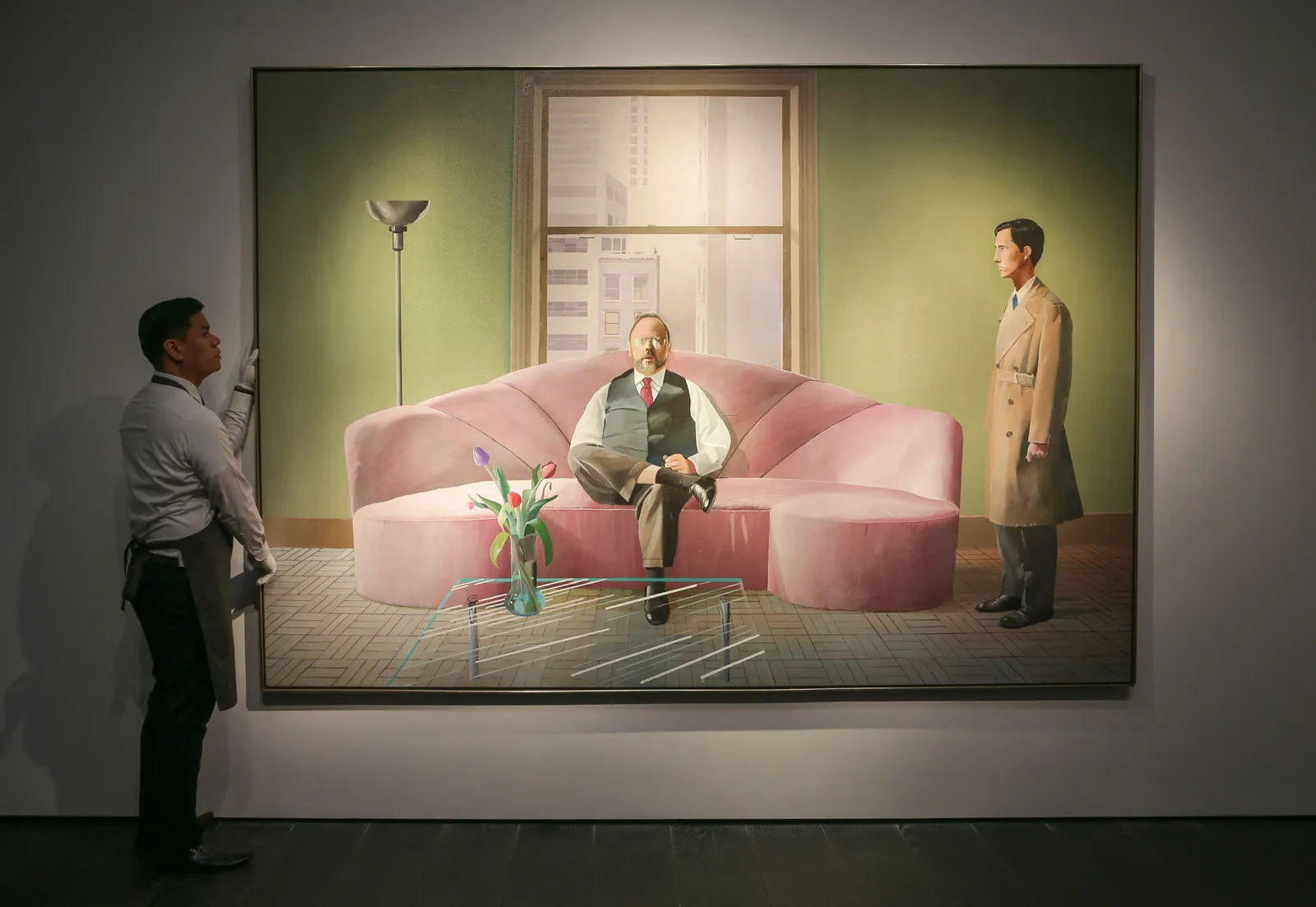
Following the passing of David Hockney last week at the age of 88, the art world has turned its collective gaze back to these seminal works. For me, this reflection is deeply personal. One of the subjects in the third portrait of the series, Henry Geldzahler and Christopher Scott (1969), was my cousin, Christopher Scott. While he remains a ghost in my family’s home movies, he is a titan in the world of high-stakes art, immortalized in a painting that once fetched nearly $50 million at auction.
/https://tf-cmsv2-smithsonianmag-media.s3.amazonaws.com/filer_public/60/db/60db270d-db60-45c1-85dc-94a2884691aa/gettyimages-1128224604.jpg)
The Architecture of Intimacy: Defining the Series
Hockney’s double portraits were never intended to be standard commissions. They were psychological maps. By positioning his subjects—often friends, lovers, or prominent figures—within a domestic landscape, Hockney invited the viewer to act as a voyeur.
In these works, the composition is rarely symmetrical. There is a "looker" and a "looked-at." Often, one figure is physically anchored to the room, while the other appears to be caught in a moment of transition. This dynamic, which critics have described as a "triangulation of gaze," forces us to ask: What happens in the space between two people when a third party, the artist, is watching?
A Chronological Study of the Double Portraits
To understand the evolution of Hockney’s legacy, one must examine the progression of these compositions, which mirrored his own journey from the rigid structures of English art school to the liberated, sun-drenched atmosphere of Los Angeles.
/https://tf-cmsv2-smithsonianmag-media.s3.amazonaws.com/accounts/headshot/Ellen_Wexler.png)
1. Christopher Isherwood and Don Bachardy (1968)
When Hockney moved from London to Los Angeles in 1964, he found a spiritual home in the company of writer Christopher Isherwood and his partner, artist Don Bachardy. As one of the first openly gay couples in Hollywood, their relationship was a beacon of authenticity.
In the painting, they sit in armchairs in their Santa Monica home. The composition is famously deliberate: Isherwood leans toward Bachardy, his eyes fixed on his lover, while Bachardy meets the viewer’s gaze with a piercing, frontal curiosity. It is a portrait of "worried concern" met with "full-frontal inquiry." The inclusion of mundane objects—a bowl of fruit, an ear of corn, and stacks of books—grounds the figures in the reality of their domestic life, signaling that their love was not a bohemian fantasy, but a daily, lived experience.
2. American Collectors (Fred and Marcia Weisman) (1968)
If Isherwood and Bachardy represented the bohemian ideal, the Weismans represented the establishment. As global titans of art collecting, their portrait functions differently. Hockney captures them in the garden of their Los Angeles home, surrounded by their own collection.
:focal(2405x1649:2406x1650)/https://tf-cmsv2-smithsonianmag-media.s3.amazonaws.com/filer_public/60/db/60db270d-db60-45c1-85dc-94a2884691aa/gettyimages-1128224604.jpg)
Marcia, in a flowing pink robe, stares directly at us, while Fred stands slightly in the foreground, his hand balled into a tight, anxious fist. The painting is a masterclass in stiffness; the couple stands as still as the sculptures surrounding them. By "flattening" the scene, Hockney creates a critique of the collector’s relationship with art—the subjects appear as curated, static objects within their own gallery-like home.
3. Henry Geldzahler and Christopher Scott (1969)
This portrait is the centerpiece of my own family history. Henry Geldzahler, the Metropolitan Museum of Art’s legendary curator, was a force of nature. Christopher, my cousin, was the quieter, enigmatic presence.
When I spoke with Christopher’s younger brother, David Scott, he offered a poignant perspective on the era. "At that point in time, Chris was referred to as Henry’s ‘assistant,’" David recalled. Even though they were a couple, the pressures of the late 60s kept their relationship in the shadows of an "open secret." In the painting, Henry commands the center of a pink sofa, while Christopher stands at the periphery, a slight figure in a raincoat, seemingly on his way out the door. It is a portrait of asymmetry—a powerful, gregarious public figure and a partner whose identity was subsumed by the "assistant" label. Yet, as David reminded me, the painting was a "watershed"—it was the moment Hockney stopped trying to be a "modern artist" and simply became the artist he was meant to be.
/https://tf-cmsv2-smithsonianmag-media.s3.amazonaws.com/filer_public/1a/4b/1a4b14b7-47eb-4394-9580-b6e969379eda/gettyimages-1322699438.jpg)
4. Mr. and Mrs. Clark and Percy (1970–71)
Perhaps the most famous of the series, this work depicts the fashion designer Ossie Clark and his wife, Celia Birtwell. Hockney, having been their best man, captured them in their apartment with their cat, Percy (though the cat in the painting was actually named Blanche).
This painting is notable for its technical struggle. Hockney notoriously painted Clark’s head over a dozen times, leading to a build-up of paint that gives the portrait a heavy, textured quality. Birtwell’s stance—hand on hip, self-assured—contrasts sharply with the reclining, slightly detached Clark. It is a portrait of a marriage in its prime, yet it carries the weight of future fragility. Birtwell herself has noted that the painting is "too personal" to look at comfortably, representing a specific, fleeting moment of their lives that they would never fully recapture.
5. Portrait of an Artist (Pool With Two Figures) (1972)
This painting is the culmination of Hockney’s obsession with the Los Angeles swimming pool. By this point, the "double portrait" had evolved into a surreal, semi-fictionalized narrative. The work depicts a swimmer beneath the water and a man in a pink jacket—Peter Schlesinger, Hockney’s former partner—staring down at him.
/https://tf-cmsv2-smithsonianmag-media.s3.amazonaws.com/filer_public/01/c0/01c07a45-03e8-4776-b060-c25a2e685821/3cmxn9k.jpg)
The creation of this piece was a grueling, cathartic exercise in processing heartbreak. The final work, completed only a day before its shipping deadline, serves as a testament to the artist’s ability to turn emotional trauma into a technical triumph. Selling for $90.3 million in 2018, it solidified Hockney’s position as a titan of the market, but its true value remains its emotional honesty: the cold, refractive light of the pool serving as a mirror to the distance between two men who were once inseparable.
Supporting Data and Technical Innovations
Hockney’s brilliance lay in his rejection of traditional perspective. In Henry Geldzahler and Christopher Scott, he famously used tape to map out the vanishing point, creating a halo effect of radiation that centered the viewer’s eye on Geldzahler’s head. This technical precision was not merely for show; it was a way to organize the chaotic emotional dynamics of his subjects.
The financial performance of these works serves as a barometer for the broader art market’s shift toward figurative painting. With prices ranging from the tens of millions to nearly a hundred million dollars, these works are not just cultural artifacts; they are blue-chip assets. However, as the artists and subjects pass away, the value of these paintings has shifted from their market price to their role as primary historical documents of a queer, mid-century social revolution.
/https://tf-cmsv2-smithsonianmag-media.s3.amazonaws.com/filer_public/43/48/43487c55-d170-44be-829b-eb629f767727/gettyimages-696531518.jpg)
Official Responses and Historical Legacy
Following Hockney’s death, tributes from the Tate, the Met, and the Los Angeles County Museum of Art (LACMA) have emphasized his role as a chronicler of his times. The consensus among art historians is that Hockney’s double portraits provided a "human" face to the Abstract Expressionism movement that dominated the era. By reintroducing narrative, light, and, most importantly, human subjects, he bridged the gap between the intellectualism of the avant-garde and the warmth of classical portraiture.
Implications for the Future of Portraiture
As we look back at these seven canvases, the implications for modern portraiture are profound. Hockney proved that a portrait does not need to be a flattering likeness to be successful; it needs to be an honest depiction of the space between people.
For my family, the portrait of Christopher and Henry serves as a reminder of the complexities of the 1960s—a time when identity was both a performance and a closely guarded secret. For the rest of the world, these works remain a testament to the power of observation. Hockney didn’t just paint people; he painted the air between them, the hesitation in their posture, and the silence in their gaze. His legacy is not just the paint on the canvas, but the enduring question he asks of us all: when we are observed, who are we really?
