

Editor’s Note: The following report contains descriptions of systemic violence, sexual assault, and state-sanctioned human rights abuses. Reader discretion is advised.
At the Salma Sarriedine gallery, the air is thick with the weight of historical trauma and the visceral immediacy of modern conflict. The solo exhibition by the artist known as Ridikkuluz, titled Klab (the Arabic term for "dogs"), functions as an unflinching autopsy of power. Through a series of jarring, high-contrast paintings, the artist interrogates the dehumanization inherent in colonial violence, utilizing the figure of the dog not merely as a symbol of aggression, but as a lens through which to view the unchecked cruelty of the Israeli state toward Palestinian, Southwest Asian, and North African (SWANA) populations.
The Art of Defiance: From Baghdad to the Present
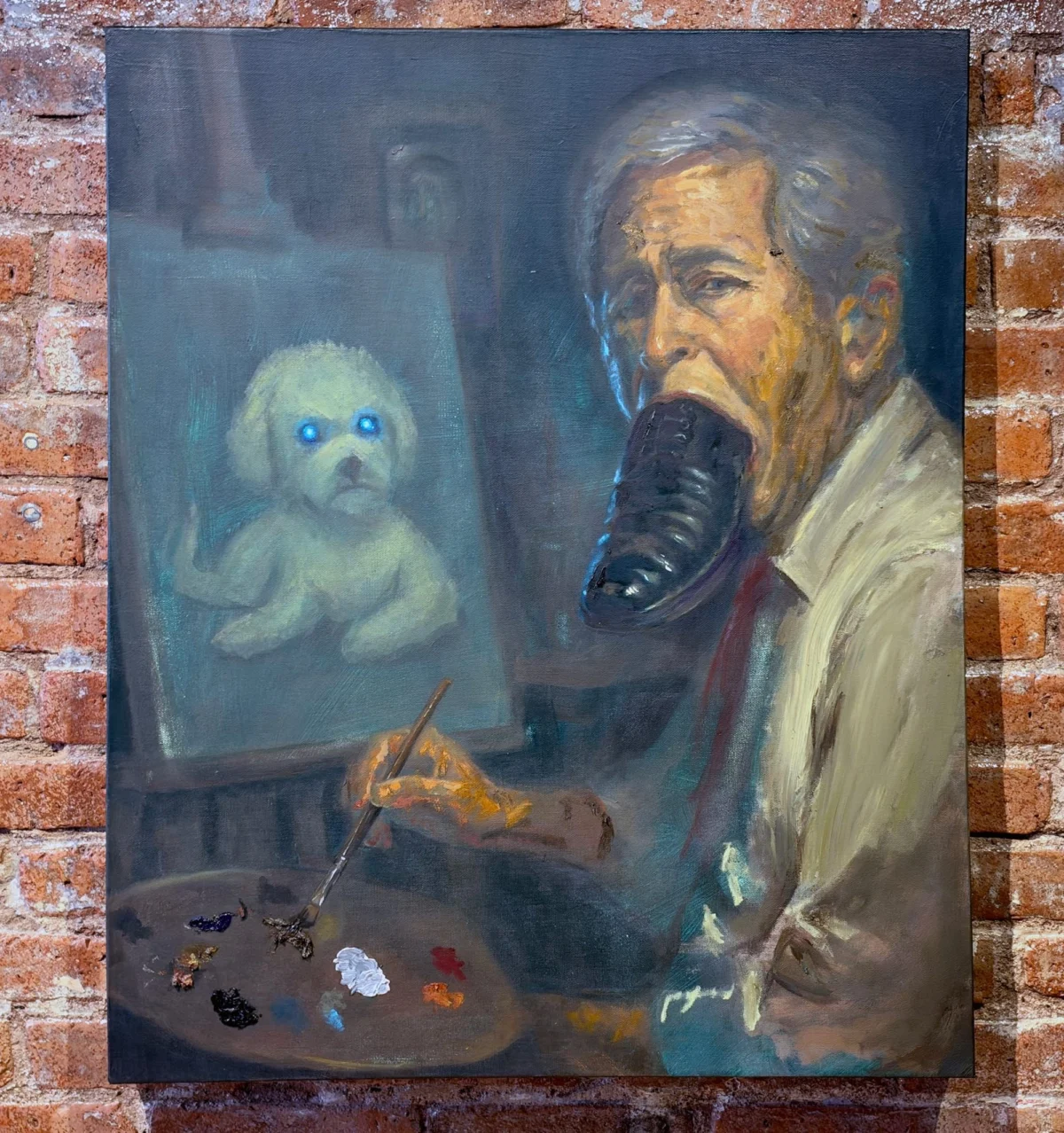
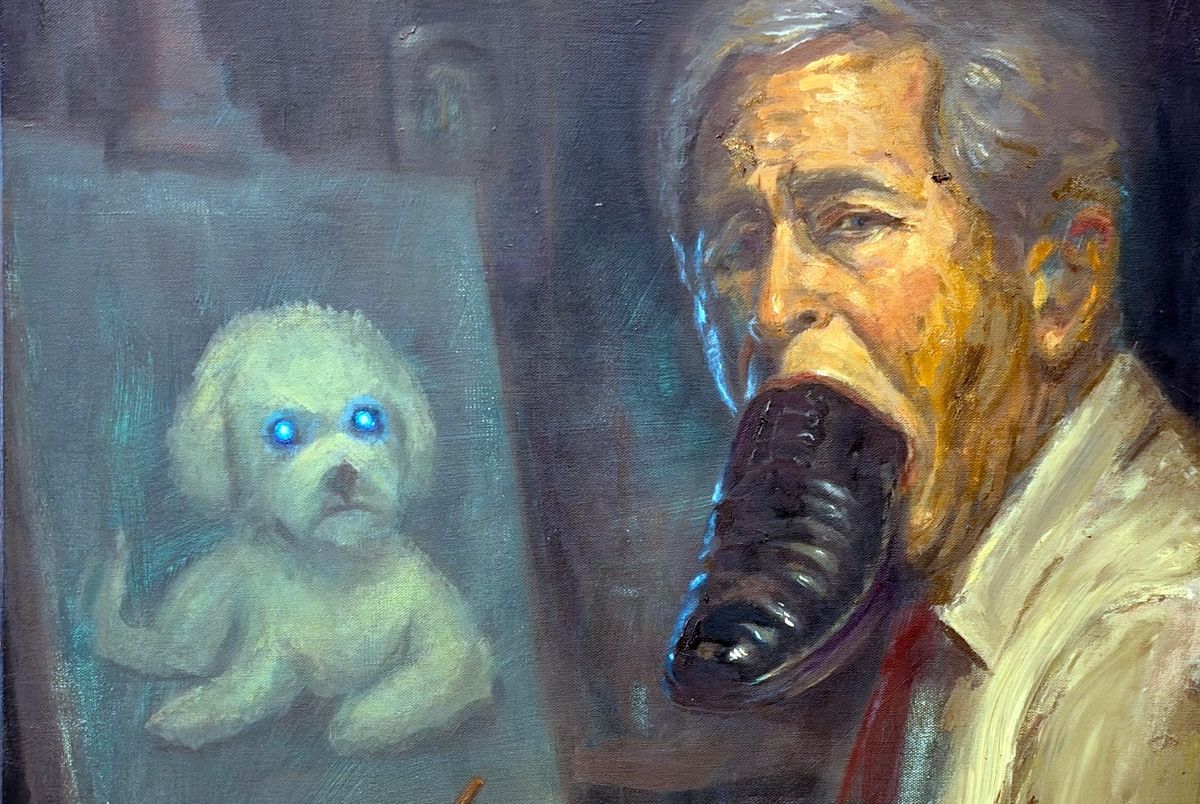
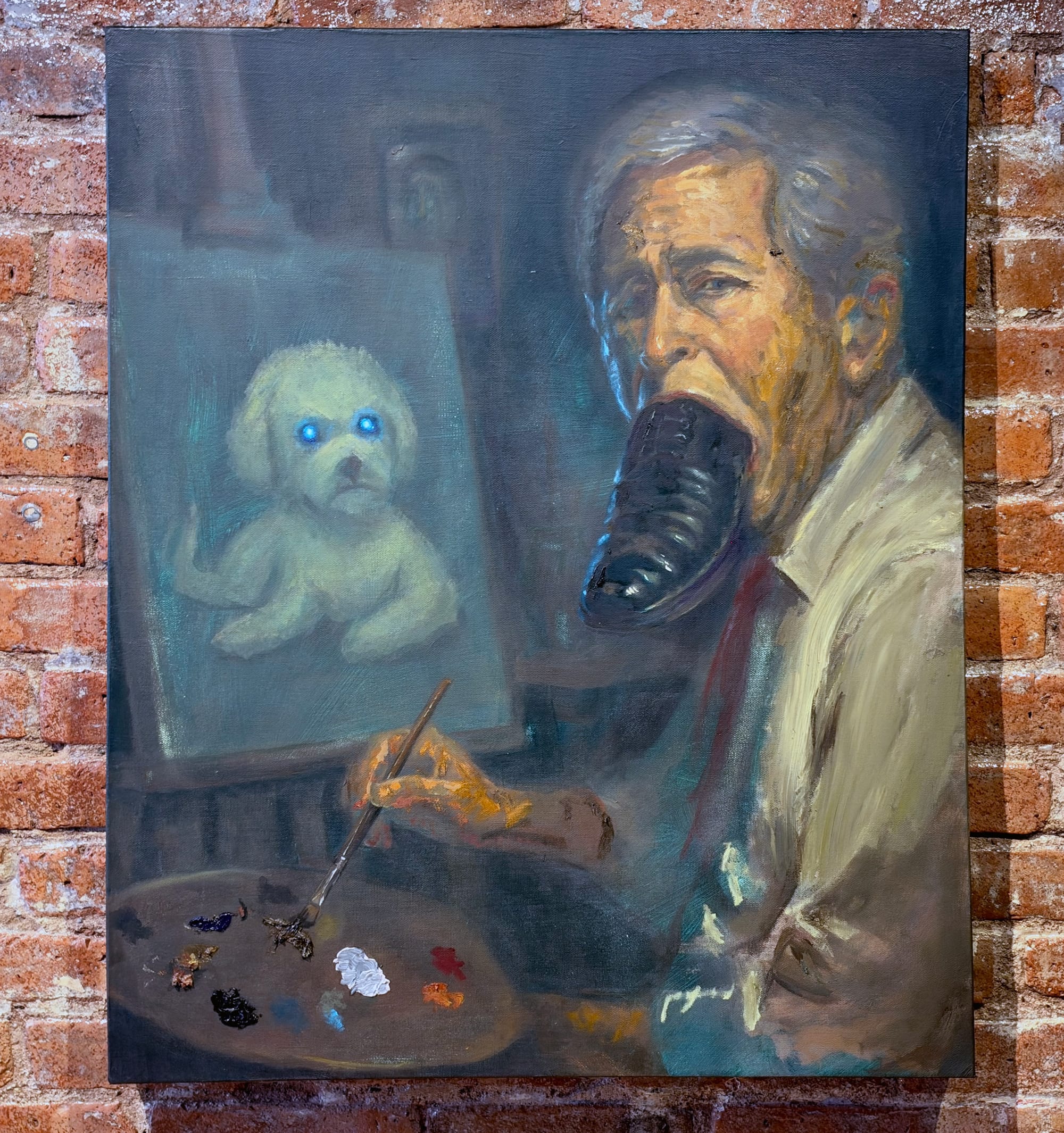
The exhibition opens with a jarring historical bridge: Ya Kalb (tribute to Al-Zaidi) (2026). The painting depicts former U.S. President George W. Bush portrayed as a bumbling Sunday painter, a loafer—the very shoe hurled at him by Iraqi journalist Muntadhar al-Zaidi in 2008—lodged firmly in his mouth.
This piece serves as an entry point into the show’s primary thesis: that the global impunity enjoyed by Western-backed leaders and military forces creates a culture where violence is not just accepted, but fetishized. In the painting, Bush is seen rendering a white poodle with unnervingly luminous blue eyes. It is a calculated, demonic presence, suggesting that the seeds of the current devastation were sown in the imperial hubris of the early 2000s. Yet, in the context of the gallery, this poodle is almost an anomaly; it is the most restrained canine in the room. As the viewer moves deeper into the exhibition, the dogs shed their domestic veneer and become avatars of systemic state brutality.
Chronology of Coercion: The Weaponization of the Canine
The recurrence of the dog motif in Klab is not a stylistic whim but a response to a documented and escalating reality. To understand the gravity of Ridikkuluz’s work, one must examine the timeline of the Israeli military’s increasingly frequent use of canine units against civilians.
The Historical Precedent
The deployment of dogs by military forces is a long-standing tactic in asymmetric warfare. However, reports from the West Bank and Gaza over the past two years have highlighted a shift from tactical, search-and-rescue, or perimeter-security roles toward the weaponization of dogs as tools of terror against detainees and civilians.
The Recent Escalation
- Late 2024–2025: Human rights monitors, including Euro-Med Human Rights Monitor, began documenting a marked increase in the deployment of dogs during night raids on Palestinian households. These incidents often involved soldiers unleashing trained attack dogs upon children and elderly residents as a means of psychological and physical coercion.
- Spring 2026: A series of investigative reports, including those by international media outlets and watchdog groups, confirmed that dogs were being utilized within detention facilities to maul, intimidate, and sexually violate Palestinian detainees. The documented use of dogs to facilitate sexual assault against men in prisons has sparked a cascade of global condemnation, though such outcries have thus far failed to curb the practice.
Supporting Data: The Anatomy of a Genocide
Ridikkuluz’s paintings force a confrontation with the "genocidal architecture" of the current conflict. By titling the show Klab, the artist reclaims an epithet. In many Arabic dialects, calling someone a dog is a profound insult, denoting a lack of humanity, loyalty, and moral standing.
The exhibition suggests that this term is no longer merely a social slur; it has become a descriptor of state behavior. The correlation between the dehumanization of Palestinians and the conduct of the Israeli Defense Forces (IDF) is the central tension of the work. When soldiers laugh while commanding animals to attack, the "dog" ceases to be a beast and becomes a proxy for the soldier’s own lost morality.

The Nakba Connection
The exhibition’s critique is not limited to the post-October 7 landscape. It reaches back to the foundational trauma of the Palestinian people. In the piece You’re Next – the Fifteenth of May (2026), Ridikkuluz re-interprets Francisco de Goya’s masterpiece, The 3rd of May 1808.
Goya’s original captured the execution of Spanish resistance fighters by Napoleon’s troops, an icon of the human cost of empire. By transposing this scene onto the timeline of the Nakba—the 1948 catastrophe that saw the displacement of 700,000 Palestinians—Ridikkuluz makes a powerful assertion: the violence currently witnessed is not a new phenomenon, but the continuation of a decades-long project of erasure. The painting warns that as long as this history remains unaddressed, the cycle of violence will inevitably be "next" for others in the region.
Official Responses and the Void of Accountability
The international community has responded to these reports with a mix of bureaucratic caution and widespread public outcry.
- United Nations & Human Rights NGOs: The UN Office for the Coordination of Humanitarian Affairs (OCHA) has repeatedly called for an independent investigation into the conduct of detention centers. However, access to these facilities remains severely restricted.
- State Statements: The Israeli government has consistently denied allegations of systemic abuse, often framing the use of canine units as a "standard security procedure" necessary for the protection of soldiers in hostile environments. They maintain that incidents of "misconduct" are investigated internally.
- Public Sentiment: For the families of the victims, the official denials are a secondary injury. The viral nature of leaked footage—showing soldiers filming themselves as their dogs attack defenseless civilians—has bypassed official state narratives, making the reality of the violence undeniable to the global public.
The Implications: Art as a Witness
What, then, is the role of the artist in the face of such overwhelming cruelty? Ridikkuluz’s Klab argues that the artist’s duty is to serve as a witness when the mechanisms of justice have failed.
The implications of this exhibition are profound. By elevating the imagery of the "attack dog" to the level of high art, Ridikkuluz forces the viewer to reconcile with the fact that these acts are being carried out by a modern state, often with the tacit approval or silence of international powers. The paintings serve as a permanent record—an archive of atrocity that cannot be "debunked" or erased by press releases.
A Call for Moral Clarity
The exhibition does not offer catharsis. There is no resolution in the paintings, only the depiction of the perpetrator and the victim, frozen in a brutal exchange. The "irascible dog" in these works serves as a mirror. If the dog is a symbol of the oppressor, then the viewer is forced to ask: who is holding the leash?
As Klab continues its run at the Salma Sarriedine gallery, it stands as a testament to the power of art to cut through the noise of political spin. It demands that we look, and that we recognize the "dogs" for what they are: the embodiment of a moral collapse that continues to rewrite the geography of the Middle East in blood.
In the final assessment, Ridikkuluz does not seek to provide solutions to a conflict that has confounded the world for nearly a century. Instead, the artist provides something perhaps more essential: an unflinching, visceral document of reality that refuses to be ignored, ensuring that the victims of these "dogs" are never truly silenced.
