


In the race toward a net-zero future, the automotive industry has positioned itself as a central player, touting electric vehicle (EV) lineups and ambitious decarbonization targets. However, a jarring new report from the financial think tank Carbon Tracker suggests that the industry’s internal math—and by extension, its environmental claims—may be built on a foundation of "unrealistic" assumptions.
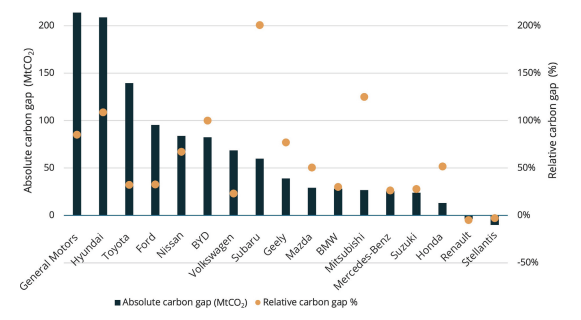
The investigation reveals a systemic "Carbon Gap" between the emissions figures reported by major global automakers and the reality of how their vehicles perform on the road. For investors, regulators, and climate advocates, this discrepancy is more than just a footnote in a sustainability report; it represents a significant material financial risk that could reshape the market valuation of the world’s largest car companies.
The Core of the Discrepancy: Scope 3, Category 11
To understand the scale of the problem, one must look at "Scope 3, Category 11" emissions. In the hierarchy of corporate carbon reporting, Scope 3 covers all indirect emissions that occur in a company’s value chain. Category 11 specifically refers to the "use of sold products"—essentially, the greenhouse gases pumped into the atmosphere by every car a manufacturer sells throughout its lifespan.
For automakers, this category typically accounts for roughly 80% of their total carbon footprint. It is the most critical metric for determining how a company contributes to climate change. Yet, Carbon Tracker’s analysis indicates that manufacturers are consistently undercounting these figures by employing creative, if not misleading, modeling parameters.
The Chronology of Miscalculation
The tension between automotive reporting and environmental reality has been building for years, but recent shifts in regulatory pressure have brought it to a head.
- Early 2020s: As global sustainability reporting standards (such as the TCFD and ISSB) began to formalize, automakers moved to standardize their Scope 3 reporting. Critics argue that in the absence of strict, globally mandated mileage assumptions, companies chose the paths of least resistance.
- Mid-2024: Researchers at Carbon Tracker began an extensive audit of major automakers’ sustainability filings, comparing stated lifetime emissions against real-world data points, including regional driving habits and actual fuel consumption metrics.
- Late 2024–Early 2025: Findings emerged demonstrating that companies were using localized, conservative assumptions for vehicles sold in global markets. For example, applying Japanese domestic driving habits to cars sold in the sprawling, car-dependent infrastructure of the United States.
- Current State: The report has ignited a debate over "greenwashing" in the auto sector, forcing investors to question whether the transition to electric vehicles is moving as fast as corporate brochures suggest, or if the "Carbon Gap" is masking a stagnant reality.
Anatomy of the Carbon Gap: Why the Math Fails
The report identifies two primary "levers" that automakers pull to keep their reported emission numbers artificially low.
1. The Mileage Myth
The most glaring issue identified by Carbon Tracker is the assumption regarding lifetime mileage. Automakers often calculate emissions based on conservative estimates of how many miles a vehicle will travel before it is scrapped.

Take Subaru as a primary example. The think tank points out that Subaru frequently uses driving data tied to its domestic Japanese market. However, approximately 70% of Subaru’s sales occur in the United States, where the average consumer drives significantly more miles annually and keeps their vehicle for a longer period. By importing the lower-mileage assumptions of a compact island nation to the vast, highway-heavy landscape of North America, the company effectively shrinks its reported footprint on paper, while the actual tailpipe emissions remain unchanged.
2. The Plug-in Hybrid (PHEV) Mirage
The second, and perhaps more controversial, factor is the treatment of plug-in hybrids. Industry testing cycles—which are often used to inform corporate sustainability reports—routinely overestimate the frequency with which these vehicles operate in "electric-only" mode.
The reality, according to independent data, is starkly different. Researchers cited a massive study of 800,000 European vehicles which found that real-world emissions for plug-in hybrids were five times higher than industry laboratory numbers suggested. This occurs because many consumers fail to charge their vehicles regularly, forcing the internal combustion engine to do the heavy lifting far more often than the laboratory models anticipate. By relying on these flawed laboratory tests for their annual reporting, automakers provide investors with a sanitized version of their fleet’s performance.
Official Responses and Corporate Defensiveness
The response from the industry has been a mix of standard corporate boilerplate and strategic silence.
Ford, a company that has been vocal about its commitment to electrification, responded to the findings by asserting that its assumptions are entirely consistent with current best practices for Scope 3, Category 11 reporting. A spokesperson for the company emphasized that their methodologies are publicly disclosed, suggesting that if the figures are low, it is a result of following the industry-standard "rules of the road" rather than a deliberate attempt to deceive.
Other industry titans, including Toyota, General Motors, and Subaru, declined to comment when approached by investigators. This silence has been interpreted by market analysts as a sign of institutional sensitivity. By refusing to engage with the critique, these companies leave themselves vulnerable to accusations that they are prioritizing favorable PR over transparency.
Implications: The Financial Risk of "Carbon Blindness"
The report from Carbon Tracker warns that the "Carbon Gap" is not merely an accounting nuance or a dry, technical dispute—it is a "material financial risk."
The Investor’s Dilemma
Investors rely on Scope 3 reporting to evaluate the long-term viability of an automaker. If a company is understating its emissions, it is effectively hiding the degree to which it is exposed to future carbon pricing mechanisms. As governments worldwide move to implement or increase carbon taxes, companies with higher actual emissions will face a sudden, massive increase in operating costs. Investors who have bought into the "lower-carbon" story of these companies may find themselves holding assets that are far more sensitive to climate regulation than the annual reports indicated.
Mispricing the Transition
The miscalculation also affects how the market prices the transition to a low-carbon economy. If an automaker claims that 20% of its fleet is "green" based on faulty PHEV data, the market may overvalue that company’s resilience. This leads to a misallocation of capital, where resources flow toward companies that are stalling on true electrification, rather than those making genuine, verifiable progress.
Regulatory Accountability
The Carbon Gap underscores the urgent need for a unified, global standard for Scope 3 reporting. Currently, the lack of a standardized framework allows automakers to "shop" for assumptions that make their fleet look cleaner. Without a rigorous, mandatory audit process that uses real-world, localized data, the gap is likely to widen as manufacturers attempt to balance their profit margins with the mounting pressure to be "green."
Conclusion: A Call for Radical Transparency
The findings by Carbon Tracker serve as a wake-up call for an industry at a crossroads. While the automotive sector is vital to the global economy, it is currently operating in a state of "carbon blindness."
As the climate crisis accelerates, the margin for error in corporate reporting is shrinking. Investors are increasingly demanding high-fidelity data that reflects the reality of the road, not the controlled environment of a laboratory. Until automakers bridge this "Carbon Gap"—by adopting more transparent, real-world mileage and usage assumptions—their sustainability claims will continue to be viewed with skepticism.
For the automotive giants, the path forward is clear: either embrace radical transparency and accept the financial implications of their true carbon footprint, or face the potential for long-term reputational damage and the severe market corrections that inevitably follow when "unrealistic" assumptions finally collide with the reality of a warming planet.
