

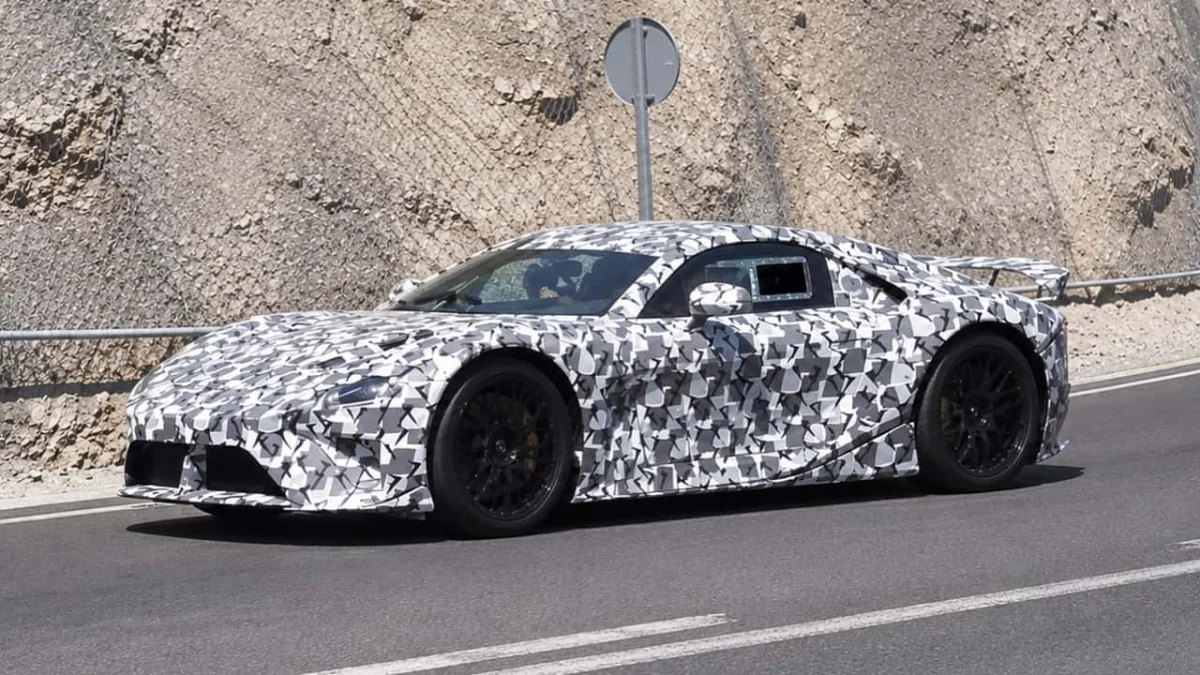
The automotive world is currently bracing for one of the most ambitious transformations in performance history. Less than a year after Lexus first unveiled the concept for its next-generation halo sports car, the Japanese luxury brand is moving at a frantic pace to bring the project to fruition. While the original Lexus LFA—with its legendary, high-revving 4.8-liter V10 engine—remains a benchmark for visceral, analog performance, its successor is taking a decidedly different path. The roar of combustion is being replaced by the silent, immediate torque of electrification. New spy imagery has surfaced, confirming that the "Lexus Electrified Sport" is no longer just a digital render, but a tangible, functioning reality currently being put through its paces in the real world.
Main Facts: The New Shape of Performance
Recent visual evidence, captured and shared by the mr.grey_4k Instagram account, provides our most detailed look yet at the development mule of the successor to the LFA. Clad in a tight-fitting, geometric camouflage wrap, the vehicle appears as a low-slung, aggressive grand tourer that stays true to the design language of the initial concept.
Key details identified from the footage include a heavily aerodynamic profile, a stretched hood, and a prominent rear wing currently fixed in a deployed position to aid high-speed stability testing. While Lexus remains famously guarded regarding the vehicle’s technical specifications, the scale of the prototype is significant. Based on data from the concept phase, the production model is expected to be substantially larger than the original LFA, measuring roughly 10 inches longer and 6 inches wider. With dimensions projected at 185.6 inches in length, 80.3 inches in width, and a mere 47.0 inches in height, the car occupies a footprint that prioritizes both cabin space for battery housing and aerodynamic efficiency.
The chassis architecture is particularly noteworthy. The prototype utilizes a specialized platform shared with the Toyota GR GT and GT3 race car development programs, stripped of the twin-turbocharged hybrid V8 powertrain intended for those competition machines. In its place, Lexus has engineered a dedicated battery-electric drivetrain that aims to redefine how the market perceives the "emotional" EV.
Chronology of the LFA’s Electrification
The path to the new LFA began in late 2021 when Toyota and Lexus shocked the world by unveiling a fleet of electric vehicle concepts, with the "Electrified Sport" positioned as the spiritual successor to the LFA.
- December 2021: The initial concept is unveiled, signaling Lexus’s intent to compete in the high-performance EV space.
- Early 2023: Reports surface suggesting the use of solid-state battery technology, aiming to provide the car with a range exceeding 400 miles and rapid-charge capabilities.
- 2024: Lexus confirms the development of a "manual" simulation for EVs, a project that is widely interpreted as the essential bridge for the LFA successor.
- Late 2024/Early 2025: Spy shots begin circulating of the production-bodied prototype, marking the transition from clay model to road-going test vehicle.
- 2027 (Projected): The official production launch date.
The "Fake It ’Til You Make It" Philosophy
The greatest criticism leveled against electric sports cars is the perceived "numbness" of the driving experience. Without the mechanical progression of a gearbox or the acoustic feedback of a reciprocating engine, many enthusiasts feel a disconnect from the machine. Lexus has a radical solution for this: simulated imperfection.
Recent patent filings reveal that Lexus is developing a highly sophisticated virtual manual transmission. Unlike traditional CVTs or single-speed direct-drive setups, this system will utilize software to control motor torque, mimicking the physical "snap" of a clutch re-engaging during a gear change. By momentarily dropping motor torque to zero—simulating the shift point—and then restoring it, the car will recreate the physical jolt and momentum shift of a traditional sequential gearbox.
This is not merely a gimmick. The system is designed to allow the driver to choose the "aggressiveness" of these shifts, ranging from smooth, daily-driving transitions to the violent, neck-snapping gear changes expected on a racetrack. When combined with the car’s paddle shifters, which were a highlight of the concept vehicle, this technology aims to provide the tactile engagement of a traditional sports car while maintaining the superior performance of an electric powertrain.
Supporting Data and Engineering Hurdles
The transition to a battery-electric platform presents Lexus with two primary challenges: mass and market appetite.
1. The Weight Penalty
The original LFA was a masterclass in carbon fiber-reinforced polymer (CFRP) construction, weighing in at approximately 3,200 pounds. Replicating that agility with a battery pack is a monumental task. Lexus is expected to utilize advanced high-density battery cells to minimize the weight penalty, but engineers are still battling the physics of inertia. The use of the GR GT3 chassis suggests that the vehicle will likely focus on extreme torsional rigidity to compensate for the weight, likely employing a mixture of aluminum and carbon fiber to keep the center of gravity as low as possible.
2. Market Dynamics
The luxury sports car market is currently facing a period of volatility regarding electrification. While demand for high-end EVs remains niche, Lexus is positioning the new LFA not as a mass-market product, but as a "halo" vehicle—a flagship designed to project the brand’s technical prowess rather than drive volume. The strategy is to leverage the "Lexus" nameplate to validate the idea that an EV can be as desirable as a V10-powered masterpiece.
Official Responses and Strategic Implications
While Lexus executives have been tight-lipped regarding specific horsepower figures or 0–60 times, the brand has been vocal about its intent to use the LFA successor to prove that electrification does not mean the end of driving pleasure.
In internal communications, Toyota/Lexus leadership has emphasized that the goal of this project is to "preserve the craft of driving." This reflects a broader corporate shift. As seen with the recent discontinuation of the Lexus TX 550h+ and the move toward a hybrid-only lineup for the NX, Lexus is aggressively pruning its internal combustion portfolio to focus on high-efficiency hybrids and high-performance EVs.
The implications of this car are profound. If Lexus succeeds in making a battery-electric vehicle that feels, sounds (through digital synthesis), and drives like an old-school supercar, it could set a new industry standard. Competitors like Hyundai, with their Ioniq 5 N, have already begun this journey, but the LFA will represent the first time a premium luxury brand has applied these technologies to a flagship performance vehicle.
The Road Ahead to 2027
As we look toward 2027, the focus shifts to the final tuning of the powertrain and the refinement of the software-controlled shifting logic. The car is expected to be more than just a speed machine; it will serve as the testbed for Toyota’s next-generation electrical architecture, including potential solid-state battery integration that could drastically reduce the weight of the vehicle compared to current lithium-ion technology.
For now, the automotive community waits for the camouflage to peel away. The LFA was once the ultimate expression of internal combustion excellence; its successor is poised to be the ultimate expression of the electric transition. Whether it can truly capture the soul of the original remains the most significant question in the automotive world today. But as the prototype continues to clock miles on the track, one thing is certain: Lexus is not just building an electric car; they are building a legacy.
The question remains: will the market, still deeply enamored with the mechanical symphony of pistons and exhaust notes, be ready to embrace the silent, calculated fury of the new LFA? If anyone can convince them, it is the team that brought us the V10 legend nearly two decades ago. The clock is ticking toward 2027, and the stakes could not be higher.
