


For most of our lives, our feet are treated as an afterthought—shoved into restrictive, cushioned, or arch-supported footwear the moment we step out the door. We treat them like static blocks of concrete meant only to carry our weight. However, as we cross the threshold into our 60s and beyond, the consequences of this "support-first" lifestyle begin to manifest as stiffness, chronic pain, and a loss of mobility.
As a fitness professional, I often see clients who have spent decades relying on orthotics and rigid shoes, only to find that their feet have essentially "gone to sleep." The truth is that your feet are not bricks; they are biological masterpieces of engineering, functioning more like the high-performance suspension system of a mountain bike. By ignoring the complex mechanics of the foot, we are inadvertently compromising our knees, hips, and spine. It is time to rethink how we treat our foundation.
The Engineering Inside Your Foot
To understand why your feet feel stiff, you must first appreciate their complexity. Each foot is an architectural marvel consisting of 26 bones (28 if you include the sesamoid bones), over 33 joints, and more than 100 muscles, tendons, and ligaments.
While most people focus exclusively on the "medial arch" (the curve on the inside of the foot), your foot is actually a three-dimensional structure featuring a lateral arch and a transverse arch. These arches do not simply provide a static base; they are dynamic, constantly shifting to distribute load. Every time you take a step, these 28 bones must work in perfect synchronization with the ground and the kinetic chain above them to ensure an efficient, stable gait.
The Physics of Impact: Suspension vs. Concrete
Imagine driving a heavy-duty pickup truck over a rocky trail. If that truck has no suspension, every jolt from the road is transmitted directly into the chassis, leading to inevitable wear and tear. Your body functions the same way.
When you walk, you generate a force roughly two to three times your body weight. When you run, that number jumps to seven times, and on hard surfaces like concrete, the impact can reach 12 to 15 times your body weight. If your feet are functioning as they were designed—using the plantar fascia like a heavy-duty winch cable—that energy is absorbed and redistributed. However, if your feet are stiff or weak, that force travels directly into the knees, hips, and lumbar spine.
Your foot is designed to flatten slightly upon impact to absorb shock, then become rigid as you push off. When we wear shoes that provide "artificial" support, we essentially bypass the body’s natural shock-absorption system, leading to a degradation of the very structures designed to protect us.
The Role of Proprioception: Your Body’s GPS
Beyond mechanics, your feet are your body’s primary sensory input devices. The soles contain a staggering density of sensory nerve endings that function like a global positioning system (GPS). Every millisecond, they are scanning for surface texture, pressure, and joint position. This data is fed to the brain, which then makes micro-adjustments to your posture and balance.
As we age, this "GPS signal" often weakens. It is rarely a brain issue; rather, it is a consequence of "sensory deprivation." By spending our lives in shoes that isolate us from the ground, we stop sending meaningful information to our nervous system. This leads to a decline in balance and coordination, which is a leading contributor to fall-related injuries in the elderly.
Restoring Function: Four Essential Exercises
If you are over 60 and feeling the "stiffness" of aging, you don’t necessarily need more support; you need more movement. The following four exercises are designed to wake up the nerves, mobilize the joints, and strengthen the intrinsic muscles of the foot.
1. The Power of Self-Massage
The plantar fascia can become incredibly tight after years of confinement. Self-massage is the first step toward restoring natural splay and flexibility.
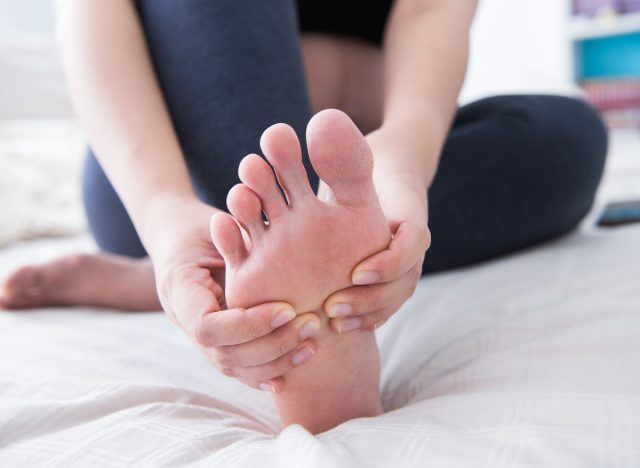
- How to do it: While seated, cross one leg over the other. Use your thumbs or a massage ball to apply firm pressure along the sole, working from the heel toward the toes. Spend 3–5 minutes per foot.
- Form Tip: Use a bit of lotion if necessary. When you finish, observe your toes; you should see slightly more space between them. This is the goal: to regain that natural, wide footprint.
2. Single-Leg Standing Toe Coordination
Once your feet are supple, you must retrain them to stabilize your body.
- How to do it: Begin by standing on one leg near a wall for safety. Once you find your balance, attempt to lift just your big toe while keeping the others down, then reverse.
- Form Tip: Progression is key. Start by practicing this while seated, move to a kneeling position, and finally stand. This builds the neuromuscular connection between your brain and your toes.
3. The "Moonwalk" Shuffle
This movement is designed to feed your proprioceptors constant, varied information about the ground.
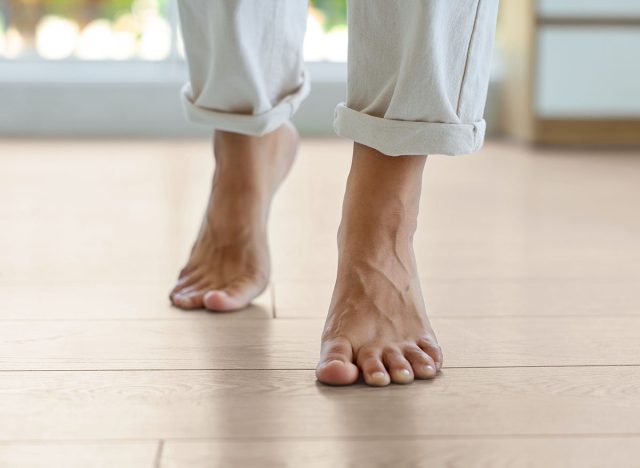
- How to do it: Stand barefoot. As you take a step, drag your foot along the ground, feeling the texture and surface as the toes extend. This "shuffle" forces the foot to go through its full range of flexion and extension.
- Form Tip: It may feel like you’re doing the moonwalk, but that deliberate, dragging motion is exactly what your nervous system needs to recalibrate. Perform this for 60–90 seconds.
4. March With Calf Raise
This exercise targets the "toe-off" phase of walking, which is critical for propulsion.
- How to do it: Perform a high march in place. When you reach the top of the march, pause for two seconds, then drive through the ball of the foot to perform a calf raise.
- Form Tip: Ensure you are not leaning forward. The focus is on the vertical drive, mimicking the power phase of a natural, healthy stride.
Implications for Longevity
The implications of "barefoot training" extend far beyond the feet. By rebuilding your natural suspension system, you are reducing the load on your joints and potentially delaying the onset of degenerative conditions in the knees and hips.
While it is important to note that shoes and orthotics have a legitimate place in treating acute injuries or specific medical deformities, they should be viewed as crutches, not permanent solutions. For the vast majority of us, the path to better mobility, improved balance, and less chronic pain is literally right beneath our feet. By dedicating just a few minutes a day to these exercises, you aren’t just strengthening muscles—you are retraining your nervous system to navigate the world with the grace and stability you had years ago.
Start slow, listen to your body, and remember: your feet are the foundation upon which your entire life is built. Give them the attention they deserve, and they will support you for years to come.
