

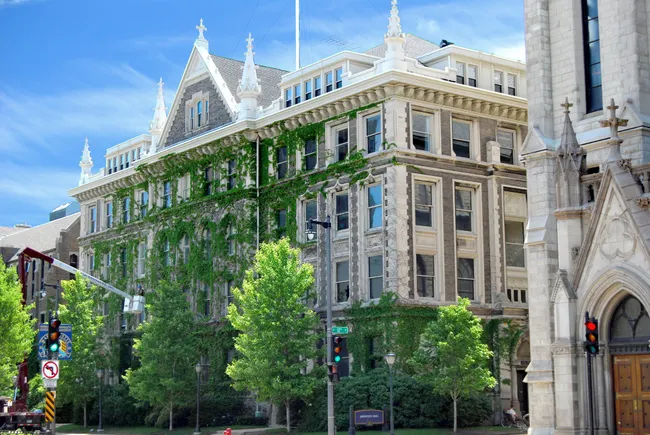
In an era defined by political polarization and increasingly fragmented public discourse, American higher education finds itself at a precarious crossroads. While some institutions are yielding to external pressure by restricting classroom discussions on sensitive topics—ranging from gender identity to systemic inequality—others are moving in the opposite direction. Marquette University, a private institution in Milwaukee, has emerged as a leader in this counter-trend, actively integrating civil discourse training into its core curriculum. By mandating courses in debate and deliberation, Marquette and a handful of peer institutions are attempting to reclaim the university’s traditional role as a laboratory for democracy.
The Mandate for Civil Discourse: A Core Competency
The initiative at Marquette University represents a departure from the "opt-in" model of most elective courses. Amelia Zurcher, director of the University Honors Program and a primary architect of the curriculum, notes that the goal was to ensure these skills were not merely acquired by those already interested in political science or rhetoric, but by every student passing through the institution.
"Part of our goal was that this wouldn’t just be students who had selected the course because they were interested in it specifically," Zurcher explained. "It would be a skill that everyone would be expected to learn at Marquette."
The curriculum is designed to move beyond theoretical debates. Each week, students are organized into small groups of six to seven, where they engage in structured, moderated discussions on high-stakes topics such as artificial intelligence, the nature of democracy, and the boundaries of freedom of expression. To ensure these conversations remain productive, the university employs 32 peer facilitators—upperclassmen who have completed the course and received specialized training in conflict de-escalation and moderation.
Chronology: From Pilot to Institutional Pillar
The path to this mandatory curriculum was paved through a deliberate, phased approach, demonstrating a commitment to academic rigor:
- 2021-2022: Rising concerns regarding "cancel culture" and student anxiety over classroom speech begin to dominate national discourse. Universities face increasing pressure to balance safety with intellectual freedom.
- 2024 (Spring): Marquette pilots the civil discourse course within a single section of its honors program. The success of the pilot demonstrates that students, when provided with a "scaffolded" environment, are eager to engage with difficult material.
- 2024 (Late): The project gains significant momentum after securing a three-year, $150,000 grant from the Arthur Vining Davis Foundations.
- 2024-2025 Academic Year: The course is fully integrated into the core curriculum. It now serves approximately 600 students annually, including the entire first-year honors cohort and a proportional number of non-honors students.
- Ongoing: Marquette faculty from diverse disciplines—ranging from nursing and business to philosophy—co-teach these sections, reinforcing the idea that civil discourse is a professional requirement, not just an academic exercise.
Supporting Data: Measuring the Impact of Dialogue
The efficacy of these programs is supported by preliminary research conducted by Zurcher, who is currently reviewing student transcripts to evaluate the quality of deliberation. Her findings suggest that the training leads to measurable growth in "intellectual humility"—the willingness to see perspectives beyond one’s own—and a marked increase in the ability to disagree constructively.
This aligns with findings from the University of Wisconsin-Eau Claire. Psychology professor April Bleske-Rechek surveyed over 10,000 students who participated in the "Unify Challenge," a virtual event connecting students across different political and geographic spectrums. Her 2025 report revealed a consistent pattern: while students often feel significant apprehension before engaging in a cross-partisan dialogue, they report feeling optimistic and empowered afterward. The "fear" that students initially harbor—the dread of being labeled, looking foolish, or facing social ostracization—often dissipates once they realize that civil engagement is a skill that can be practiced and mastered.
Official Responses and the National Landscape
The movement toward mandatory discourse training is not occurring in a vacuum. It is a direct response to a legislative and social climate that has become increasingly restrictive. According to data from PEN America, at least 21 states have enacted laws or policies since 2021 designed to censor or restrict classroom teaching in higher education.
These interventions have had a chilling effect. At institutions like Indiana University, professors have faced disciplinary action for discussing controversial topics, often under the guise of complying with state-mandated "intellectual diversity" laws. Similarly, in Texas, the systemic push to ban discussions regarding "gender and race ideology" has led to the removal of foundational texts from syllabi, such as certain works of Plato at Texas A&M.
Connor Murnane, campus advocacy chief of staff at the Foundation for Individual Rights and Expression (FIRE), argues that these efforts—whether they come from state legislatures or student-led "deplatforming" campaigns—ultimately undermine the value of a degree. "Things break down fast when dissent gets treated like hostility or folks avoid conflict entirely," Murnane said. "Students need these skills for work and civic life, as democracy depends on one’s ability to argue, listen, reconsider and live in communities with people who disagree."
The "Scaffolding" of Intellectual Freedom
How do universities create an environment where students feel safe enough to speak their minds? The consensus among educators like Brad Skow of MIT and Noreen Lape of Dickinson College is that "scaffolding" is essential.
Skow, who helped launch MIT’s Concourse Program, emphasizes that the burden of setting the tone lies with the faculty. "You have to create a room where people trust each other, while simultaneously creating a room where people feel distanced enough that they don’t censor themselves out of fear," Skow noted. This involves explicit agreements at the start of the semester: what is said in the classroom stays in the classroom, and the goal is not to win an argument, but to understand the logic behind an opponent’s position.
Noreen Lape, an educational studies professor currently authoring a book on the subject, points to the "social capital" trap. Students are often terrified that expressing a non-conforming view will lead to social exile among their peers. To combat this, successful programs like the University of New Hampshire’s Civil Discourse Lab and the University of Virginia’s "Think Again" initiative provide students with frameworks for "principled disagreement."
Implications for the Future of Higher Education
The long-term success of these initiatives depends on whether they remain peripheral "one-off" events or become permanent fixtures of the undergraduate experience. Kristen Shahverdian, director of campus free speech at PEN America, cautions that short-term investments are insufficient. "Programs that teach civic skills shouldn’t be limited to specialized departments," she argues. "They should be infused into existing curricula in ways that align with the institution’s mission."
The implications are profound. If universities continue to treat disagreement as a threat to be managed rather than a pedagogical opportunity, they risk producing graduates who are ill-equipped for the demands of a pluralistic society. However, if programs like those at Marquette and MIT become the standard, higher education may yet succeed in its most important mission: teaching the next generation not just what to think, but how to think alongside those who think differently.
As the political landscape remains volatile, the "Marquette model" offers a blueprint for the future. By prioritizing the human element of democracy—listening, reconsidering, and engaging in good faith—universities can protect the sanctity of the classroom while fulfilling their obligation to the common good. The message from these campuses is clear: the only way to save the university is to lean into the very conversations that have, until now, been avoided at all costs.
