

The landscape of Jersey City’s waterfront has undergone a dramatic metamorphosis over the past several decades, evolving from a gritty, post-industrial industrial hub into one of the most sought-after residential corridors in the New York metropolitan area. This transformation reached a significant milestone this week with the grand opening of Everton, a 60-story, transit-oriented luxury tower that stands as the crown jewel of the Hudson Exchange master-planned development.
Developed by the partnership of BGRE—formerly known as Brookfield Properties—and G&S Investors, Everton is not merely a residential building; it is a manifestation of the modern urban ideal. By integrating high-density housing with essential community services, including a massive new flagship ShopRite, the project aims to redefine the standard for vertical living in New Jersey.
Main Facts: A Landmark at 99 Provost Street
Located at 99 Provost Street, Everton is strategically positioned adjacent to the Hudson-Bergen Light Rail, providing residents with immediate access to regional transit. The project is an ambitious undertaking that reaches 60 stories into the Jersey City sky, housing 802 market-rate apartments.
The architectural intent behind Everton was to prioritize both scale and utility. The residential units span a diverse range of configurations, including studio, one, two, and three-bedroom layouts designed to cater to a demographic ranging from young professionals to growing families.
Central to the building’s identity is its massive commercial component. The ground floor features an 85,000-square-foot Inserra ShopRite, a major victory for the neighborhood’s livability. This is supported by an additional 19,000 square feet of retail space, which will eventually host a curated mix of tenants, including Goldfish Swim School, Modcup Coffee, and a sophisticated new restaurant concept from the culinary team behind Izakaya Kumade.
The Chronology of Transformation
The story of Everton is deeply intertwined with the broader development history of the Hudson Exchange. The project is the second phase of a massive, multi-year redevelopment of a six-block footprint that has long served as a focal point for Jersey City’s growth.
- Pre-Development: The site was once part of the city’s vast industrial waterfront. The current iteration of the master plan follows the success of earlier phases, specifically the construction of VYV North and VYV South. These two 36-story luxury towers established the foundational demand for the area, offering 850 units and 20,000 square feet of retail.
- 2023 Groundbreaking: The site at 99 Provost St. officially broke ground in 2023, marking a period of intense construction activity as the city’s skyline began to push upward and westward from the waterfront.
- 2026 Rebranding: In a strategic shift, Brookfield Properties rebranded its development arm to BGRE, reflecting a pivot in the firm’s long-term vision for its national portfolio.
- The Present Day: Following the successful launch of the ShopRite, the residential component of Everton has opened its doors, welcoming its first wave of tenants to a building that now stands as the tallest, most prominent structure in the Hudson Exchange neighborhood.
Supporting Data: Luxury Meets Infrastructure
Everton is defined by a blend of high-end finishes and functional, forward-thinking infrastructure. The residential floors, beginning at the seventh level, offer expansive, unobstructed views of the Hudson River, the Manhattan skyline, and the historic streets of Jersey City.
Unit Features and Aesthetic
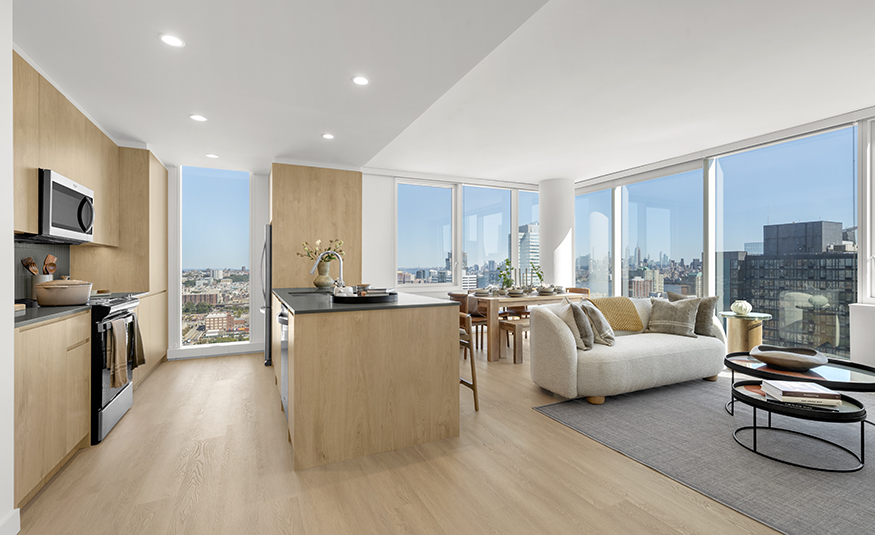
The interior design philosophy centers on light and efficiency. Every unit features floor-to-ceiling windows (reaching up to nine feet in height) that maximize natural light. Key luxury features include:
- Kitchens: Equipped with stainless steel appliance suites and quartz countertops.
- Bathrooms: Designed with modern aesthetics, featuring backlit vanity mirrors and premium fixtures.
- Utility: Every apartment includes an in-home washer and dryer, a critical convenience for urban dwellers.
The Retail and Community Ecosystem
The Hudson Exchange project is not designed to be an isolated island of luxury. It is a master-planned neighborhood. The inclusion of 20,000 square feet of public green space is a vital component of the development, providing a necessary “breathing room” in a high-density environment.
The relocation of the ShopRite from Marin Boulevard to this location acts as a community anchor. By centralizing grocery, dining, and transit in one location, BGRE and G&S Investors have effectively reduced the need for car travel, promoting a more sustainable, walkable lifestyle that aligns with contemporary urban planning principles.
Official Perspectives: The Vision for Jersey City
The development of a 60-story tower requires more than just capital; it requires a deep understanding of the local market’s trajectory. According to Frank Frallicciardi, senior vice president of development at BGRE, the project is a direct response to the shifting needs of the modern workforce and urban residents.
“The demand for thoughtfully designed housing, convenient retail, and neighborhood amenities continues to demonstrate the strength of the Jersey City market,” Frallicciardi stated during the opening ceremony. “Everton was designed to meet that demand while contributing to the vibrancy and connectivity of the Jersey City community.”
The partnership between BGRE and G&S Investors has been lauded by local stakeholders for its commitment to the “live-work-play” model. By investing in the infrastructure that supports the residents—such as the swim school and local coffee shops—the developers are fostering a genuine sense of community, rather than creating a transient housing environment.
Implications: A Model for Future Urban Growth
The opening of Everton sends a clear signal to the real estate market: Jersey City is no longer just an alternative to Manhattan; it is a destination in its own right. The implications of this development are manifold:
1. The Power of Transit-Oriented Development
By situating 802 units directly adjacent to the Hudson-Bergen Light Rail, Everton serves as a case study for the success of transit-oriented development (TOD). As traffic congestion continues to challenge the region, developments that allow residents to live without reliance on private automobiles become significantly more valuable to both the city and the end-user.
2. Retail as a Community Anchor
The inclusion of a large-scale, high-quality grocery store like ShopRite within the base of a luxury tower is a strategic masterstroke. It creates an immediate sense of permanence for the neighborhood. Retail, which was once an afterthought in residential projects, is now the heartbeat of the Hudson Exchange, ensuring that the development remains active throughout the day and into the evening.
3. The Height and Density Paradigm
The success of 60-story towers like Everton suggests that the "Manhattanization" of the Jersey City waterfront is accelerating. As land becomes increasingly scarce and expensive, vertical growth remains the only viable path to satisfying the relentless demand for housing. However, the requirement for green space and community services, as seen in the 20,000 square feet of public parks planned for Hudson Exchange, indicates a more mature approach to development than the unchecked density of previous decades.
4. Economic Vitality and Reinvestment
The redevelopment of former industrial land into high-value residential and commercial property has generated significant tax revenue and construction jobs, while also bringing in a new demographic of residents who contribute to the local economy. The transition from industrial storage to luxury living has effectively widened the city’s tax base, providing the municipality with the capital necessary to maintain and improve public services elsewhere in Jersey City.
Conclusion
As the sun sets over the Hudson River, the glowing windows of the newly opened Everton serve as a symbol of Jersey City’s ongoing evolution. The project stands as a testament to the power of thoughtful urban planning, where private enterprise and public needs intersect to create something greater than the sum of its parts.
With its combination of high-rise luxury, seamless transit access, and the essential convenience of a major neighborhood retailer, Everton is more than a building—it is a landmark for a new generation of urbanites. As the remaining retail spaces fill up and the green spaces begin to mature, the Hudson Exchange will likely be remembered as the project that solidified Jersey City’s status as a primary hub for modern, convenient, and aspirational metropolitan living.
