


The American automotive landscape is undergoing a subtle but significant shift. Following months of gradual inventory recovery from the post-pandemic production slump, the supply of new vehicles at U.S. dealerships saw a contraction in August. As the industry grapples with the delicate balance between supply, consumer demand, and manufacturing logistics, buyers are once again finding that the "golden age" of choice—at least regarding specific configurations—may be retreating.
Main Facts: A Shift in the Supply Chain
At the start of August, American car dealerships were stocked with approximately 2.73 million new vehicles. By the end of the month, that figure had dipped to 2.68 million. While a drop of 50,000 units might seem negligible in a multi-billion-dollar industry, it serves as a bellwether for a cooling in supply chain momentum.
Compounding the frustration for consumers is the financial reality of the market: the average price for a new vehicle has once again crested the $50,000 threshold. This confluence—lower supply paired with high price points—suggests that the automotive market is not yet ready to return to the pre-2020 era of heavy discounting and bloated, over-supplied dealership lots.
The Chronology: How We Reached This Point
To understand the current state of inventory, one must look back at the trajectory of the last four years:
- 2020–2022 (The Scarcity Era): Global semiconductor shortages and logistics bottlenecks decimated production lines. Inventory levels plummeted, leading to "market adjustment" fees and a seller’s market where MSRP became the floor, not the ceiling.
- 2023 (The Gradual Rebound): As microchip availability stabilized, manufacturers began ramping up production. Inventory slowly crept toward the historical norms, and consumers began to see some relief in the form of modest incentives.
- Mid-2024 (The Plateau): The industry reached a point of relative stabilization, but demand remained uneven. Manufacturers began to carefully manage production to avoid the costly overhead of holding too much inventory.
- August 2024 (The Current Contraction): The industry ended the month with a 73-day supply, a four-day decrease from July. This drop marks a pivot point where automakers are seemingly recalibrating output to align more tightly with actual sales velocity.
Understanding "Days of Inventory"
The primary metric used by industry analysts to track the health of the automotive market is "days of inventory." This figure calculates how long it would take a dealership to sell out of its current stock if no new vehicles were delivered, based on the current sales pace.

The industry gold standard, a rule of thumb followed for decades, is a 75-day supply. This is typically broken down into 60 days of inventory sitting on the lot and 15 days of vehicles currently in transit or in the order pipeline.
When inventory drops below this threshold, consumers lose options. They may find that the specific trim level, color, or optional package they desire is unavailable, forcing them to either settle for an in-stock unit or wait weeks for a custom order. Conversely, when inventory rises well above 75 days, dealers incur significant "floorplan" costs—interest payments on the loans taken to stock their lots—which eventually necessitates aggressive discounting to clear space.
Supporting Data: The Tale of Two Markets
The 73-day industry average hides a massive disparity between manufacturers. The automotive market is currently divided into two distinct camps: those with lean, high-demand inventories, and those struggling with excess stock.
The Lean Performers: Toyota and Lexus
At the forefront of the supply-tightening trend are Toyota and its luxury division, Lexus. These brands have consistently maintained some of the tightest inventories in the industry, often hovering at roughly 30 to 40 days of supply. The struggle is particularly acute with high-volume models like the RAV4. Despite being a perennial bestseller, production constraints have kept the RAV4 in short supply for much of the year, limiting the ability of dealers to move metal as quickly as they might like.
The Overstocked Segment: Stellantis
On the opposite end of the spectrum, Stellantis—the parent company for Chrysler, Dodge, Jeep, and Ram—has seen its inventory levels swell well past the 100-day mark. This accumulation of vehicles suggests a disconnect between the brand’s current production output and the actual consumer demand for its lineup.
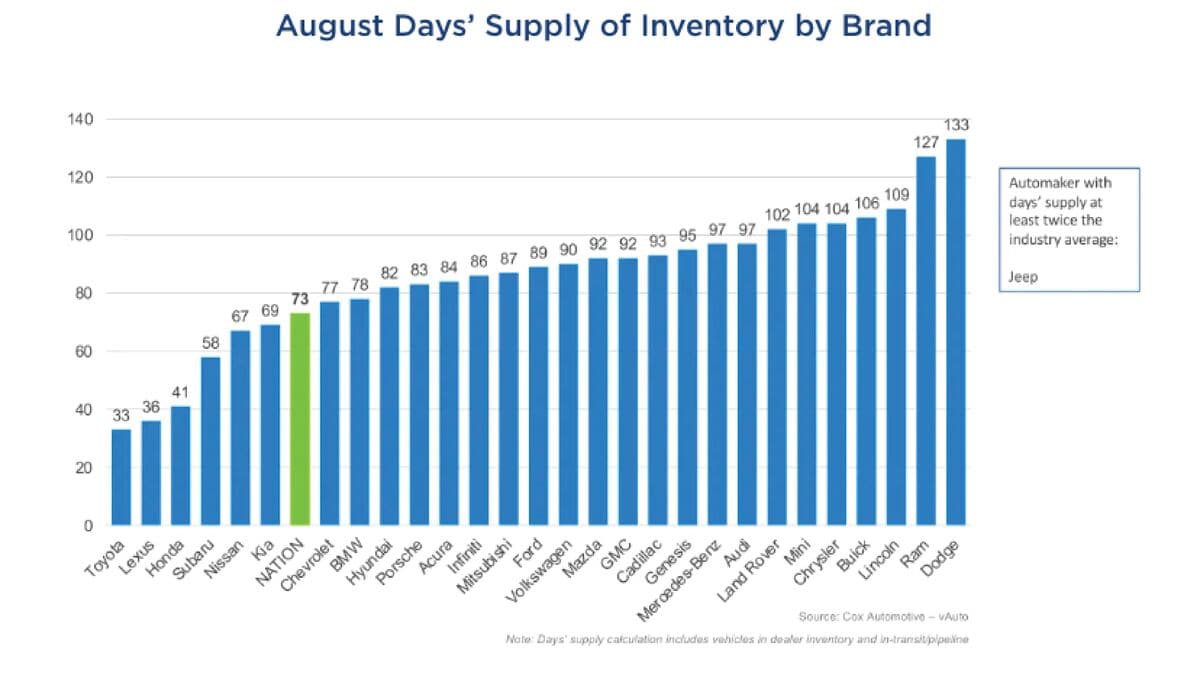
For the prospective car buyer, this disparity is a critical piece of leverage. While a shopper looking for a Toyota may face a "take it or leave it" pricing scenario, a shopper in the market for a Ram or a Jeep likely has significantly more room to negotiate. Dealers holding over 100 days of stock are often motivated to offer financing incentives, rebates, and price reductions to move inventory and lower their carrying costs.
Official Perspectives and Industry Implications
The implications of this supply tightening are felt throughout the entire economic chain.
The Manufacturer’s Dilemma
Automakers are currently walking a tightrope. In the post-pandemic environment, they learned that higher prices and lower inventory volumes can lead to higher profit margins. By avoiding the "lot-filling" practices of the past, they reduce their overhead and keep residuals high. However, if they tighten supply too much, they risk losing market share to competitors who are willing to keep more vehicles on the ground.
The Consumer’s Reality
For the average buyer, the news of tightening inventory is a signal to act with precision. With the average transaction price remaining above $50,000, the barrier to entry for new vehicles is higher than it has been in decades.
Experts suggest that buyers should:

- Research Inventory Levels: Use online tools to check local lot inventory. If you are shopping for a brand with a high days-of-supply metric, don’t be afraid to ask for a discount.
- Prioritize Flexibility: If you are set on a specific brand known for low supply, be prepared to compromise on non-essential features or colors to secure a vehicle.
- Consider the Used Market: If the $50,000 price point for new cars is prohibitive, the used car market offers a way to bypass the current supply volatility, though it comes with its own set of risks regarding maintenance and financing.
Looking Ahead: The Q4 Forecast
As we move into the final quarter of the year, the industry is closely watching interest rates and consumer sentiment. If the Federal Reserve shifts its monetary policy, it could provide the breathing room necessary for manufacturers to increase production without fear of interest-rate-bloated inventory costs.
However, until then, the market remains in a state of delicate equilibrium. The "tightening" seen in August is likely a calculated move by manufacturers to maintain high margins in a high-price environment. Whether this strategy will hold through the end of the year depends on how consumers respond to the $50,000 price floor and whether those with excess inventory—like Stellantis—can successfully clear their lots before the new model year fully arrives.
In conclusion, the tightening of supply is not necessarily a sign of a failing industry, but rather a mature one reacting to the lessons of the past four years. For the consumer, it remains a challenging environment that rewards those who are well-informed, flexible, and ready to navigate the vast differences between brand inventories. The days of "easy" car buying are gone, replaced by a strategic, data-driven approach to one of the largest purchases most Americans make.
