

By Olivia Tauber
October 22, 2026
"Life imitates art—imitates life!"
It is a sentiment that feels tailor-made for Robert Downey Jr., the actor whose decade-long tenure as Tony Stark defined a generation’s perception of futuristic technology. For years, audiences watched as Stark summoned holographic interfaces with a mere flick of his wrist. Now, that cinematic fiction is bleeding into the real world. On October 20, 2026, Snap Inc. announced a seismic partnership: Robert Downey Jr. has officially joined the company as the "Honorary Chief Customer Experience Officer" for their ambitious augmented reality (AR) hardware division, Specs.
This collaboration is far more than a high-profile celebrity endorsement. It represents a strategic pivot for Snap as it attempts to transition from a social media powerhouse into a hardware-first technology company, banking on the credibility of an actor who is culturally synonymous with the promise of high-tech innovation.
The Convergence of Tech and Stardom
The announcement, which sent shockwaves through both the tech and entertainment sectors, confirms that Downey will be deeply involved in the evolution of Snap’s AR ecosystem. His role is multifaceted, spanning the creation of original content, the development of custom AR experiences, and close collaboration on hardware design.

For the average observer, the casting feels almost too perfect. Downey himself acknowledged the irony, noting that the Specs glasses finally deliver on the futuristic, intuitive AR promise that defined his Marvel cinematic persona. "Trying is believing," Downey stated in the official announcement. "Having tested practically every wearable tech that’s come to market in the last 20 years, and been largely unimpressed, I was absolutely sold on SPECS within 40 seconds."
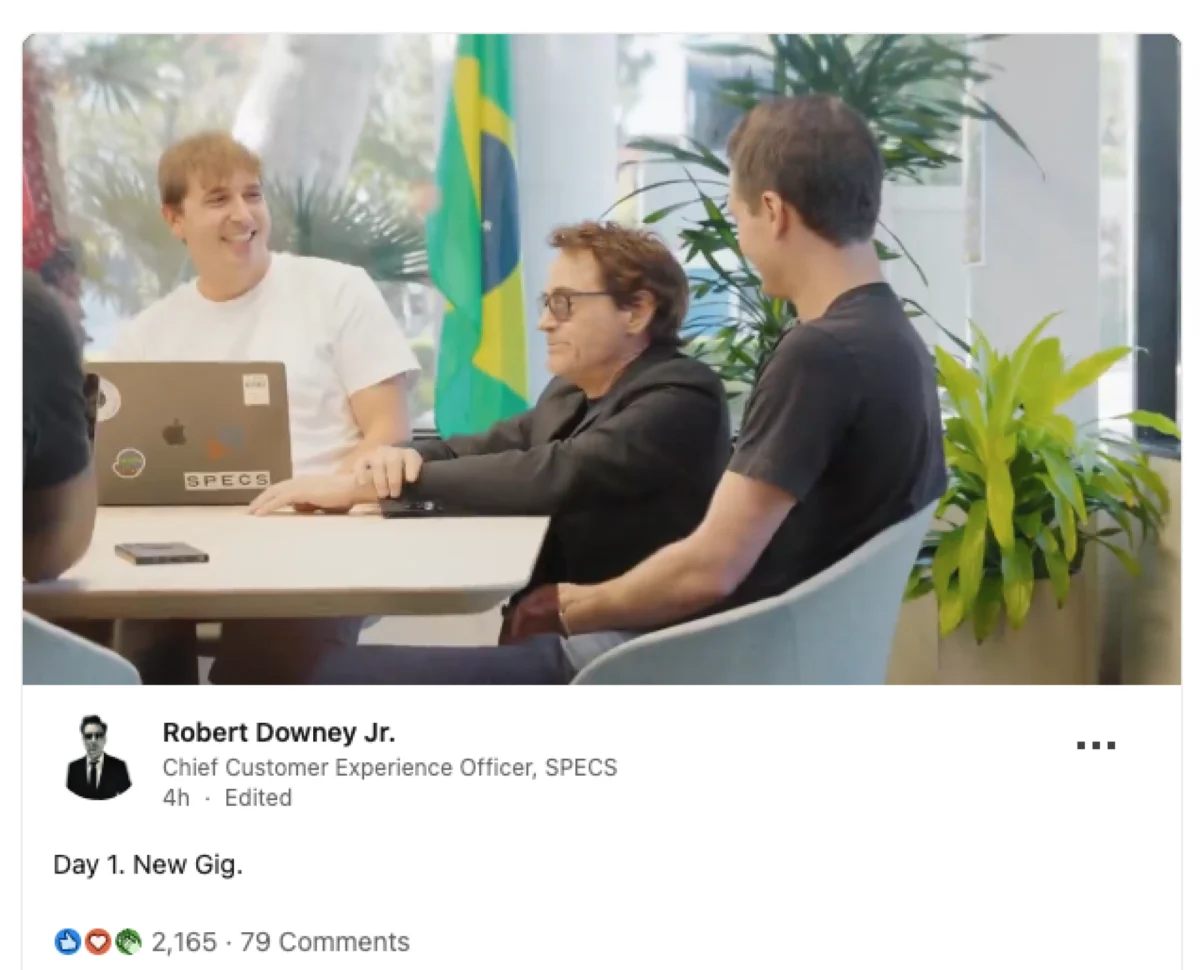
This isn’t merely a figurehead position. Downey has spent years cultivating a reputation as a thoughtful, if selective, tech investor. By taking the role "LinkedIn official"—posting a video of himself arriving at the Snap headquarters in Santa Monica with the caption "Day 1. New Gig"—he signaled a level of commitment rarely seen in typical brand partnerships.
A History of Technological Advocacy
Downey’s interest in the intersection of humanity and technology predates this partnership by nearly a decade. In 2018, he hosted and executive-produced the YouTube series The Age of AI, which interrogated how artificial intelligence would fundamentally alter human interaction.
However, his enthusiasm has always been tempered by a healthy, and often vocal, skepticism regarding the ethics of the industry. During a 2024 appearance on Kara Swisher’s podcast, Downey famously pledged to sue any future executive who attempted to recreate his likeness using AI after his death, famously noting that his law firm would remain "very active" even in his absence.
This duality—a belief in the potential of technology to improve lives, combined with a fierce protection of personal autonomy—is precisely the narrative Snap hopes to leverage. By aligning with a star who is simultaneously a champion of innovation and a critic of AI-driven exploitation, Snap is attempting to distance itself from the "dystopian" baggage often associated with smart glasses. In his debut promotional content, Downey is seen literally dumping a box labeled "AI glasses" into the trash, a clear, if heavy-handed, signal that Snap views its product as something entirely different: a human-centric tool, not just another invasive device.

Inside the Technology: What are Specs?
Snap’s foray into the hardware space reached a critical milestone in June 2026 with the introduction of its standalone AR glasses, priced at $2,195. Unlike the bulkier VR headsets that dominate the market, Specs are designed to function as an independent computer. They utilize transparent lenses to overlay digital information onto the wearer’s real-world environment, controlled through a combination of voice commands and gesture tracking.
Analysts, including Mashable’s own Timothy Beck Werth, have noted that the device feels less like a pair of smart sunglasses and more like a minimalist, wearable version of Apple’s Vision Pro. While the glasses are undeniably "chunky" by traditional eyewear standards, their wireless, compact nature marks a significant leap forward in wearable computing.
The goal, according to Snap CEO Evan Spiegel, is not to replace the smartphone, but to create a new way for people to engage with their surroundings. During the initial reveal, Spiegel emphasized that the company is targeting developers and early adopters—those who can see the value in hands-free computing, whether for perfecting a golf swing or managing a complex manufacturing task without the need for a screen.
The Competitive Landscape
Snap is entering a crowded and skeptical market. While the vision is grand, the financial reality remains a hurdle. During the August 2026 earnings call, Spiegel refrained from disclosing specific preorder numbers, acknowledging that the $2,195 price point makes the device a "high consideration purchase." He further cautioned that mass-market adoption likely won’t occur until the end of the decade.
The competition is formidable. Meta, in partnership with EssilorLuxottica, has dominated the early AI-glasses market, with over 7 million units sold in 2025 alone. Meta’s eyewear currently accounts for over 80 percent of global AI-glasses shipments. However, Meta’s success has come at the cost of intense scrutiny. Privacy regulators in Europe, specifically the European Data Protection Board, have raised alarms regarding the discreet cameras embedded in smart frames, leading to new, restrictive safety mandates.

Snap faces the dual challenge of convincing consumers to invest in an expensive piece of hardware while simultaneously navigating the public’s growing anxiety over being filmed in public spaces. By bringing Downey into the fold, Snap is attempting to shift the conversation from "surveillance hardware" to "empowering tool."
The Roadmap Ahead: Beyond the Hype
The partnership officially kicked off during Game 1 of the World Series, where the first of a series of original content clips debuted. The video showcased the versatility of Specs, moving seamlessly from professional engineering environments to creative and recreational use cases.
For Snap, the stakes could not be higher. After the 2016 Spectacles launch, which resulted in nearly $40 million in inventory write-downs, the company cannot afford another misstep. The addition of a high-profile, tech-savvy figure like Robert Downey Jr. is a calculated bet. It provides the "cool factor" necessary to transcend the niche developer community and reach the broader public consciousness.
As the series continues to roll out on the official Specs website and YouTube channel, the company will be watching closely to see if the "Stark Effect" translates into genuine consumer demand. The road to the future of AR is littered with failed prototypes and corporate overreach. Whether Snap—and its new Honorary Chief Customer Experience Officer—can navigate these waters will define the company’s trajectory for the next decade.
For now, the message from the boardroom is clear: the future of computing isn’t in your pocket, and it isn’t behind a screen. It’s right in front of your eyes. And if anyone has the charisma to convince the world to strap a computer to their face, it’s the man who built the suit.
