

You sit down to relax, hit "play" on a curated playlist, and let the music wash over you. In the past, this was a passive, uncomplicated experience. Today, however, the digital soundscape is increasingly populated by ghosts—tracks that fit your sonic preferences perfectly, yet were birthed not in a recording studio by human hands, but within the cold, complex logic of generative artificial intelligence.
As AI-generated audio floods the world’s most popular music streaming platforms, listeners are finding themselves playing the role of amateur detectives, scrutinizing artist profiles and searching for evidence of human authorship. This week, the industry took a significant step toward transparency. Google’s YouTube Music and the French streaming service Deezer have unveiled new features designed to pull back the curtain on synthetic music, promising to return some agency to the listener.
The Dawn of Disclosure: New Tools for a New Reality
The fundamental challenge facing streaming platforms today is a crisis of provenance. How can a listener know if they are connecting with a human artist or a sophisticated algorithm?
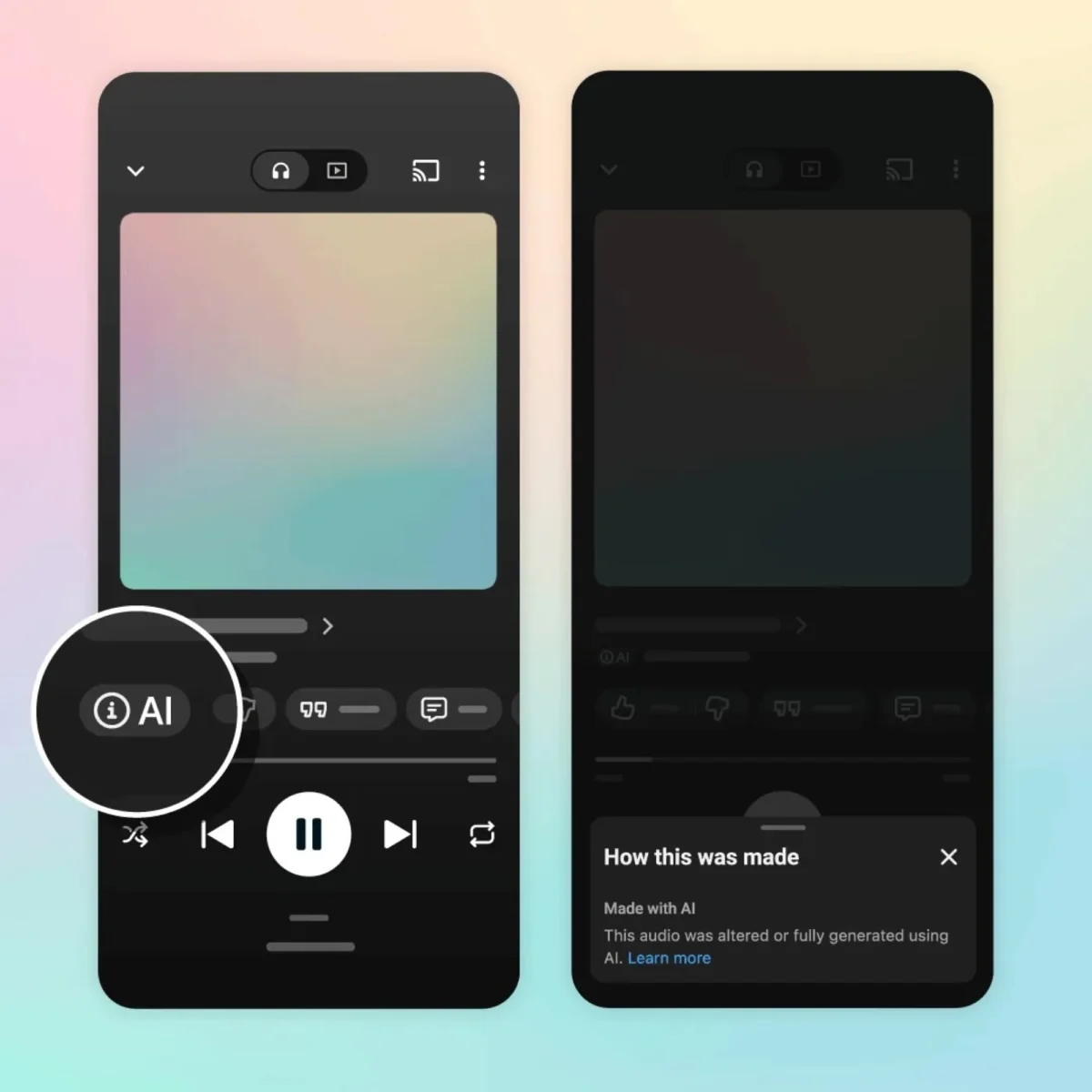
Beginning October 14, YouTube Music is rolling out mandatory labeling for content created primarily through generative AI. Whether it is a synthetic composition or a computer-generated vocal, users will see a label directly on the player interface. Tapping this label triggers an information panel, offering transparency into how the audio was crafted. YouTube has confirmed that these labels will also extend to the main YouTube platform, utilizing a combination of internal detection tools and collaborative partnerships with music labels to ensure compliance.
Simultaneously, Deezer is opting for a more aggressive approach to user control. By the end of 2026, the platform will launch a global "AI filter" toggle. Once activated, this feature will purge search results of fully AI-generated tracks, albums, and associated artists. This follows Deezer’s existing policy of excluding such content from algorithmic and editorial recommendations. "We’ve seen a clear user demand for the ability to filter out AI-generated music," stated Deezer CEO Alexis Lanternier.
These developments place these platforms in a growing cohort of tech giants attempting to navigate the intersection of AI innovation and artistic integrity. Spotify, for instance, has introduced "AI Persona" badges to identify synthetic artists, while Apple Music is reportedly leveraging "Transparency Tags" that rely on labels and distributors to disclose the use of AI in compositions, artwork, and music videos.

A Timeline of the Synthetic Surge
The rise of AI music was not a singular event, but a rapid, multi-year escalation that caught the industry off guard.
- 2022: The emergence of virtual entities like "FN Meka," an AI-generated rapper, sparked a firestorm of controversy. Beyond the ethical questions regarding the appropriation of Black culture, the project highlighted the hidden human labor behind synthetic masks, as claims surfaced that actual human performers were being used without credit or compensation.
- 2025 (November): A landmark blind test conducted by Deezer and Ipsos revealed the startling efficacy of AI. The study found that 97 percent of participants were unable to distinguish between human-made tracks and those generated by AI. This solidified the reality that the "ear test" was no longer a reliable metric for authenticity.
- 2025 (Throughout): The rise of "ghost" acts like The Velvet Sundown became emblematic of the problem. Despite amassing hundreds of thousands of listeners, the band had no physical existence, no history, and no identifiable producers—only high-fidelity, synthetic output.
- 2026 (October): The sentencing of Michael Smith, a North Carolina musician who utilized AI to facilitate an $8 million royalty fraud scheme, marked a turning point in the legal and financial fight against automated music abuse.
- October 14, 2026: YouTube Music and Deezer announce their respective labeling and filtering initiatives, signaling a coordinated industry push for transparency.
The Economics of the Infinite Upload
The motivation behind these platform changes is not merely to appease curious listeners; it is to combat a burgeoning financial threat. Deezer estimates that it receives roughly 90,000 fully AI-generated tracks every single day. While this volume represents only 1 to 3 percent of the platform’s total streams, the quality of these streams is highly suspect.
Data suggests that the "AI music" ecosystem is a hotbed for fraudulent activity. In 2025, as much as 85 percent of streams for fully generated tracks were identified as fraudulent. This is the "bot farm" economy in action. By uploading hundreds of thousands of AI tracks and using automated scripts to stream them billions of times, bad actors can siphon significant sums from the shared royalty pools—money that, in a fairer system, would support human songwriters and performers.
Michael Smith’s case is the cautionary tale the industry is currently using to justify these new rules. By spreading streams across a vast library of AI tracks, Smith avoided triggering standard anti-fraud alerts for years. His conviction for conspiracy to commit wire fraud demonstrates that the "who gets paid" question is becoming a primary focus for law enforcement and regulators alike.
Implications for the Future of Artistry
The introduction of labels and filters is a positive development for consumer choice, but it also highlights the limitations of current technology. As these tools roll out, they raise several critical questions about the future of the music industry.
1. The Burden of Detection
The success of these initiatives rests entirely on the platforms’ ability to accurately detect AI. If a song lacks an "AI" label, is it truly human-made, or has it simply evaded the platform’s detection algorithms? The industry is currently locked in an arms race between AI creators and AI detectors. As generative models become more subtle—blurring the lines between "human-assisted" and "AI-generated"—the distinction will become increasingly difficult to enforce.

2. The Nuance of Collaboration
Most modern music is already "AI-assisted." Producers use pitch-correction, beat-generation, and mastering tools that have relied on machine learning for years. Will these new labels distinguish between a track that is fully synthetic and one that uses AI as a sophisticated instrument? If the industry does not provide clear definitions, it risks stigmatizing legitimate technological advancements in music production.
3. The Question of Identity
Labels like Spotify’s "AI Persona" badges help identify synthetic faces, but they do little to solve the problem of cultural appropriation and hidden labor. When an AI avatar is used to perform music, it often masks the actual human songwriters and vocalists involved. If the industry relies solely on a "badge" to signal authenticity, it may inadvertently obscure the deeper ethical issues of intellectual property and credit.
4. Consumer Behavior vs. The Algorithmic Feed
The most significant hurdle is the fact that many users do not "seek out" AI music—it finds them. As Mashable’s Rachel Thompson discovered when Spotify’s "Smart Shuffle" inserted an AI-generated funk track into her queue, the platform’s own recommendation engines are the primary vector for AI music consumption. Even if a user wants to avoid synthetic music, they are at the mercy of the algorithms that drive the modern streaming experience.
Conclusion: A Step Toward Transparency
The era of blind trust in streaming platforms is coming to an end. As technology continues to lower the barrier to entry for content creation, the value of human authorship is being re-evaluated in real-time.
For the average listener, these new labels and filters offer a reprieve from the "detective work" that has recently characterized the digital music experience. They allow users to make informed decisions about what they support with their time and money. However, these tools are just the first step. To truly address the impact of AI, the industry must look beyond the user interface and address the underlying royalty systems and the ethical implications of virtual artists.
For now, the promise is clear: when you press play, you should know whether you are listening to a human expression of life or a sophisticated, calculated mimicry of it. While we may not always be able to hear the difference, we now have the right to see it.
