

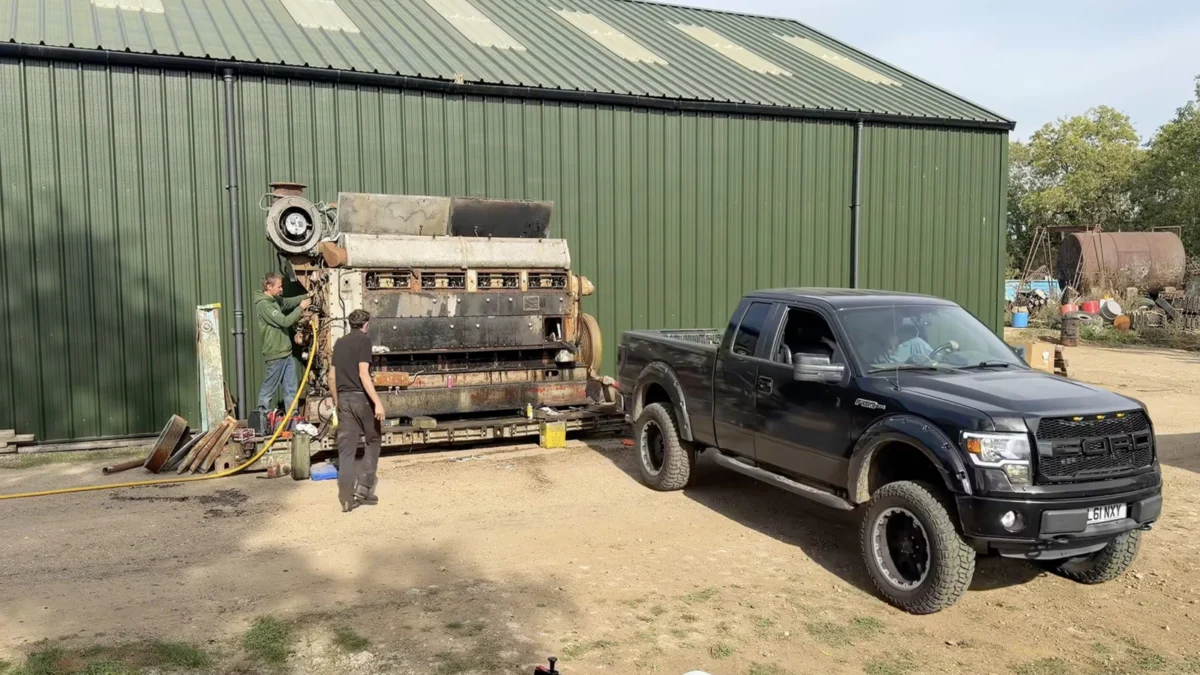
In the pantheon of industrial history, there are machines, and then there are monuments to the sheer audacity of human engineering. Deep in the annals of post-World War II mechanical history lies a relic that defies modern automotive logic: the Mirrlees Blackstone JS8. With a displacement of 102.4 liters, this inline-eight-cylinder turbodiesel stands not as a marvel of efficiency, but as a testament to the industrial scale of the 1940s. Recently, the resurrection of one such unit—discovered in a state of advanced decay—has captivated mechanical enthusiasts, serving as a reminder of an era when power was measured in mass and reliability rather than horsepower-per-liter metrics.
The Architecture of a Giant: Main Facts
To understand the Mirrlees Blackstone JS8, one must discard the conventional wisdom of the modern internal combustion engine. While a contemporary supercar might squeeze 1,000 horsepower out of a 3.0-liter block, the JS8 operates on a different philosophical plane.
This engine was never designed to accelerate a vehicle away from a stoplight; it was designed to provide unyielding, constant-load electrical power for the Royal Air Force (RAF). Its displacement of 102.4 liters is not a flex of performance, but a requirement for the physical movement of massive pistons. With a bore of 9.75 inches and a stroke of 10.5 inches, each individual cylinder has a displacement greater than an entire high-performance V8 engine found in a modern muscle car.
The JS8 is a "low-revving" machine. While a modern engine might hit its peak power at 6,500 or 7,000 RPM, the Mirrlees produces its sustained muscle at under 1,000 RPM. This is the hallmark of the "stationary engine" class—equipment built to run for weeks at a time without interruption, fueled by the logic that mass and momentum are more reliable than high-frequency stress.
A Chronological Odyssey: From Post-War Scotland to the Modern Workshop
The history of the JS8 is inextricably linked to the rebuilding of post-war Britain. Following the cessation of hostilities in 1945, the U.K. Air Ministry faced a massive infrastructure challenge: electrifying and maintaining remote airbases. Mirrlees Blackstone, a company with over half a century of experience in diesel development, was the natural choice for the contract.
The Service Life
Delivered to a Scottish RAF installation shortly after the war, the engine served as the heartbeat of the facility. Records indicate the specific unit recently rescued by YouTuber Joe Hewes (known as "Mr. Hewes") had only 720 hours of operational service. In the world of industrial diesels, this is effectively "new." For context, Mirrlees Blackstone typically stress-tested their J-series engines for 1,650 hours before they were even considered broken in.
The Decades of Slumber
For decades, the engine sat in the damp, unforgiving climate of Scotland. As the base was decommissioned and the equipment was left to the elements, the JS8 became a victim of time. Water entered the intake, the valves seized, and the internal lubricants—meant to preserve the heart of the machine—degraded into a sludge of rust and condensation.
The Rescue Mission
Enter Joe Hewes, a specialist in the restoration of heavy military and industrial powertrains. Upon discovering the unit, Hewes was faced with a mechanical conundrum: how to wake a beast that hadn’t breathed in half a century. The process of documentation began with a deep clean and the assessment of internal damage. Valves were frozen solid, and the cooling jackets were clogged with decades of sediment. The restoration was not merely a repair; it was an act of mechanical archaeology.
Supporting Data: The Efficiency Gap
When comparing the Mirrlees Blackstone JS8 to modern powerplants, the statistics highlight a fundamental shift in engineering priorities.
| Metric | Mirrlees Blackstone JS8 | 2023 Dodge Demon 170 |
|---|---|---|
| Displacement | 102.4 Liters | 3.0 Liters |
| Peak RPM | < 1,000 RPM | 6,500 RPM |
| Power/Liter | ~24 HP/Liter | 341 HP/Liter |
| Primary Use | Industrial Generation | High-Performance Transit |
The "anemic" power-per-liter of the JS8, which delivers roughly 24 horsepower per liter, would be considered a failure by today’s standards. However, this comparison misses the point of the machine. The JS8 was designed for torque at idle and the ability to maintain that torque for 20,000 hours of continuous operation. The modern high-revving engine is a sprint runner; the Mirrlees is a marathon hiker capable of carrying a mountain on its back.
The Ignition Challenge: Why Compressed Air?
The most significant hurdle in the restoration was the starting mechanism. Modern engines utilize a 12-volt or 24-volt electric starter motor to turn the crankshaft until the combustion cycle begins. The JS8, however, is too massive for such a simple electrical solution.
The JS8 employs "air start." In this system, a reservoir of compressed air is injected directly into the cylinders at high pressure. This pushes the massive pistons downward, forcing the engine to rotate until the diesel fuel—which ignites purely through compression heat—can take over.
In his attempts to revive the unit, Hewes discovered that standard shop-grade compressed air was insufficient. The seals had degraded, and the sheer inertia of the 102.4-liter assembly required a sustained burst of pressure that standard equipment could not provide. After the initial failures, Hewes had to resort to unconventional methods. By wrapping a heavy-duty ratchet strap around the massive flywheel and utilizing the torque of a modern Ford F-Series pickup truck, he was able to provide the initial momentum required to "break" the engine free.
Implications: The Legacy of Industrial Giants
What are we to take away from the restoration of a 102.4-liter relic?
First, there is the implication for modern engineering sustainability. We live in an era of planned obsolescence, where components are designed to be replaced rather than serviced. The JS8 serves as a reminder that we once built machines intended to last for generations. The fact that an engine filled with water and neglected for decades could be turned over and tuned to run again speaks to the over-engineering inherent in the mid-20th-century British industrial complex.
Second, the story highlights the shift in our relationship with power. We have traded the low-frequency, high-mass power of the industrial age for the high-frequency, low-mass power of the digital age. While the efficiency gains of the latter are undeniable, the aesthetic and visceral experience of the JS8—a machine that shakes the earth beneath it—cannot be replicated by modern technology.
Finally, the restoration efforts of individuals like Hewes are crucial for historical preservation. As these massive industrial engines are scrapped for their raw metal, we lose the physical evidence of how the modern world was built. These engines powered the radar stations that watched the skies and the factories that produced the goods of the post-war boom.
Conclusion
The Mirrlees Blackstone JS8 is more than just a large engine; it is a time capsule. Watching it return to life—oil spraying as it begins to fire on all eight cylinders, the deep, rhythmic thrum echoing in the workshop—is a victory for the mechanical arts. It is a reminder that while the world moves faster and becomes more efficient, there is a singular, irreplaceable beauty in the heavy, iron-clad titans of the past. As Hewes stood by the engine, fine-tuning the mixture while covered in the grease of a half-century-old machine, he wasn’t just fixing a generator. He was keeping a piece of history breathing, proving that even the largest, rustiest giants can be coaxed back into the light.
