


In a move that promises to redraw the map of the American energy landscape, NextEra Energy, the nation’s largest utility by market capitalization, has announced a definitive agreement to merge with Dominion Energy. The $67 billion all-stock deal is designed to create a global behemoth in the regulated electric utility sector, signaling a seismic shift in how the United States intends to power its rapidly expanding digital infrastructure.
As artificial intelligence and massive data center clusters demand unprecedented amounts of electricity, this merger seeks to marry NextEra’s sprawling, renewables-heavy infrastructure with Dominion’s strategic foothold in Northern Virginia—the epicenter of the world’s data center industry. However, the proposal has ignited an immediate firestorm of debate, with consumer advocates, climate activists, and market analysts questioning whether the consolidation of such immense power will ultimately serve the public interest or merely satisfy the appetites of shareholders.
The Anatomy of the Deal
The proposed merger, announced Monday morning, would integrate two of the most significant players in the North American power grid. Under the terms of the agreement, NextEra Energy—headquartered in Juno Beach, Florida—would absorb Dominion Energy, based in Richmond, Virginia. The transaction is structured as an all-stock deal, with NextEra shareholders retaining a 74.5 percent stake in the combined entity, while Dominion shareholders will hold the remaining 25.5 percent.
The leadership structure for the post-merger entity is already defined: NextEra CEO John W. Ketchum will lead the unified company, maintaining his current role. Robert M. Blue, the current CEO of Dominion, is slated to head the regulated utilities division of the combined corporation.
According to the companies, the deal is contingent upon extensive state and federal regulatory scrutiny, a process they estimate will span 12 to 18 months. If finalized, the merger would create a company so large that its market value would be surpassed only by oil and gas giants Exxon Mobil and Chevron within the U.S. energy sector.

Chronology of Consolidation and Strategic Rationale
For industry observers, the move is the culmination of years of positioning by NextEra. While NextEra has long dominated the wholesale renewable energy market, it has historically trailed behind some of its regulated peers in capturing the lucrative data center market.
By acquiring Dominion, NextEra gains immediate access to the "Data Center Alley" in Northern Virginia, where Dominion serves the world’s largest concentration of cloud computing facilities. This infrastructure is the crown jewel of the deal. In an investor presentation, the companies noted that the merger would create a massive project pipeline capable of meeting 130 gigawatts of potential data center demand, with an aim to more than double the combined company’s overall generation capacity to 225 gigawatts by 2032.
"We are bringing NextEra Energy and Dominion Energy together because scale matters more than ever," said John W. Ketchum in a statement. "This is not for the sake of size, but because scale translates into capital and operating efficiencies that will benefit our customers and the energy transition."
Supporting Data: A Behemoth in the Making
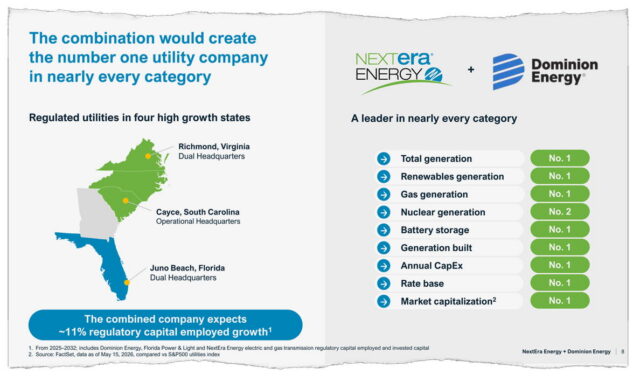
The sheer scale of the proposed entity is difficult to overstate. The combined company would become the unrivaled leader in nearly every category of the U.S. power industry, including total electricity generation, natural gas, and renewable energy assets.
While it would rank second in nuclear power capacity and the total number of regulated customers—trailing Chicago-based Exelon Corp—it would hold a dominant position across the board. The merger creates a company with a footprint covering several states, including Florida, Virginia, North Carolina, and South Carolina.
However, the "synergies" promised by the companies are viewed with deep skepticism by independent experts. The deal includes $2.25 billion in bill credits for Dominion customers over two years, a gesture meant to placate regulators and consumers. Yet, critics argue that these credits are a drop in the bucket compared to the long-term potential for rate increases inherent in such a massive consolidation.
Official Responses and Industry Skepticism
The reaction from the regulatory and advocacy community has been swift and largely critical.
Ari Peskoe, director of the Electricity Law Initiative at Harvard Law School, cut to the heart of the matter, stating, "Mergers are not about consumers; they’re about shareholders. For the Dominion shareholders, they are selling their shares at a premium. The executives are getting massive payouts for facilitating this, and obviously, NextEra believes the transaction is going to add value. Ratepayers are all an afterthought."
Marissa Paslick Gillett, former chair of the Connecticut Public Utilities Commission and current senior fellow at the American Economic Liberties Project, echoed this sentiment. Drawing on her experience with the 2012 Exelon-Constellation merger, she expressed frustration at the "tone deafness" of utility executives.
"I’m not sure that any of us could point to a major utility merger acquisition that’s happened in the past decade where that merger has definitively provided the synergies they told their commissions would come out," Gillett said. "We know how this goes, and the real, tangible problems of having to regulate a behemoth like this are significant."

Implications for Consumers and the Environment
The environmental implications of the merger are equally contentious. While both companies have significant renewable portfolios, they also remain deeply invested in fossil fuels. According to the Natural Resources Defense Council’s 2024 Benchmarking Air Emissions report, NextEra and Dominion rank among the top producers of carbon emissions in the U.S. utility sector.
Susan Glickman, vice president of policy and partnerships at the CLEO Institute, warned that the merger could exacerbate climate-related vulnerabilities. "They’re going to continue to be at the short end of the stick, while these companies build more methane gas plants to provide power for data centers, adding to the pollution that is warming our climate," she said. Glickman noted that in regions like Florida, where hurricane intensity is increasing, the most vulnerable populations—who often have the fewest resources—are the ones who suffer first and worst when utility costs rise or infrastructure fails.
Furthermore, there is the issue of political influence. Stephen Smith, executive director of the Southern Alliance for Clean Energy, raised concerns about the "tremendous amount of political power" such a merged entity would wield. "The more political power a utility has, the more probable it is that they will use that power to the disadvantage of ratepayers," Smith warned.
The Path Ahead: Regulatory Hurdles
Despite the grand ambitions of NextEra and Dominion, the deal is far from a certainty. NextEra’s history with large-scale acquisitions is checkered; a notable attempt to merge with Duke Energy in 2020 was aborted after regulatory and political pushback.
William Shobe, a research professor emeritus of public policy at the University of Virginia, noted that the merger will not exempt the company from local mandates. Virginia’s stringent laws, including the Virginia Clean Economy Act, which mandates a carbon-free grid by 2050, will still apply to the utility’s footprint regardless of the parent company’s name.

"The regulations don’t mention Dominion; they mention the utility that covers the footprint," Shobe noted. He suggested there is a slim possibility that NextEra’s expertise in renewable energy could push Dominion toward more aggressive decarbonization. However, this remains a speculative outcome in an industry where profitability often dictates the pace of change.
The recent $7 billion rate hike approved for Florida Power & Light—a NextEra subsidiary—serves as a grim foreshadowing for consumer advocates. Legal challenges against that hike remain ongoing, and many observers view the current merger as a move to further solidify the company’s financial dominance at the expense of captive ratepayers.
As the industry moves toward a future defined by the electricity-hungry AI revolution, this $67 billion merger will serve as the ultimate litmus test for American utility regulation. The question remains: can a company this large be effectively regulated, or will the "Titan of the Grid" be allowed to rewrite the rules of the road at the public’s expense? The next 18 months of regulatory hearings will likely decide the answer.
