

For over half a century, Chilean artist, poet, and activist Cecilia Vicuña has stood as a defiant voice against the encroachment of Western-centric, patriarchal systems. Her work, which spans sculpture, performance, painting, and written word, serves as a visceral critique of the historical and environmental exploitation that has defined the post-colonial era. Now, London’s Whitechapel Gallery presents Living Threads, a landmark retrospective that offers a comprehensive survey of Vicuña’s six-decade career, untangling the complex tapestry of art, political exile, and radical environmental resistance that has defined her life’s work.
The Architecture of Memory: The Quipus
At the heart of Vicuña’s artistic vocabulary is the quipu—a system of knotted, dyed wool strings that served as a sophisticated method of communication and record-keeping in Andean cultures before the Spanish conquest. By reclaiming this ancestral technology, Vicuña creates "spatial poetry." Her quipu installations are not merely static sculptures; they are haunting, immersive environments that demand the viewer engage with the physical labor of the hand, the weight of history, and the fragility of our ecosystems.
In the Living Threads exhibition, these installations stand as silent witnesses to history. They represent a bridge between the ancient wisdom of indigenous South America and the urgent, often fragmented, reality of the 21st-century climate crisis. By utilizing unspun wool—a material that is both raw and organic—Vicuña challenges the polished, sterile nature of Western gallery spaces, forcing a confrontation with the "living" nature of her materials.
A Chronology of Resistance: From Santiago to Exile
To understand the urgency behind Living Threads, one must trace the arc of Vicuña’s life, which has been fundamentally shaped by the political volatility of 20th-century Chile.
The Formative Years (1960s–1972)
Vicuña began her journey as a painter in 1969. Following a visit to the Museum of Modern Art (MoMA) in New York, she found herself disillusioned by the prevailing minimalist, male-dominated art canon. She was struck by the contrast between the "high art" displayed in the main galleries and the "so-called primitive" works relegated to the periphery. This experience was a catalyst: "I decided I will work with this imposed colonial material [oil paint], but I will subvert it," she has noted. Her early work focused on merging the religious iconography imposed by colonial forces with the indigenous spiritual sensibilities of her homeland.
The Disruption of 1973
The turning point for Vicuña, as for much of Chile, was the military coup led by General Augusto Pinochet in 1973. The violence that dismantled the democratic fabric of her country acted as a profound rupture in her life and her creative output. During this time, she was living in London, having arrived on a scholarship to study at the Slade School of Fine Art.
The distance between her new home and her homeland did not provide safety; rather, it amplified her agony. "It was like the end of the world," she recalls. "It was a level of violence we could never have dreamed of. It’s like something in me died… We had to find the strength to go on and act in solidarity."
Exile and Rebirth (1974–Present)
During her exile in the UK and later in New York, Vicuña faced intense institutional pressure. The British government, under the Conservative administration, attempted to strip scholarship visas from Chilean students. Vicuña’s successful fight to remain in London marked the beginning of her lifelong commitment to political activism. Her work shifted, becoming increasingly focused on the intersection of the female body, the earth, and the violence of state power.
The Aesthetic of the "Bad Painter"
One of the most compelling aspects of the Whitechapel retrospective is the inclusion of her early, subversive paintings. Vicuña famously adopted the persona of a "bad painter" to deliberately offend the colonial standards of what constituted "good" art.
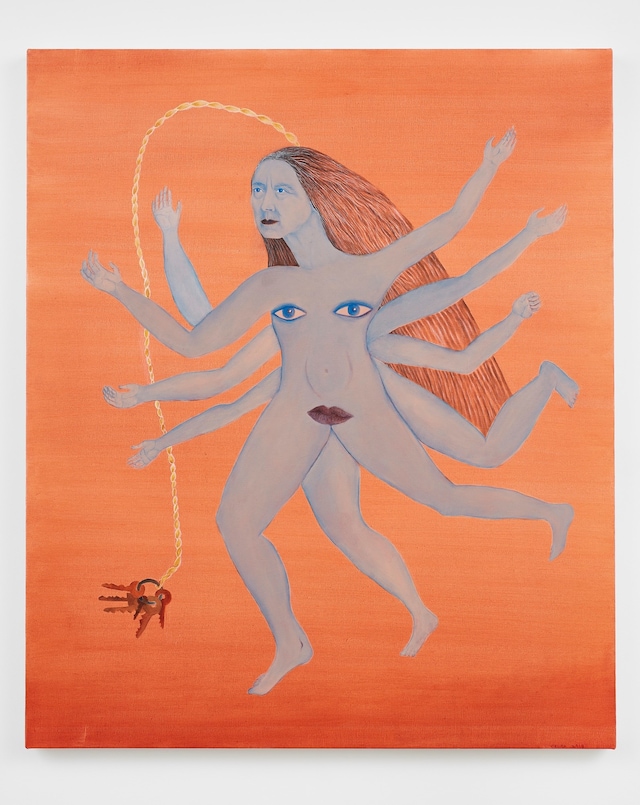
In Llaverito (Blue Lady) / Ladilla, Crab (1977/2019), the viewer encounters a woman/crustacean hybrid—a creature of bright orange hues clutching a set of keys. The imagery is deeply rooted in local cultural vernacular, where women were simultaneously regarded as the keepers of pleasure and targets of derogatory metaphors. By re-contextualizing these tropes, Vicuña allows the female figure to be multifaceted, powerful, and unruly.
Similarly, Jaguar II (1978/2025) depicts a muscular figure merging with a big cat. Inspired by the sight of a captive jaguar pacing in a forest clearing—a metaphor for the imprisoned woman—the work serves as a testament to the resilience of the female spirit in the face of systemic confinement. These paintings, long thought lost or destroyed, were reconstructed by the artist, marking a conscious decision to reclaim her own history from the erasure of exile.
The Climate Crisis: A Premonition of Destruction
Vicuña’s work has consistently pointed toward the environmental collapse that has now become our current reality. Her piece Quipu Menstrual 1 (unknotted) (2006 / 2024), featured prominently in the exhibition, utilizes vast quantities of red wool to evoke the blood of the earth and the cycle of human life. This work evolved from The Blood of Glaciers (2006), where she placed red threads at the foot of the El Plomo Glacier in Chile, a symbolic protest against the melting of the world’s ice caps.
Vicuña argues that the climate crisis is not a recent discovery, but a disaster long foretold. "This message has been ignored since the 60s," she explains. "Women scientists even in the 19th century were analyzing that carbon emissions would cause the planet to heat up to such an extent that human civilization would not be sustainable anymore." Her work serves as a sobering reminder that we are living in the era of consequence, where the denial of scientific truth has led to unprecedented global instability.
Ecofeminism as a Path Forward
The implications of Living Threads are clear: we cannot solve the climate crisis without dismantling the patriarchal structures that underpin our destructive relationship with the natural world. Vicuña advocates for an ecofeminism rooted in communal care. She draws inspiration from the matriarchal structures of indigenous communities in Africa, South America, and Northern Europe, which prioritize regeneration over extraction.
"What is needed is a sort of visionary feminism where women are really in charge because of their sensibility and way of being to care for the continuity of life," she argues. This is not merely a political stance but an artistic imperative. Her work invites the audience to re-orientate their culture toward the act of caring, shifting the focus away from the relentless pursuit of growth at the expense of our planetary home.
Official Responses and Curatorial Significance
The Whitechapel Gallery’s decision to mount Living Threads highlights the growing institutional recognition of Vicuña’s role as a seminal figure in both Latin American and global contemporary art. By placing her installations alongside her poetry and early paintings, the curators have created a dialogue between the different facets of her practice.
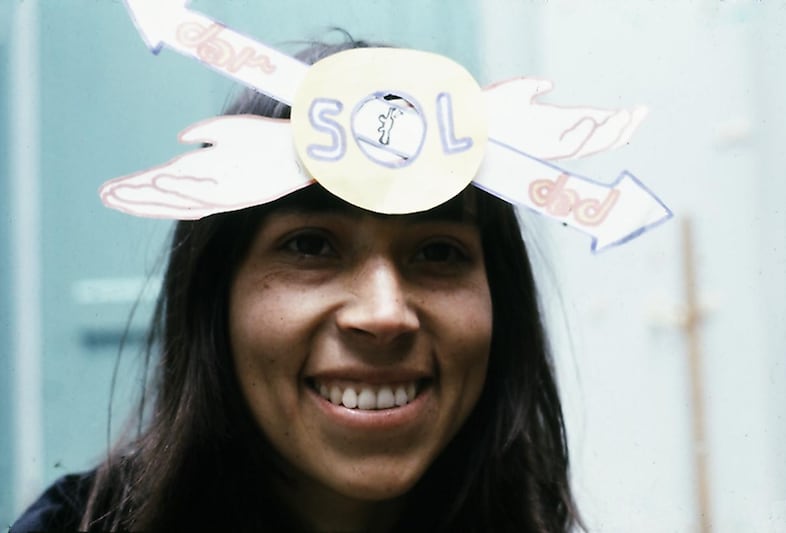
Critics have noted that the exhibition is not merely a retrospective but a call to arms. It forces institutions to reckon with their own roles in colonial history and provides a platform for voices that have traditionally been excluded from the "canonical" narrative. As the climate crisis intensifies, Vicuña’s work has become more relevant than ever, serving as a beacon for artists who wish to use their platforms to drive social and ecological change.
Conclusion: The Wisdom of the Elder
At 78, Cecilia Vicuña occupies a space of profound authority. She speaks of aging not with the fear often associated with Western perceptions of the elderly, but with a sense of wholeness and pride. "I knew being an old woman, if you had your art, you were whole," she says.
As an elder of the art world, her presence in Living Threads feels like a culmination of decades of labor, loss, and resilience. She is no longer just the artist fighting against the doors of a London institution; she is the one holding them open for the next generation. Her work serves as an essential reminder that while the destruction of our world may seem inevitable, the power to weave a different narrative—one of regeneration, solidarity, and care—remains in our hands.
Living Threads is not just an exhibition; it is a testament to the fact that even when the world seems to be falling apart, there is always a thread to be picked up, a knot to be tied, and a new story to be woven.
