

By Ellen Wexler
April 17, 2026
The most iconic moments in the canon of Andrew Lloyd Webber are defined by their sense of scale: the subterranean, candle-lit lake beneath the Paris Opera House; a tribe of Jellicle cats poised to ascend to the Heaviside Layer; or the shimmering, Elvis-inflected portrait of an Egyptian pharaoh. For decades, the composer has mastered the art of the musical spectacle, turning high-concept drama into global commercial phenomena. Now, the man behind The Phantom of the Opera is preparing to tackle an entirely new subject—not one of fiction, but one of the most enigmatic chapters in art history: the 1911 disappearance of the Mona Lisa.
In a recent interview, Lloyd Webber confirmed that he is in the early stages of developing a new musical based on the daring theft of Leonardo da Vinci’s masterpiece. "It’s a true story about how the Mona Lisa disappeared—and ended up in Italy," the composer revealed. For a creator whose career has been built on the intersection of grand theatricality and mass appeal, the story of the painting that launched a thousand police reports serves as a fittingly dramatic canvas.
A Legacy of Spectacle
Lloyd Webber is currently balancing a frantic creative slate. His production company is fresh off the April 7 Broadway opening of Cats: The Jellicle Ball, a bold, queer-coded reimagining of his 1981 classic, now set within the high-stakes world of ballroom culture. Simultaneously, he is deep in the composition of The Illusionist, an adaptation of the 2006 film.
/https://tf-cmsv2-smithsonianmag-media.s3.amazonaws.com/filer_public/0e/c8/0ec8a237-40da-4c05-bd13-7115915903ae/gettyimages-80912904.jpg)
Yet, it is his offhand comment regarding "the other one"—the Mona Lisa project—that has piqued the interest of the theater world. Hours after the premiere of The Jellicle Ball, Lloyd Webber alluded to the project with characteristic brevity. "More than that I cannot really tell you," he noted, "for the simple reason that I’m going away next week to write it."
This pivot to historical intrigue suggests a desire to return to the kind of narrative-driven, period-specific spectacle that characterized his biggest hits. In the world of theater, as in the world of art, the Mona Lisa represents the ultimate "spectacle." With the Louvre currently reporting that roughly 80 percent of its visitors arrive specifically to catch a glimpse of the 30-inch-tall portrait, the painting remains the world’s most visited—and perhaps most scrutinized—artifact.
Chronology of a Crime: The 1911 Heist
To understand the potential narrative arc of Lloyd Webber’s upcoming show, one must look back to the early morning of August 21, 1911. At the time, the Mona Lisa was known to scholars but had not yet achieved its status as a global cultural touchstone. It was, however, beginning to exert a strange magnetism on the public. Author R.A. Scotti, in Vanished Smile, noted that the painting received its own fan mail and "love letters" from infatuated admirers.
Recognizing the painting’s growing prominence, the Louvre commissioned an Italian glazier and housepainter named Vincenzo Peruggia to help secure the masterpiece behind protective glass. As Scotti wrote, "Since he had put her in the frame, he knew better than anyone how to remove her."
/https://tf-cmsv2-smithsonianmag-media.s3.amazonaws.com/accounts/headshot/Ellen_Wexler.png)
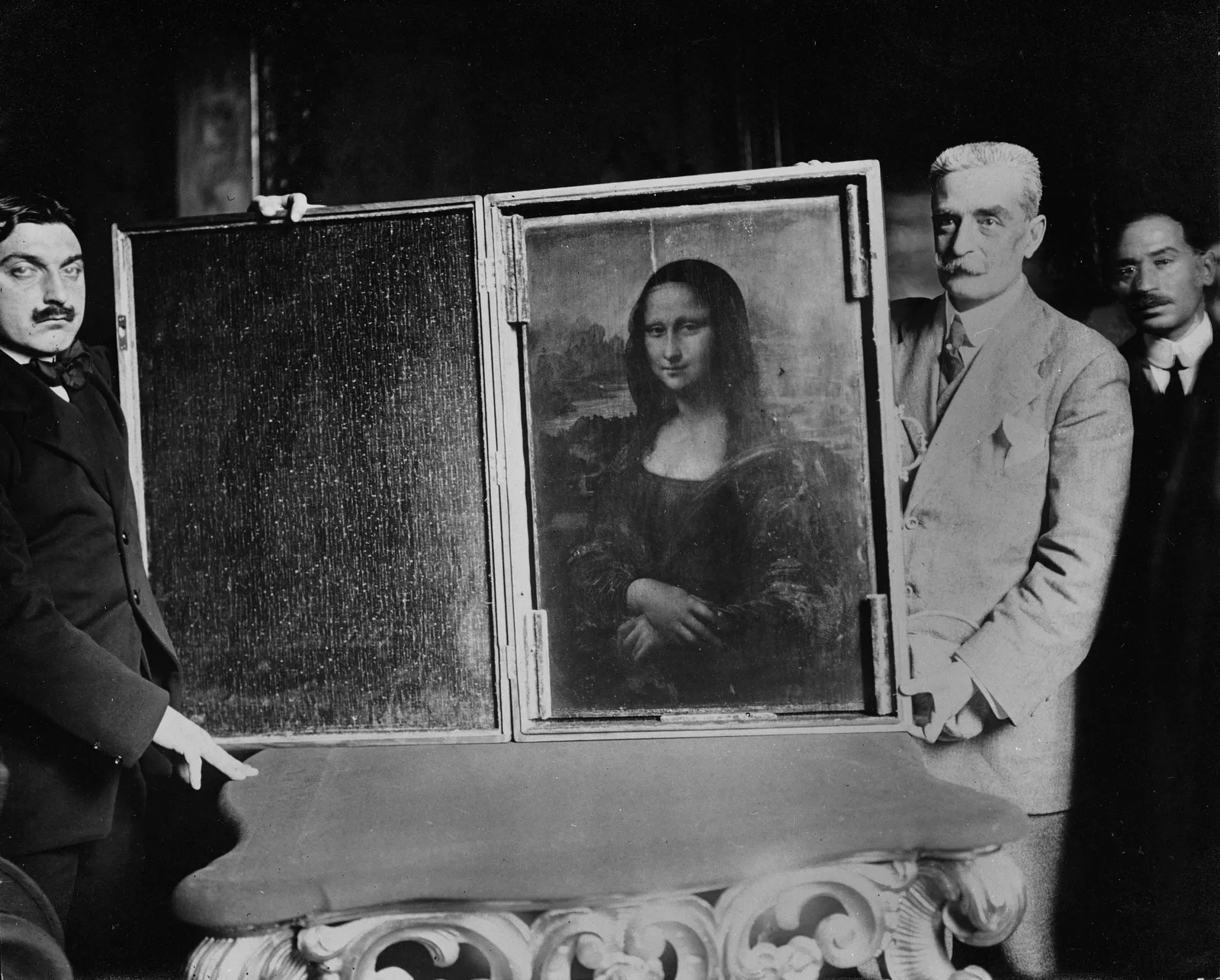
On that fateful day in 1911, while the museum was closed, Peruggia donned a worker’s smock to blend in with the staff. He easily removed the painting from its case, carried it into a secluded stairwell, stripped it of its heavy frame, and vanished. The theft went undiscovered for 28 hours, as museum staff initially assumed the painting had been removed for photographic documentation. When the realization finally set in that the Mona Lisa was gone, it triggered a massive, international investigation.
The police net was cast wide. Officials even detained a young Pablo Picasso, who was living in Paris at the time, for questioning. Peruggia himself was interviewed in his apartment, where he had stashed the painting in a trunk. Because he had been a worker at the museum, his alibi held, and the authorities moved on, failing to realize that the most famous stolen object in history was sitting just feet away.
It took two years for the trail to go cold and then, unexpectedly, to heat up again. In late 1913, Peruggia contacted an Italian art dealer, demanding a ransom for the work. The dealer alerted the authorities, and Peruggia was arrested. His capture turned the Mona Lisa into an overnight sensation, cementing its status as the world’s most famous image.
The Transformation of an Icon
The theft of 1911 changed the painting’s trajectory forever. Before the crime, the Mona Lisa was simply one of many masterworks in the Louvre. After the theft, it became a celebrity. Thousands of people—including the writer Franz Kafka—flocked to the Louvre simply to stare at the empty wall where the painting had hung.
:focal(1916x1542:1917x1543)/https://tf-cmsv2-smithsonianmag-media.s3.amazonaws.com/filer_public/0e/c8/0ec8a237-40da-4c05-bd13-7115915903ae/gettyimages-80912904.jpg)
Peruggia’s defense, which he articulated in his ransom note, was that he was a patriot returning the work to its homeland. "The stolen work of Leonardo da Vinci is in my possession," he wrote. "It seems to belong to Italy since its painter was an Italian."
Historians have long debated whether Peruggia was a nationalist zealot or simply a man enchanted by the painting’s mystery. In his own accounts, he described a deeply personal, almost romantic obsession with the work. "I stood bewitched," he told investigators. "I fell victim to her smile and feasted my eyes on my treasure every evening, discovering each time new beauty and perversity in her. I fell in love with her."
When the painting finally returned to the Louvre, it was met by a crowd of 100,000 visitors in just the first two days. It had become a martyr of art, a victim of its own beauty, and the centerpiece of a narrative that combined high art with the gritty reality of a common thief.
The Intersection of Art and Commerce
Lloyd Webber’s interest in this story is no accident. The composer has long been a master of the "accessible spectacle." Critics have often pointed out that his work serves as a gateway for audiences who might otherwise find high-brow forms—like opera—intimidating.
/https://tf-cmsv2-smithsonianmag-media.s3.amazonaws.com/filer_public/ea/fd/eafd6580-63c5-41a1-835d-0e09a8e22d0c/gettyimages-141556745.jpg)
"It provided a night at the opera for people who, as a rule, did not go to the opera," critic Andrea Long Chu wrote in Vulture regarding The Phantom of the Opera. By stripping away the "longueurs" and technical impenetrability of traditional opera, Lloyd Webber created a form of musical theater that prioritizes emotional resonance and grand visual set-pieces.
The Mona Lisa offers the perfect bridge for his style. It is a story about the intersection of art and fame, a theme that has permeated his work for decades. Millions line up for Phantom because they want to be transported; millions line up at the Louvre for the same reason. Both are institutions that have transcended their original purpose to become global brands.
Implications for the Stage
As Lloyd Webber begins his writing process, the theatrical community is already speculating on the tone of the production. Will it be a dark, historical thriller, or will it lean into the absurd, romantic obsession that Peruggia felt for the painting?
The logistics of the Mona Lisa‘s future are also shifting, which adds a layer of contemporary relevance to the composer’s choice of subject. The Louvre is currently planning to move the painting to an underground chamber where visitors will have to purchase separate, dedicated tickets to view it. This further highlights the commodification of the image—a concept that fits perfectly into the themes of a Broadway musical.
/https://tf-cmsv2-smithsonianmag-media.s3.amazonaws.com/filer_public/d4/86/d4867fc3-18ba-46a5-b20c-e40874c196f5/gettyimages-514875422.jpg)
Whether the show focuses on the political tensions of pre-WWI Europe, the obsessive mind of a housepainter, or the sheer, unadulterated fame of the portrait itself, one thing is certain: the world will be watching. Andrew Lloyd Webber has spent his life turning the invisible into the audible. In the Mona Lisa, he has found a subject that is both profoundly silent and, in the history of the 20th century, the loudest masterpiece of them all.
As he heads off to write, the question remains: will the Mona Lisa finally "sing" for a new audience? If history is any indicator, Lloyd Webber has a knack for ensuring that the answer is a resounding, sold-out "yes."
