

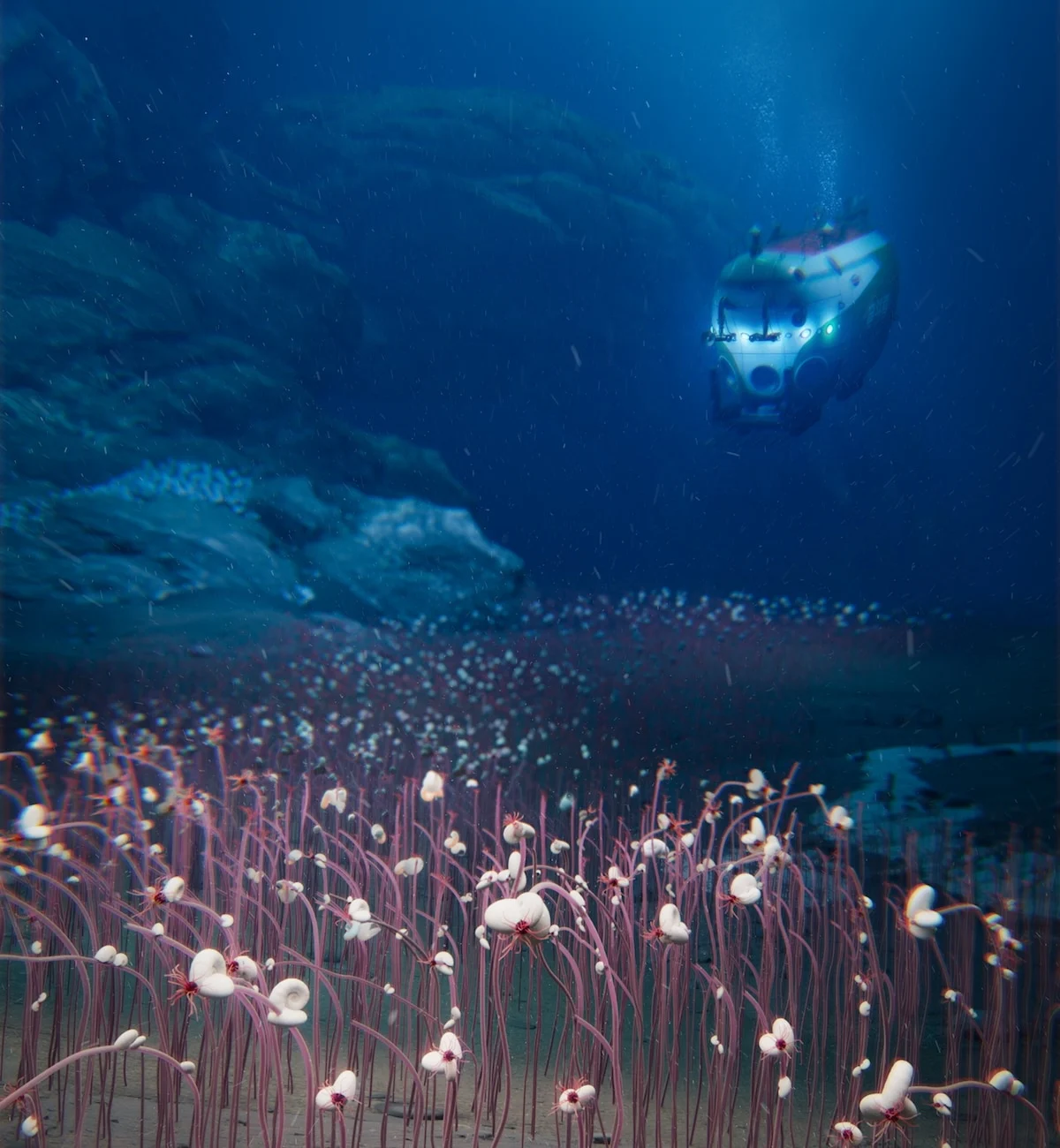
In a landmark discovery that has fundamentally altered our understanding of biological limits, researchers have identified the deepest and most extensive chemosynthesis-based animal communities ever recorded on Earth. A team of scientists utilizing the Chinese manned submersible Fendouzhe successfully navigated the crushing pressures of the Mariana Trench and other hadal zones, documenting a thriving ecosystem of mollusks, worms, and crustaceans nearly six miles beneath the surface.
This finding, recently published in the journal Nature, confirms that life does not merely survive in the "hadal" zones—the deepest, darkest, and most desolate reaches of the ocean—but flourishes there in densities previously thought impossible.
The Discovery: A Vibrant Oasis in the Deep
For decades, the hadal trenches were viewed by the scientific community as biological deserts. With pressures reaching over 1,000 times that of sea level and temperatures hovering just above freezing, these regions were considered inhospitable to all but the most microscopic life forms. However, the Fendouzhe expedition has shattered this perception.
During a series of 23 dives into the western Pacific’s Mariana Trench, researchers observed vast fields of life. The expedition, led by the Institute of Deep-sea Science and Engineering (IDSSE) at the Chinese Academy of Sciences, captured high-definition footage of tubeworms—some reaching up to a foot in length—living alongside dense clusters of bivalves, spiky crustaceans, sea lilies, and sea cucumbers.
“What makes our discovery groundbreaking is not just its greater depth—it’s the astonishing abundance and diversity of chemosynthetic life we observed,” said study co-author Mengran Du, a marine geochemist at the IDSSE. “Unlike isolated pockets of organisms, this community thrives like a vibrant oasis in the vast desert of the deep sea.”
Chronology of the Expedition
The path to this discovery was not linear, but rather the culmination of years of technological refinement and oceanographic ambition.
- 1960: The first human expedition to the bottom of the Mariana Trench takes place. The environment is labeled "desolate" and "alien," setting the tone for scientific expectations for the next half-century.
- 2012: Hollywood director James Cameron completes his historic solo descent to the Challenger Deep, providing visual confirmation of the extreme barrenness of the trench floor.
- 2020s: The Fendouzhe submersible enters service, equipped with advanced imaging and sampling technology capable of withstanding the immense pressures of the hadal zone.
- 2024: Over the course of 23 rigorous dives, the research team maps a vast, 1,553.4-mile corridor across the Kuril-Kamchatka and western Aleutian trenches, alongside the Mariana Trench.
- 2025: The findings are officially peer-reviewed and published in the journal Nature, marking a paradigm shift in deep-sea biology.
Supporting Data: How Life Thrives Without Sunlight
The most significant scientific question posed by the discovery is how such large organisms sustain themselves in a realm where no sunlight can penetrate. The answer lies in chemosynthesis.
In these extreme depths, life is not fueled by the sun’s energy, but by the chemical energy seeping from the Earth’s crust. The research team identified that these communities are sustained by hydrogen sulfide-rich and methane-rich fluids. These fluids are transported along deep-seated geological faults that traverse the trench sediment.
Isotopic analysis performed by the team confirmed that methane is produced microbially from deposited organic matter, providing a steady food source for the invertebrates. The study noted a clear pattern: tubeworms were frequently observed clustering around "snow-like" microbial mats, which act as the base of the food web. This discovery challenges existing models of carbon cycling, suggesting that the deep ocean is far more active in processing organic carbon than previously theorized.
Official Responses and Scientific Context
The scientific community has reacted with significant enthusiasm, noting that the sheer scale of the discovery suggests that hadal trenches are not isolated anomalies but part of a global, interconnected system of deep-sea life.

Lead author Xiatong Peng emphasized the geological implications of the study. “Given geological similarities with other hadal trenches, such chemosynthesis-based communities might be more widespread than previously anticipated,” Peng stated.
While earlier studies had documented single-celled organisms and rare invertebrates at hydrothermal vents—typically found at shallower depths of around 1.2 miles—the Fendouzhe discovery represents a jump in scale and depth. The presence of such a diverse community nearly six miles down implies that our current map of Earth’s biosphere is drastically incomplete.
Implications for Future Exploration and Conservation
The discovery of these thriving colonies comes at a critical juncture in global environmental policy. As nations and corporations eye the deep ocean for potential mineral extraction, the question of "deep-sea mining" has become a flashpoint for international debate.
The Threat of Deep-Sea Mining
Advocates for deep-sea mining argue that the transition to green energy requires a massive influx of rare earth metals, often found in mineral-rich nodules on the ocean floor. However, marine biologists warn that the discovery of these vast, fragile, and slow-growing ecosystems renders the ocean floor a "no-go zone."
The International Seabed Authority (ISA) is currently struggling to establish a regulatory framework that balances economic interest with environmental protection. This new study provides a sobering data point: if life can flourish at these extreme depths, then the ecological impact of mining—which involves dredging and sediment dispersal—could cause irreparable harm to organisms that have evolved over millions of years in near-total isolation.
A New Frontier
Beyond the conservation debate, the study opens a new chapter in astrobiology. If life can thrive in the high-pressure, chemical-dependent environment of a hadal trench, it increases the probability that similar life forms could exist on icy moons within our solar system, such as Jupiter’s Europa or Saturn’s Enceladus, which are thought to possess deep, sub-surface oceans.
Conclusion: A Hidden World Unveiled
The "vibrant oasis" found by the Fendouzhe team serves as a humbling reminder of how little we know about our own planet. The deep sea remains Earth’s final frontier, a place where the rules of biology are rewritten by the sheer force of pressure and the chemical ingenuity of life.
As researchers continue to analyze the data from the 2024 expedition, the global scientific community is left to reckon with a new reality: the deepest valleys on Earth are not empty voids, but bustling, complex, and potentially fragile ecosystems. The challenge now is to ensure that as we gain the technology to explore these hidden worlds, we also gain the wisdom to protect them before they are lost to the encroaching demands of human industry.
The mystery of the abyss has been partially unveiled, but as the researchers noted, every dive is like traveling through time—a journey that is likely only beginning.
