

For the average New Yorker, navigating the five boroughs by car is less of a commute and more of a tactical endurance test. Between the relentless slalom of potholes, the endless, agonizing search for a parking spot, and the psychological warfare of street-cleaning regulations, the city’s traffic is legendary for all the wrong reasons. Despite this, the Big Apple remains a stubbornly car-centric metropolis, and it is currently undergoing a quiet, high-stakes transformation: the transition to electric vehicles (EVs).
As of September, the city has seen its combined registrations for EVs and plug-in hybrids climb past 81,000 units. While these numbers signify a shift toward a greener future, they also highlight a glaring structural deficiency. In the suburban sprawl, charging an EV is a simple matter of plugging in at a garage. In the vertical density of New York City, where millions live in apartments and rely on street parking, "plugging in" is an entirely different—and often impossible—challenge.
The Crisis of Convenience: Why Traditional Charging Fails
The current infrastructure model for electric vehicles in the U.S. is heavily skewed toward high-powered, lightning-fast chargers designed for highway stops. While these stations are essential for long-distance travel, they are often ill-suited for the rhythms of urban life.
New York City’s density presents a triple threat to rapid charger expansion: sky-high real estate costs, complex bureaucratic permitting processes, and the physical limitations of century-old street infrastructure. Furthermore, fast chargers are expensive and can be hard on battery health if used exclusively. For the average city dweller, the ideal solution isn’t a high-speed blast of energy, but rather a "trickle" charge—a Level 2 connection that provides power while the vehicle is already stationary for several hours, such as overnight or during a workday.
A New Strategy: Leveraging Existing Infrastructure
Enter the era of "opportunistic charging." Several New York-based startups are now betting that the solution isn’t to build new, massive charging hubs, but to utilize the thousands of utility poles and lampposts that already occupy the city’s sidewalks.
The most prominent player in this space is Voltpost, which recently unveiled its "Voltpost Air" system—an EV charger integrated directly into a standard city lamppost. The concept is elegant in its simplicity: rather than tearing up concrete to lay new conduit, companies like Voltpost are retrofitting existing streetlights to act as curbside fueling stations.
A Chronology of the Shift
- Early 2024: The urgency for urban charging solutions reaches a boiling point as public fast-charging queues in NYC become notorious, often leading to long waits and frustrated drivers.
- Mid-2024: Startups like Voltpost and "It’s Electric" begin piloting pole-mounted and curb-side charging projects, moving away from the "gas station" model of EV refueling.
- Late 2024: The first major deployment of the Voltpost Air system occurs at Bush Terminal Park in South Brooklyn, serving as the primary proof-of-concept for the city’s broader EV ambitions.
- 2025 and Beyond: The New York State Energy Research and Development Authority (NYSERDA) announces a $3 million funding initiative, setting the stage for hundreds of these chargers to be deployed across the state, with NYC at the center of the rollout.
The Field Test: A User Experience Analysis
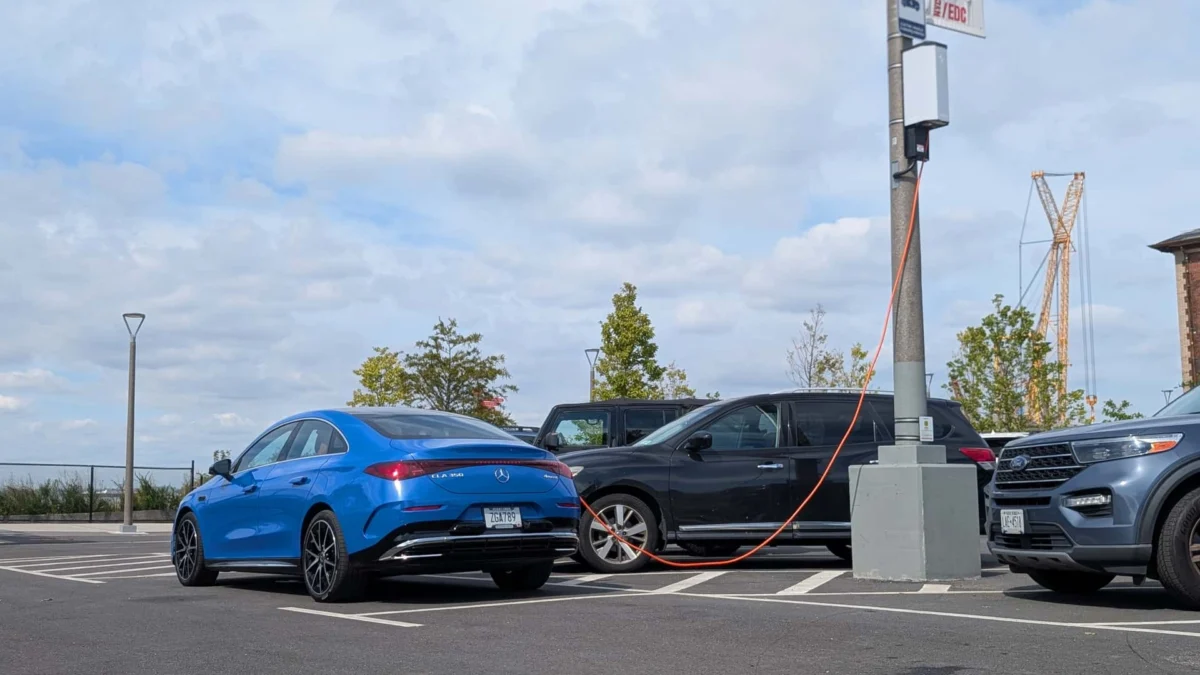
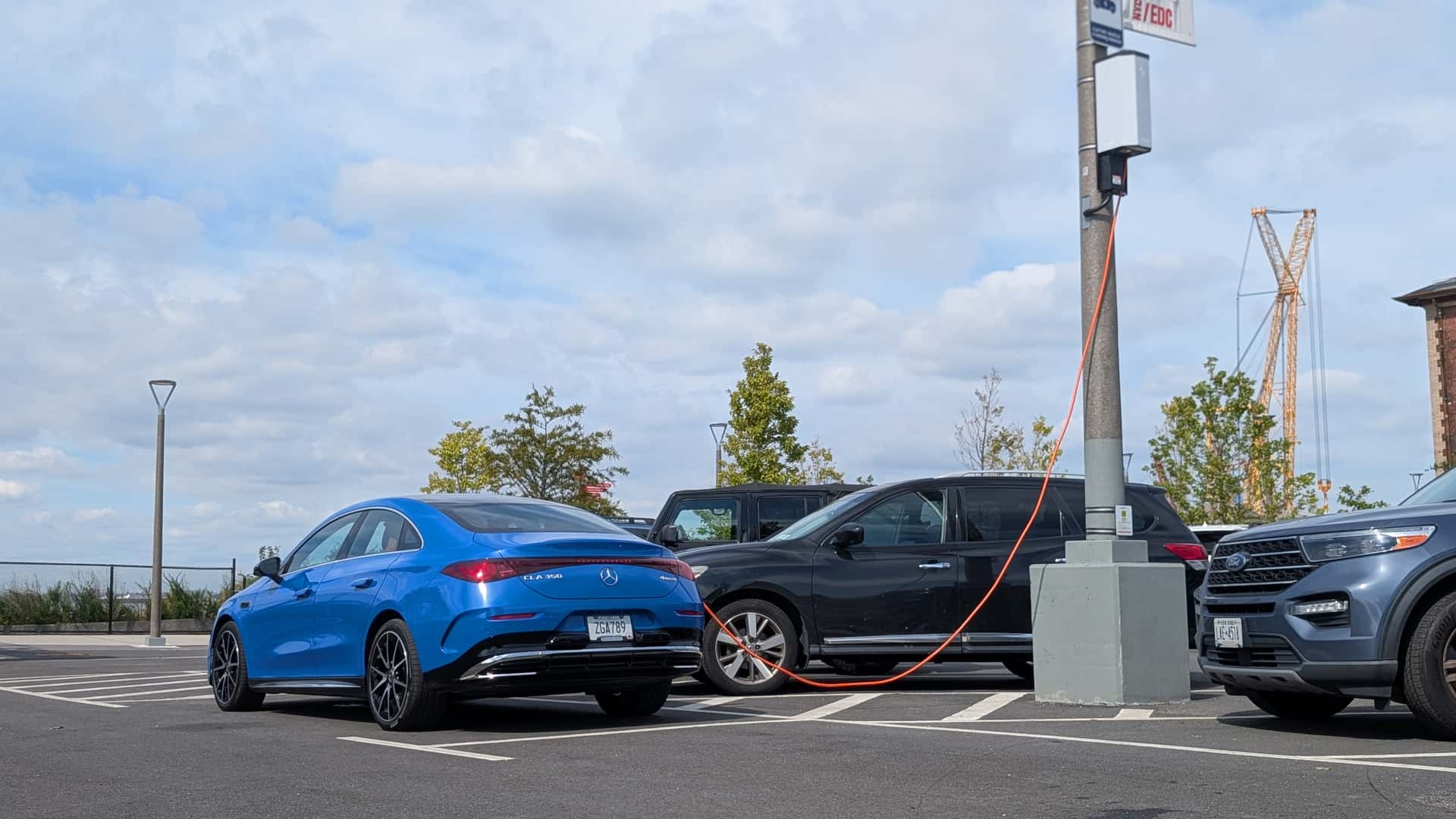
To understand the viability of this technology, one must look at the reality of the street. During a recent test of the Voltpost Air charger in Brooklyn, the experience was markedly different from the clunky, often broken interfaces of traditional public chargers.
The charger is mounted roughly ten feet up the pole—a deliberate design choice to mitigate the risk of vandalism and flood damage. Despite the presence of gas-powered cars flanking the spot, the system’s 25-foot cable easily reached the Mercedes-Benz CLA 350 test vehicle without obstructing the sidewalk.
The activation process is handled via a QR code. While many users—myself included—often lament the reliance on apps over simple credit card readers, the Voltpost interface proved to be seamless. A few taps, and the cable automatically lowered from its perch. Within an hour, the vehicle had gained approximately 30 miles of range—perfect for a standard urban daily commute.
The Economic and Technical Case
The primary advantage of the lamppost-mounted charger is cost-efficiency. According to Luke Mairo, COO and co-founder of Voltpost, the deployment of these units can reduce project costs by as much as 70%.
"The main benefit of using pole-mounted infrastructure is that we don’t do construction and trenching work," Mairo explained. "This means less permitting, significant reductions in the cost to install, and less disruption to the communities."
Crucially, these chargers do not sap power from the streetlights themselves. Instead, they leverage the spare electrical capacity now available due to the city’s massive conversion to LED lighting. By tapping into this existing grid, Voltpost can deliver up to 9.6 kilowatts at 240 volts, providing a robust charge without needing a complete overhaul of the neighborhood electrical substation.
The Competition: Startups vs. The Status Quo
Voltpost is not acting in a vacuum. Other startups are experimenting with different models of urban accessibility:
- It’s Electric: This firm focuses on a model where drivers provide their own cables. By drawing power from adjacent commercial or residential buildings, they remove the need for bulky, sidewalk-obstructing hardware.
- Gravity: Targeting a larger scale, Gravity has installed a 500 kW charging center in Times Square, proving that even the most congested parts of the city can host high-capacity charging if the power management is handled intelligently.
These companies represent a fundamental shift in the philosophy of urban planning: stop waiting for the city to rebuild itself and start working within the existing "bones" of the urban landscape.
The Global Context and Future Implications
New York is, by global standards, a laggard. In London, there are already over 27,000 curbside chargers, many of which are similar lamppost retrofits. While New York currently has only a small network of chargers installed by companies like Flo, the demand is undeniable.
The implications of this shift are profound. If the city can scale these installations—with roughly 600 units already planned for the near future—it could solve the "apartment dweller’s dilemma" that currently prevents millions of New Yorkers from considering an EV.
However, challenges remain. Maintenance is a significant concern. City streets are harsh environments, and charging equipment is frequently subject to damage, weather extremes, and neglect. Voltpost maintains that its systems are rated for temperatures between -22°F and 122°F and are monitored in real-time to allow for remote diagnostics. Yet, the true test will be the "scale test": how these units hold up when deployed by the thousands, used by hundreds of thousands of people, and managed by a variety of third-party operators.
Conclusion: The Path Forward
The transition to electric vehicles in New York City is no longer just about buying the car; it is about re-engineering the sidewalk. By turning the mundane infrastructure of the lamppost into an essential node of the energy grid, the city is finally beginning to address the friction that has held back EV adoption.
The technology is proven, the economics are favorable, and the demand is surging. The success of this initiative will not be measured by the debut of the first charger in Brooklyn, but by the invisibility and reliability of the network five years from now. If the city can successfully integrate these chargers into its chaotic, dense, and vibrant streetscape, it will not only meet its climate goals—it will set a blueprint for every other major, high-density city on the planet to follow.
