

In the shifting landscape of contemporary art, few figures are as preoccupied with the "ghosts" of cultural history as Paris-based artist Mira M. Yang. Her latest exhibition, Ensemble, currently on display at the Kunsthalle Friart in Fribourg, Switzerland, serves as a profound meditation on the permeability of borders—both national and temporal. By excavating the forgotten legacies of figures like the legendary Korean dancer Choi Seung-hee, Yang challenges the static nature of the archive, transforming historical data into a visceral, multisensory exploration of identity, exoticism, and the globalized cultural field.
The Architecture of Transmission: A Two-Chapter Narrative
The exhibition is structured in two distinct chapters, a curatorial choice that mirrors the thematic focus of the work: the circulation and transmission of performance. The first chapter, currently housed in the intimate, rigorous space of the Kunsthalle Friart, will transition to Paris’s prestigious Fondation Pernod Ricard in November. This movement across borders is not merely logistical; it is a conceptual requirement for a body of work that is inherently about "histories and images in transit."

Yang’s methodology is rooted in a practice of archival excavation. During a residency in Paris two years ago, she encountered Chris Marker’s 1959 book Coréennes (Korean Women) in the library of the Museum of East Asian Art in Cologne. The book, a collection of photographs taken by the French filmmaker during a 1956 trip to North Korea, became a catalyst for her current work.
"I’m fascinated by Marker’s way of sampling memory, place, time, myth, and the everyday into a highly sensitizing and poetic cinematic language," Yang explains. However, she also acknowledges the inherent power dynamics within the work. "At the same time, Coréennes is a precious document of everyday life in North Korea in the ’50s, of international socialist cultural programs, and of the beauty of North Korean women as seen through the camera of a Frenchman, which also makes this book a document of the Western male gaze at the time."

Chronology of a Cultural Icon: The Resurgence of Choi Seung-hee
Central to Yang’s investigation is the enigmatic figure of Choi Seung-hee (1911–1969). A pioneer of modern dance in Asia, Choi rose to global prominence in the 1930s, performing across the United States—even sharing a stage with the titan of modern dance, Martha Graham—and throughout Europe. Her career was a complex tapestry of artistic innovation and survival.
Choi’s work often navigated the difficult intersection of cultural authenticity and the expectations of Western audiences. She adapted traditional pan-Asian dances to fit the "exoticized" lens of the West, creating a precursor to what we now recognize as the globalized cultural field. Yet, as Yang points out, there was a sophisticated level of performance in her self-presentation. In one notable piece, Choi embodied her own father, dancing in a manner that synthesized modernist German Expressionism with talchum, the traditional Korean mask dance.

For Ensemble, Yang has meticulously combed through rare performance programs and archival images housed at the Centre National de la Danse in Paris. These fragments—the few remaining traces of a once-dazzling career—provide the blueprint for her reimagining of Choi’s lost choreographies.
Supporting Data: Translating the Body through Technology
Yang’s process of "reanimating" these histories involves a sophisticated marriage of analog and digital mediums. In Cinematheque Moranbong (2025), a work featuring 80 projected slides, Yang re-photographed Marker’s original images through an archival magnifying lens. The distortion caused by the lens serves as a metaphor for the degradation of memory over time. By projecting these images via two Kodak slide projectors onto a single surface in a series of slow, rhythmic dissolves, she creates a "magic lantern" effect that brings the static photographs into a ghostly, kinetic dance.

This commitment to the corporeal is further evidenced in her film Transmissions (2026). Collaborating with contemporary dancer and choreographer Paula Pau, Yang utilized a body-mounted camera to capture performances at sites in Paris that hold historical significance for Choi Seung-hee, such as the Salle Pleyel and the Musée Guimet. The resulting film is not a documentary but an impressionistic, distorted travelogue that overlays contemporary Paris with the specters of the 1930s.
"I wanted to look at bodies and archives that have historically been exoticized and objectified in order to translate them through my own perspective and moment in time," Yang says.

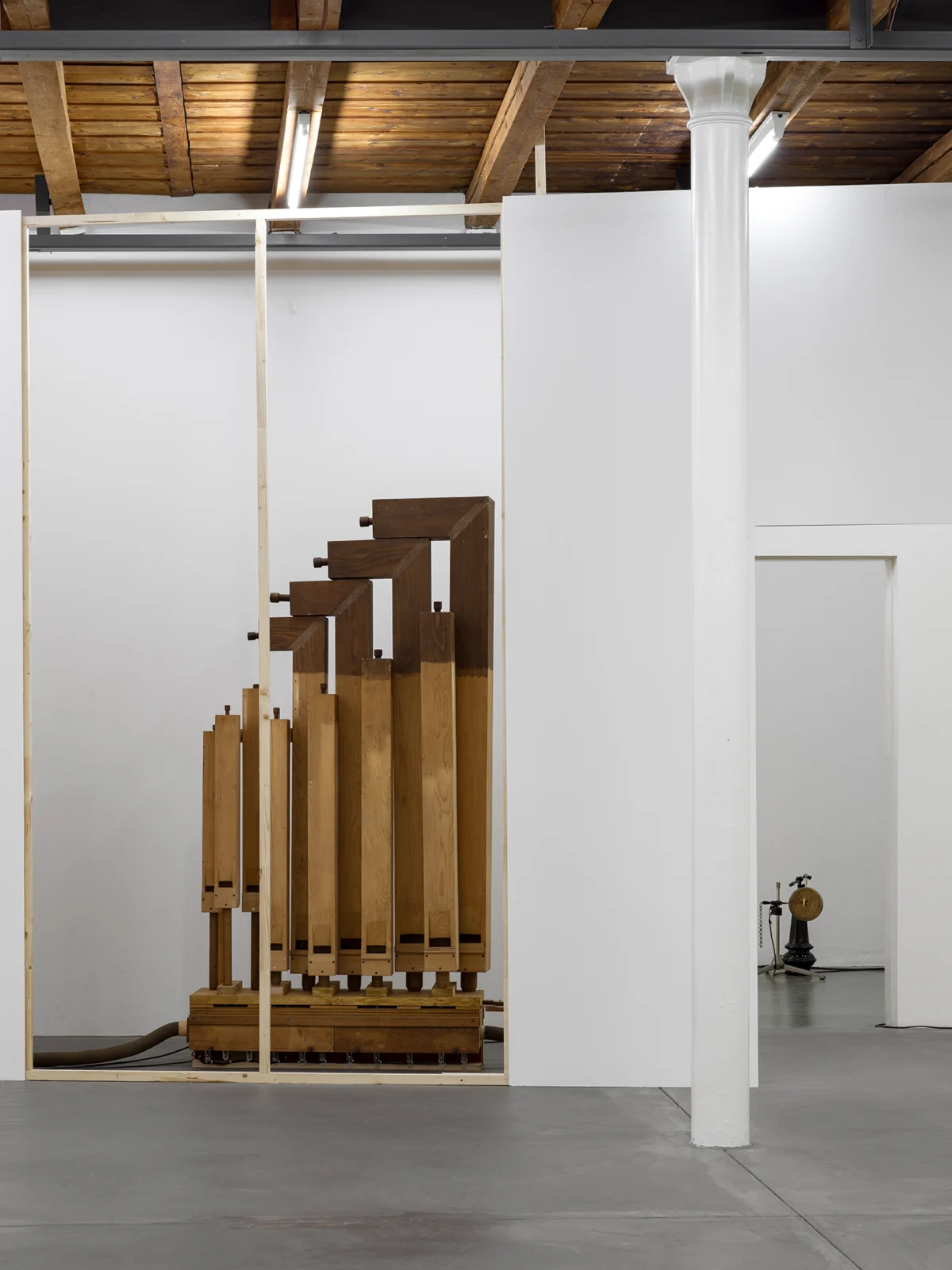
Perhaps the most ambitious component of the exhibition is Yang’s use of Kinetography Laban—a system of movement notation—to translate the elusive, missing musical accompaniments of Choi’s dances into a physical score. This score, interpreted by a deconstructed pipe organ hidden within the gallery walls, generates low, haunting vibrations. The organ functions as a mechanical body, its pneumatic system breathing life into the exhibition space and providing a sonic landscape that replaces the lost, original melodies.
Official Responses and Curatorial Context
The exhibition, curated by Kathrin Bentele, has been lauded for its ability to navigate the tension between the "totalizing pictures" of historical figures and the nuanced reality of their lived experiences. By avoiding a linear, didactic presentation, Yang and Bentele invite the viewer into a "hallucinatory, momentary, fragmented experience."

The institutional support for this project—spanning the Kunsthalle Friart and the Fondation Pernod Ricard—reflects a growing interest in archival art that interrogates the history of cultural exchange. The project is not merely an homage; it is a critical engagement with the "imperialist ideology" that often dictates how we archive and perceive non-Western art history.
Implications: A Call for Collective Memory
The broader implications of Ensemble lie in its questioning of what it means to "live together" in an increasingly fractured society. By titling the show Ensemble—a word signifying a group of musicians working in concert—Yang poses a rhetorical question to her audience: How do we, as a global society, construct a shared history when the very materials of that history are prone to distortion, loss, and appropriation?

Yang’s work acts as a form of resistance against the erasure of non-Western cultural practitioners. By restaging these choreographies, she does not attempt to "fix" or "complete" the archive; rather, she emphasizes the beauty of the gaps. The "missing" sounds and the distorted images are, in her view, part of the truth of the historical record.
As the exhibition moves toward its Paris iteration in late November, the conversation surrounding Yang’s work will likely intensify. Her ability to synthesize the political with the poetic, and the mechanical with the organic, places her at the forefront of a generation of artists who view the archive not as a graveyard, but as a site of potential rebirth.

"Reanimating or restaging this material through performance is a way of countering totalizing pictures of Choi, her legacy, and imperialist ideology," Yang concludes. Through Ensemble, she has successfully created a space where the past is not merely remembered, but felt, heard, and—most importantly—reclaimed.
Exhibition Details:
- Exhibition: Mira M. Yang: Ensemble
- Curator: Kathrin Bentele
- Venue 1: Kunsthalle Friart Fribourg, Switzerland (September 12 – November 13, 2026)
- Venue 2: Fondation Pernod Ricard, Paris (Opens November 23, 2026)
