

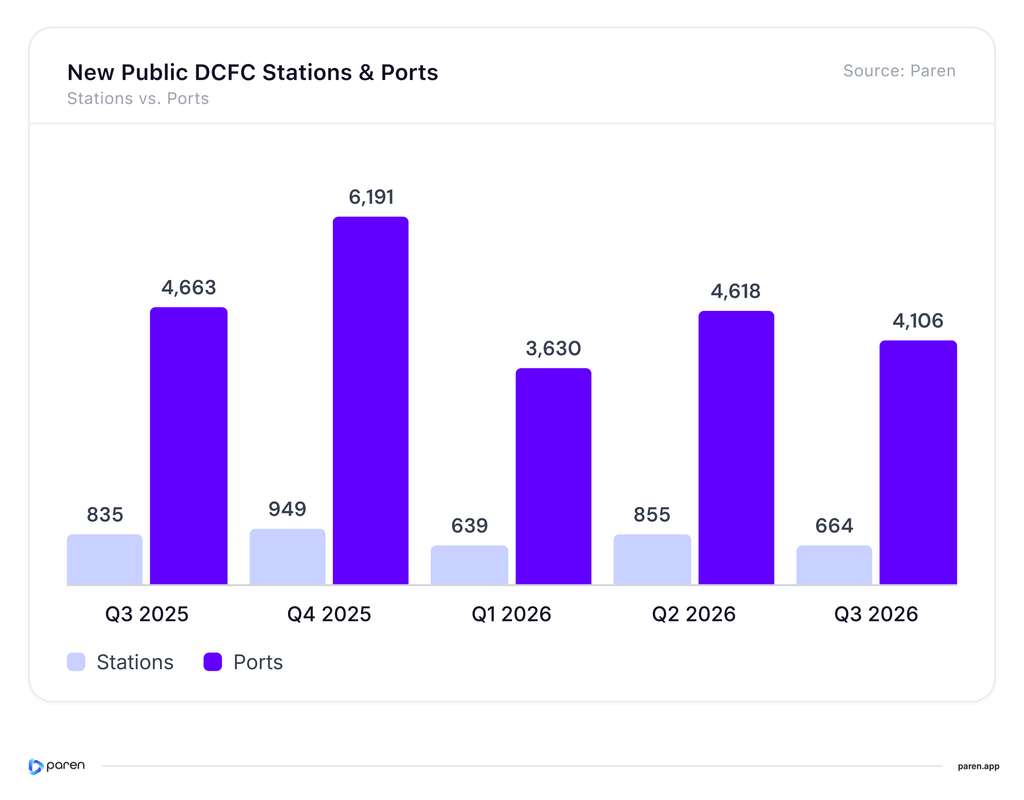
The landscape of electric vehicle (EV) infrastructure in the United States reached a significant, albeit nuanced, milestone in the third quarter of 2026. According to the latest data from the charging analytics platform Paren, the U.S. public fast-charging network officially surpassed the 80,000-port threshold. However, this achievement occurs against a backdrop of cooling growth rates, as the pace of new installations saw a marked deceleration compared to the same period in 2025.
As EV sales experience a cooling effect—influenced by a broader economic slowdown and a strategic rollback of several federal EV-friendly initiatives—the charging industry is recalibrating its deployment strategies. While the sheer volume of new hardware hitting the ground has dipped, the underlying trend is shifting from a "quantity over quality" model to a more sophisticated strategy focused on power, reliability, and strategic placement.
A Statistical Snapshot: Growth Amidst Contraction
The numbers provided by Paren for the third quarter are striking. The U.S. added 4,106 new public fast-charging ports across 664 stations. When compared to year-over-year performance, this represents a 12% decline in total ports and a significant 20% drop in new station deployments.
For industry observers, these figures are not necessarily a sign of a dying market, but rather a reflection of the "maturation phase" of the infrastructure build-out. The rapid, expansive growth seen in 2024 and early 2025 was fueled by aggressive government subsidies and a "gold rush" mentality among networks trying to capture prime real estate. Today, the focus has shifted toward operational efficiency and the deployment of high-voltage hardware that meets the demands of next-generation EV architectures.
Despite the percentage-based decline in deployment speed, the network is undeniably growing. The addition of 80,000-plus ports is a critical psychological and practical benchmark for the American charging grid, providing the backbone necessary to support the millions of EVs currently traversing the nation’s highways.
Chronology of the Q3 Shift
The slowdown in deployment was not uniform across the industry, but rather concentrated among the largest players, most notably Tesla.
The Tesla Effect
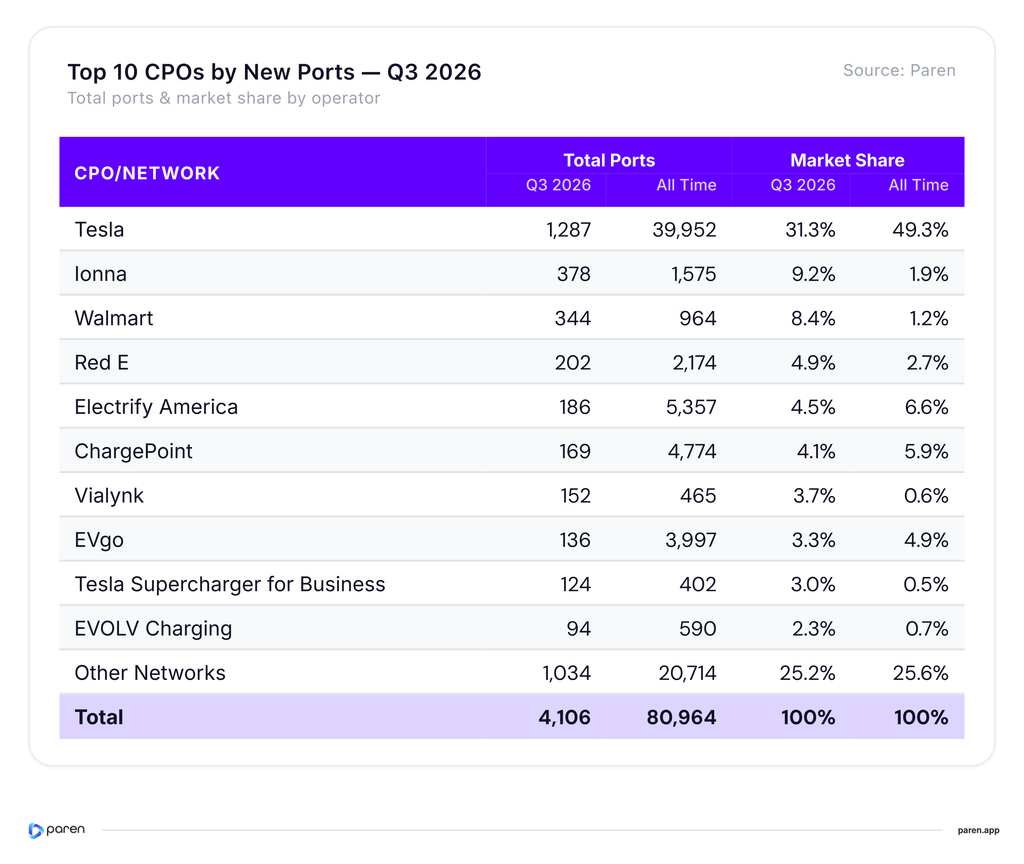
Tesla’s Supercharger network, which has long served as the industry’s gold standard for reliability and coverage, accounted for a substantial portion of the quarterly slowdown. Between July and September, Tesla added 1,287 new ports. While this is an impressive figure for any single entity, it represents 533 fewer ports than the automaker installed during the same period in 2025.
Industry analysts point to a strategic pivot within Tesla. The company is currently reallocating resources toward its new B2B (business-to-business) division, which sells Supercharger hardware to third-party retailers and commercial property owners. While this new line of business added 124 ports during the quarter, it does not yet compensate for the reduced velocity in the company’s internal network expansion. Despite this, Tesla remains the single largest contributor to the U.S. fast-charging capacity, maintaining its dominance even as it optimizes its deployment pace.
The Rise of the Consortiums and Retail Giants
While the leader slowed down, other players gained momentum. Ionna—the high-profile consortium backed by major automakers including BMW, General Motors, Honda, Hyundai, Kia, Mercedes-Benz, and Stellantis—has emerged as a formidable challenger. In the third quarter, Ionna nearly tripled its year-over-year rollout, successfully bringing 378 new ports online. This reflects a coordinated, long-term strategy to reach its goal of 30,000 chargers in North America by the end of the decade.
Retail giant Walmart also cemented its position as a critical infrastructure partner, contributing 344 new ports in the third quarter. By leveraging its vast footprint of parking lots, Walmart is addressing one of the primary "range anxiety" drivers: the desire for safe, well-lit, and amenity-rich charging stops.
Regional Dynamics and the "Charging Desert" Challenge
The geographic distribution of new charging stations continues to mirror existing EV adoption trends, reinforcing the divide between high-adoption states and those where EV ownership remains a niche endeavor.
California continues to dominate the map, accounting for 87 of the new stations added in Q3. However, the data reveals a fascinating trend: the next three most active states were all governed by Republican leadership. Texas added 66 stations, while North Carolina and Georgia each added 26. This indicates that while coastal states are the traditional strongholds for EVs, the "Sun Belt" is becoming a critical corridor for infrastructure investment.
Despite these gains, the concentration remains heavily skewed toward urban and suburban hubs. 42% of all new openings occurred in just five states: California, Texas, Florida, Illinois, and New York. At the municipal level, the Dallas-Fort Worth and Houston metropolitan areas led the way, followed by Oklahoma City and Kansas City.
The most concerning statistic from the report is that rural areas accounted for only 10% of all new ports added during the quarter. This imbalance highlights the "charging desert" issue. For EV adoption to reach mass-market levels, the charging industry must find a sustainable economic model for deploying high-speed chargers in less densely populated, long-distance corridors where utilization rates are initially lower but essential for cross-country travel.
Supporting Data: The Power Shift
One of the most encouraging takeaways from the Q3 report is the rapid transition toward high-powered, future-proof hardware. The industry is effectively abandoning the "standard" fast chargers of yesteryear in favor of stations capable of delivering 250 kW or more.
- The 250 kW Threshold: Approximately 73% of all new ports added in the third quarter are capable of delivering at least 250 kW. This is a significant jump from 60% just one year ago.
- The 400 kW Movement: Stations capable of 400 kW have become the industry standard for new installations, driven by the needs of modern 800-volt electric architectures.
- Tesla’s V4 Push: Tesla is accelerating the rollout of its V4 Supercharger cabinets, which boast a 500 kW capacity. Currently, there are 42 locations and 487 ports capable of these extreme speeds, providing a glimpse into the future of "refueling-like" charging times.
This push for power is not merely a technical flex; it is a necessity for the next generation of luxury and performance EVs. Vehicles like the Lucid Gravity, the upcoming electric Porsche Cayenne, and the BMW iX3 are designed to pull massive amounts of power, and the infrastructure is finally beginning to catch up.
Implications for the Consumer
For the average consumer, this shift has two primary implications:
- The "Road Trip" Reality: The industry is moving away from destination-based charging toward "travel center" charging. By placing 400 kW chargers at gas stations and travel centers, networks are aiming to replicate the convenience of traditional gas stops. The goal is to get drivers back on the road in 15 to 20 minutes, a target that is becoming increasingly achievable with modern hardware.
- Broadened Accessibility: Higher-powered charging is no longer the exclusive domain of six-figure luxury cars. Affordable platforms, such as the upcoming Rivian R2 and the widely popular Hyundai Ioniq 5 and Kia EV6, are built to exploit these high-voltage stations. This democratization of charging speed is critical for mainstream EV adoption.
The Road Ahead: Efficiency and Utilization
While the headlines regarding the "slowdown" in deployment may seem discouraging, the data suggests the market is simply shifting from a phase of raw expansion to a phase of strategic optimization. The record-breaking 17.6 million charging sessions in July 2026 prove that the demand for public charging remains robust, even if the pace of new installations has moderated.
The industry’s future will be defined by how effectively it can bridge the gap in rural America and how quickly it can replace legacy, lower-powered hardware with the high-speed systems that modern drivers demand. As federal policies shift and market competition between networks like Ionna and legacy players like Tesla intensifies, the American driver is the ultimate beneficiary: they are gaining a more reliable, faster, and more widespread charging network that, for the first time, feels like it can genuinely compete with the legacy of the internal combustion engine.
As we look toward the end of 2026 and into 2027, the focus will undoubtedly remain on reliability and throughput. If the Q3 data is any indication, the "charging revolution" isn’t stopping—it’s just getting smarter.
