

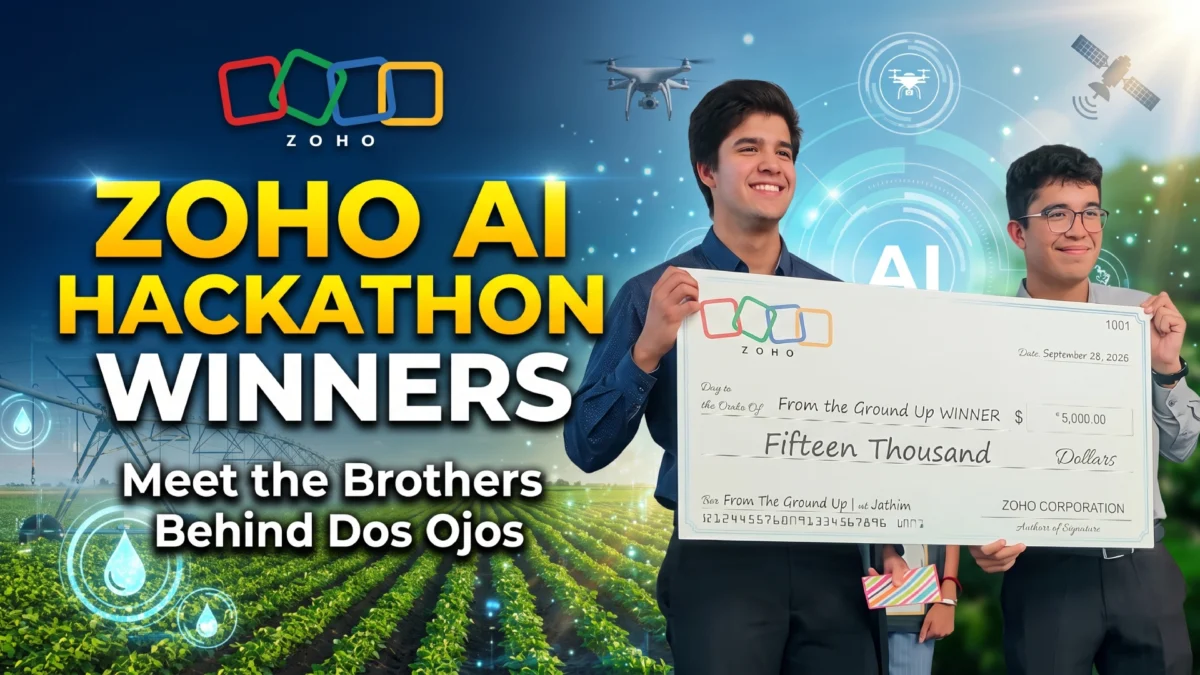
For farmers in drought-prone regions, water is not merely a resource; it is the lifeblood of their livelihood. When the taps run dry, the consequences ripple outward, destroying crops, decimating livestock, and destabilizing local economies. For brothers Edgar and Eduardo Bello Gonzalez, this was not an abstract environmental concept—it was their childhood reality.
Growing up in Mexico, the brothers witnessed the devastating effects of systemic water shortages firsthand. After relocating to the Rio Grande Valley (RGV) in Texas, they noticed the same warning signs of ecological strain threatening the local agricultural community. Determined to bridge the gap between high-level technology and the needs of small-scale farmers, the brothers developed Dos Ojos, an AI-powered crop monitoring system that recently captured the top prize at Zoho’s inaugural "From the Ground Up" AI Hackathon.
The Genesis of Dos Ojos: A Solution Born from Experience
The inspiration for Dos Ojos is deeply personal. Edgar and Eduardo, both students at the University of Texas Rio Grande Valley (UTRGV), spent their formative years in Mexico during periods of severe drought. They recall a time when water access was strictly rationed, affecting everything from daily hygiene to the regional food supply.
Upon moving to the Rio Grande Valley, the brothers observed that the agricultural landscape shared striking similarities with their hometown. They saw an opportunity to intervene. While large-scale commercial farms often have the capital to invest in proprietary, high-tech irrigation sensors and proprietary data platforms, smaller agricultural operations are frequently left behind, unable to justify the high costs of such technology.
The brothers decided to change this dynamic. By leveraging their complementary skills—Edgar’s expertise in computer science and electrical engineering, and Eduardo’s focus on systems planning, outreach, and logistics—they designed a tool that prioritizes accessibility and simplicity.
How Dos Ojos Works: The Technical Architecture
At its core, Dos Ojos is a multi-layered monitoring system designed to provide actionable intelligence without the barrier of steep technical learning curves. The system functions through three primary components:
1. Satellite Imagery Integration
The platform utilizes free, publicly available data from the Sentinel-2 satellite, provided via AWS. Sentinel-2 orbits the Earth regularly, capturing multispectral images that track crop health. The AI system fetches the most recent data for a user’s specific farm, comparing it against historical data from months or even years prior to identify deviations in crop color and vitality.
2. Drone-Based Computer Vision
For farmers seeking higher granularity, the system integrates drone imagery. Edgar developed a series of neural networks—trained exclusively using NumPy—to perform real-time computer vision analysis. These networks can count individual crops, measure their height, and compare the condition of a specific plant against its neighbors to detect localized stress.
3. SMS-Based Communication
Perhaps the most innovative aspect of the design is the interface. Recognizing that many farmers are in the field and lack consistent access to high-speed internet or complex dashboards, the brothers built a bilingual SMS-based chatbot. Farmers simply text their location or a Google Maps link to the system. The AI then processes the data and sends back concise, actionable irrigation recommendations.
The Role of Artificial Intelligence
The "intelligence" behind Dos Ojos is twofold. First, it employs a large language model (LLM) to interface with the farmer. To prevent "hallucinations"—a common issue with generative AI—the system validates all recommendations against soil moisture and irrigation data before sending a text. If the numbers do not align, the AI is programmed to re-evaluate its findings.
Second, the computer vision models act as the system’s "eyes." By training three separate neural networks to handle crop counting, height measurement, and comparative health analysis, the system can distinguish between a crop that is suffering from drought and one that has simply been harvested.
Chronology of the Project
- The Problem Identification: Years of observing drought in Mexico and the Rio Grande Valley created a long-standing desire to help, which remained in the background of the brothers’ studies.
- The Hackathon Catalyst: Edgar discovered the Zoho "From the Ground Up" AI Hackathon via a university announcement. Recognizing the potential to turn their research into a real-world tool, he signed them up.
- Rapid Development: Once they were selected as finalists, the brothers shifted into high gear, dividing labor between technical development (Edgar) and logistics/outreach (Eduardo).
- The Competition: The brothers traveled to California to present Dos Ojos, where their clear vision, technical competence, and budget planning impressed the judges, securing their win.
- Post-Hackathon Outreach: Following their victory, the brothers began working with the USDA and local agricultural connections to begin real-world testing and field validation.
Implications for Small-Scale Agriculture
The most significant implication of the Dos Ojos project is the democratization of technology. By opting for SMS over a proprietary app, the brothers have removed the "digital divide" that often prevents smaller farms from adopting modern solutions.
"We know that most of the farmers are not really up to date with technology," Edgar noted during an interview with Leland McFarland. "We wanted to make it the most user-friendly as possible."
This philosophy aligns with the current shift in agricultural tech, where the focus is moving away from "big data" dashboards toward "small data" insights that provide immediate, practical value. The system is designed to provide recommendations, not mandates, preserving the autonomy of the farmer who possesses the localized knowledge that no AI can replicate.
Official Responses and Future Outlook
The brothers are currently navigating the transition from a prototype to a scalable tool. Their immediate goals include:
- Establishing Server Infrastructure: Moving from a local laptop-based environment to a robust server network to handle increased demand.
- Expanded Field Testing: Working with the USDA to connect with more farmers to refine the accuracy of their recommendations.
- Feature Expansion: The brothers are already researching how to expand the AI’s capabilities to detect agricultural pests or specific plant diseases based on visual signatures.
While the project is still in its infancy, the potential for impact is substantial. By lowering the barrier to entry, the Bello Gonzalez brothers are proving that the most effective technological innovations are often those that solve the most human problems.
Conclusion: The Path Ahead
The journey of Edgar and Eduardo Bello Gonzalez serves as a powerful case study for aspiring innovators. They did not wait for a massive budget or a venture-capital-backed enterprise to begin solving a problem they cared about. Instead, they used the tools readily available to them—public satellite data, basic drone hardware, and their own coding skills—to create a system that addresses a genuine, urgent need.
As they continue to balance their academic responsibilities with the growth of Dos Ojos, the agricultural community will be watching. If they succeed in making this technology a staple for small farmers in the Rio Grande Valley, they may well provide a blueprint for how AI can be effectively integrated into agriculture globally, one text message at a time. The brothers’ story is a testament to the fact that meaningful innovation begins with a simple, yet profound question: "How can we help?"
