

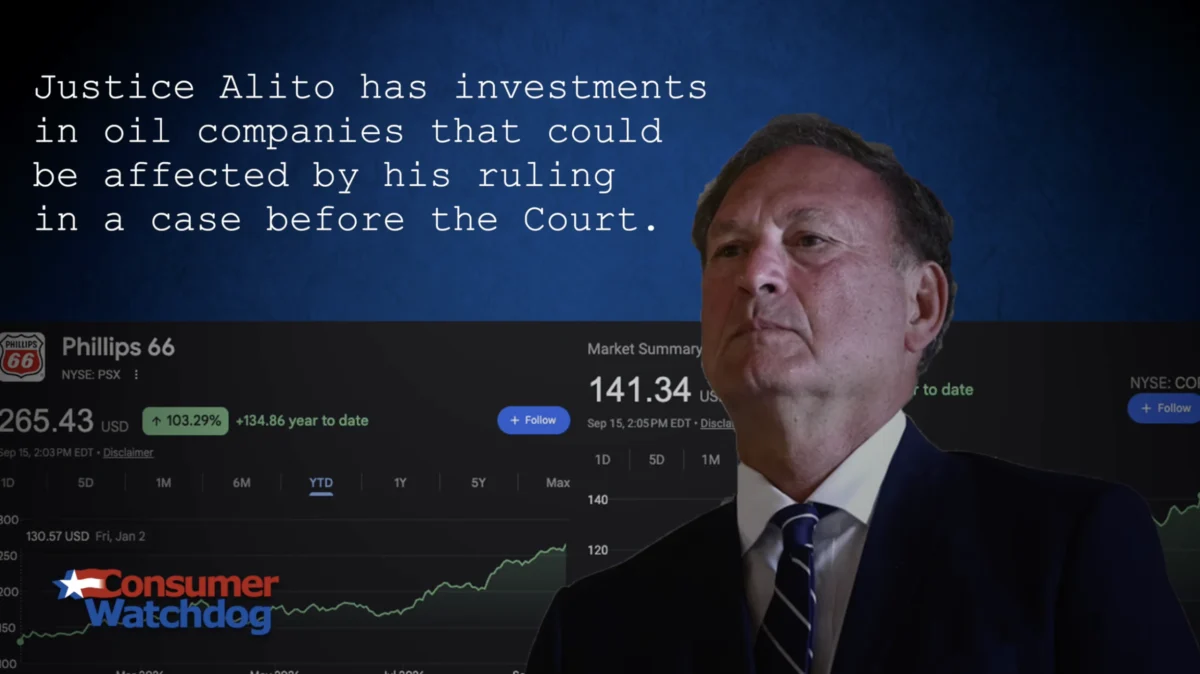
The U.S. Supreme Court convened this past Monday to hear arguments in the high-stakes climate liability case Suncor v. Boulder, but the bench was conspicuously short-handed. Justice Samuel Alito, a long-standing member of the Court’s conservative wing, was absent from the proceedings, having formally recused himself just days prior.
This unexpected departure from the bench marks a pivotal moment in the ongoing legal battle between local governments and the fossil fuel industry. For years, cities and states have sought to hold oil giants accountable for climate deception, arguing that these corporations knowingly misled the public about the environmental consequences of their products. Now, with the Court operating at an 8-judge capacity, the legal landscape for these climate tort cases has been fundamentally altered.
The Catalyst: Consumer Watchdog’s Strategic Intervention
The recusal did not happen in a vacuum. While various advocacy groups had pressured Justice Alito to step aside for months, citing his financial holdings in the energy sector, it was a specific, evidence-based report from Consumer Watchdog that ultimately tipped the scales.
The research unveiled a direct, documented link between the Justice’s personal stock portfolio and the specific legal arguments being presented to him. Consumer Watchdog identified that Alito held stock in major oil companies, including Phillips 66 and ConocoPhillips. Simultaneously, trade associations representing these very companies were filing amicus briefs in Suncor v. Boulder, explicitly warning the Court that a ruling against the industry would trigger a "snowball" of legal liability.
By highlighting that these companies had formally disclosed to their own investors that climate litigation posed a "material risk" to their bottom line, Consumer Watchdog provided a concrete argument: Justice Alito’s personal financial interests were not just tangentially related to the industry, but were directly tied to the outcome of this specific case.
Chronology of a Judicial Reversal
The path to Alito’s recusal was a slow burn that accelerated into a sudden shift.
- Months of Public Pressure: For over a year, environmental groups and judicial ethics watchdogs had raised concerns regarding Justice Alito’s investments. However, the Justice had previously maintained that his holdings did not rise to the level of a conflict of interest necessitating recusal.
- The Consumer Watchdog Report: In the week leading up to the Suncor arguments, Consumer Watchdog released a detailed dossier mapping the overlap between Alito’s portfolio and the industry’s own internal warnings regarding climate litigation.
- The "Material Risk" Disclosure: The report showcased how the fossil fuel industry—through its trade groups—was arguing in court that the Suncor case was an existential threat. This effectively validated the "financial interest" criteria for recusal.
- The Realization: Justice Alito, in an interview regarding his new book, admitted that as he "immersed" himself in the arguments presented by both sides, he re-evaluated his position.
- Formal Recusal: Days before the hearing, the Court announced Alito’s recusal, removing him from the Suncor case.
Understanding the "Snowball" Argument
The core of the issue in Suncor v. Boulder is whether climate-related tort claims—lawsuits based on state law, such as fraud or public nuisance—should be heard in state courts or preempted by federal law.
Industry giants argue that climate change is a global, federal issue that cannot be managed by a patchwork of state-level lawsuits. Conversely, local governments argue that the companies engaged in deliberate, deceptive marketing campaigns that harmed their specific jurisdictions, and therefore, they should be entitled to trial by jury in state courts.
In his candid admission, Justice Alito acknowledged the weight of the industry’s own narrative:
"This is a case in which the petitioner and the petitioners’ amici are arguing that a decision against them would start a snowball rolling down a hill which could ultimately lead to devastating consequences for the oil and gas industry."
By admitting that the industry perceived the outcome as a potential existential crisis, Alito essentially confirmed that his financial interest—as a shareholder in those companies—was directly at risk.
Official Responses and Judicial Ethics
The recusal has sparked a broader conversation about judicial ethics, particularly concerning the Supreme Court’s lack of a binding code of conduct that mirrors the standards of lower federal courts.
Alito’s explanation, delivered with a sense of reluctance, provides a rare window into the internal calculus of a Supreme Court Justice. "There is a second question and that is whether the justice’s financial interest might be substantially affected by the outcome of the case," Alito noted. "I did it reluctantly, but I thought that was what I ought to do under those particular circumstances."
Legal scholars have noted that this rare acknowledgment of personal financial conflict sets a significant precedent. It suggests that when litigants—or public interest researchers—can clearly demonstrate that a Justice has a "material stake" in the outcome, the pressure for transparency becomes difficult to ignore.
The Implications of a 4-4 Split
With Justice Alito recused, the Court is left with eight Justices. In the event of a 4-4 deadlock, the ruling of the lower court—which, in the case of Suncor v. Boulder, has generally favored the plaintiffs—would remain in effect.
1. The Preservation of State Tort Law
A 4-4 split would effectively deny the fossil fuel industry the federal-level victory they have been seeking. It would leave the door open for state courts to proceed with climate litigation. For cities like Boulder, this means the opportunity to present evidence of climate deception to a jury remains intact.
2. A Deterrent to Future Industry Strategies
The industry’s argument that these lawsuits represent a "snowball" of liability has been validated by the highest court in the land. Ironically, by emphasizing the existential threat of these lawsuits to win the argument on judicial conflict, the industry may have unintentionally underscored the gravity and legitimacy of the local governments’ grievances.
3. Strengthening the "Public Interest" Research Model
The successful outcome of Consumer Watchdog’s campaign highlights a shift in how civil society interacts with the judiciary. By providing the Court with the specific, data-driven "material risk" evidence that trade associations were already sharing with investors, they provided the judiciary with an objective basis for recusal that went beyond mere political pressure.
Looking Ahead: The Future of Climate Accountability
As the legal world watches the Suncor proceedings, the focus shifts to the potential for a deadlock. If the Court is indeed evenly divided, the legal battle will likely continue in lower courts, where the fossil fuel industry will face the prospect of jury trials.
The precedent set here is twofold. First, it affirms that the financial holdings of Supreme Court Justices are not immune to public scrutiny, especially when those holdings are directly impacted by the litigation before them. Second, it reaffirms that the climate accountability movement is a serious, credible legal challenge that major corporations are taking to the highest levels of government to stop.
As the song suggests, "sometimes you get shown just a little of the light in the strangest of places." For those advocating for climate justice, the "light" appeared in the form of a rare, reluctant recusal that may prove to be the most significant turning point in the battle to hold Big Oil accountable. Whether or not this leads to a permanent shift in how climate cases are handled at the federal level remains to be seen, but for now, the snowball continues to roll—and the industry is watching with nervous anticipation.
Supporting Data and Context
- The Economic Argument: Fossil fuel companies have consistently reported to the SEC that litigation regarding climate change is a "material risk." These disclosures are intended to protect shareholders, but they have now become the primary evidence used to argue for the disqualification of judges with oil-linked portfolios.
- The Preemption Doctrine: The core legal battle revolves around whether federal environmental laws (like the Clean Air Act) "preempt" state-level tort claims. The industry argues that the Supreme Court must intervene to stop a national wave of state-level rulings.
- The Judicial Ethics Debate: Unlike other federal judges, Supreme Court Justices are not subject to a formal, enforceable code of ethics. This case has provided lawmakers with renewed ammunition to demand legislative reform, arguing that the Suncor recusal shouldn’t have required months of public pressure, but should have been the standard, automatic procedure.
The coming weeks will determine whether the Court can reach a definitive ruling or if the deadlock will preserve the status quo of state-court jurisdiction. Either way, the impact of the Suncor case has already reached far beyond the courtroom walls, setting a new benchmark for how we measure the intersection of private wealth, corporate liability, and the future of our climate.
