

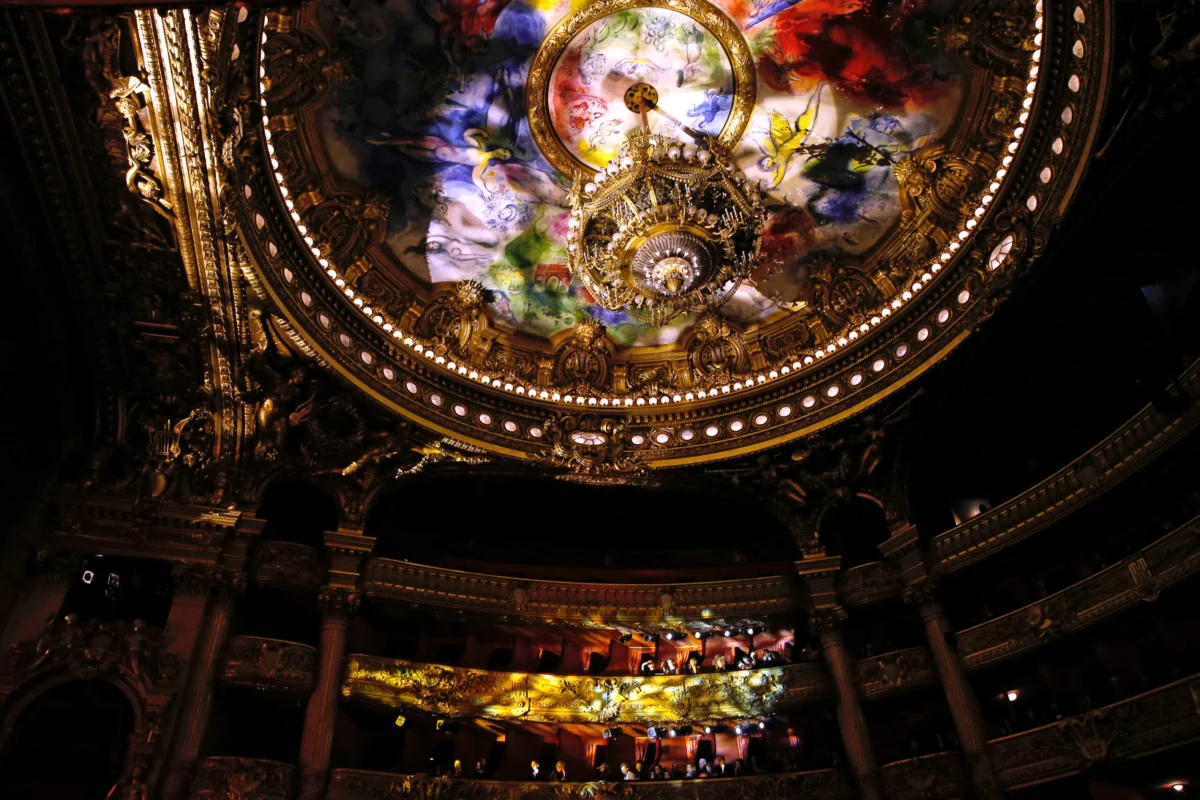
For over six decades, the ceiling of the Palais Garnier in Paris has been defined by the vibrant, dreamlike brushstrokes of Marc Chagall. Commissioned in 1962 by then-Minister of Cultural Affairs André Malraux, Chagall’s 2,400-square-foot masterpiece serves as a modernist crown jewel for one of the world’s most opulent opera houses. Yet, beneath this celebrated canopy lies a ghost: the original, now-hidden fresco painted by the 19th-century academic master Jules-Eugène Lenepveu.
As the Palais Garnier prepares for a massive, five-year renovation cycle beginning in 2027, a long-simmering dispute has erupted into a potential legal crusade. The descendants of Lenepveu, led by his great-great-great-great-grandnephew, Arnaud Carayon, are demanding that the historical integrity of the opera house be restored—or, at the very least, shared.
The Forgotten Master: Who Was Jules-Eugène Lenepveu?
To understand the intensity of this campaign, one must first understand the stature of the man who occupied the ceiling before Chagall. Jules-Eugène Lenepveu (1819–1898) was not merely a decorator; he was an academic titan of the Second Empire. A Prix de Rome winner and a celebrated teacher, Lenepveu was the darling of the French art establishment. He is perhaps best remembered today for his monumental cycle of paintings depicting the life of Joan of Arc, which adorn the Panthéon in Paris.
In the mid-19th century, when Charles Garnier designed the eponymous opera house that would become the epicenter of Parisian cultural life, he selected Lenepveu to execute the ceiling mural. Garnier, a perfectionist who obsessed over every architectural detail—from the grand staircase to the smallest brass doorknob—viewed Lenepveu’s work as an integral component of the building’s holistic design.
However, the tide of art history is often cruel. As the 20th century dawned, the rigid, classicist precision of the academic style fell out of favor, ruthlessly eclipsed by the rise of Impressionism and the subsequent modernist avant-garde. Lenepveu, once a star of the Salon, faded into obscurity, relegated to the footnotes of history books.
A Secret Commission: The Chagall Intervention
The transformation of the ceiling in 1962 remains one of the most controversial aesthetic interventions in French cultural history. When André Malraux approached Marc Chagall to create a new ceiling, he did so with the intent of bridging the gap between the building’s opulent history and the vibrant energy of 20th-century art.
Chagall, then 77 years old, worked in secret to create 24 wedge-shaped canvases. These canvases were not painted directly onto the ceiling; rather, they were mounted on panels designed to be installed over the existing structure. When the work was unveiled, the public reaction was polarized. Traditionalists were horrified at the "desecration" of the Garnier’s classicist aesthetic, while modernists hailed it as a triumphant fusion of old and new.

For sixty years, the Chagall ceiling has been treated as a permanent fixture. Yet, according to Arnaud Carayon, the installation was never meant to be a permanent erasure. He argues that the very nature of the wedge-shaped canvases, which were engineered to be removable, implies that the original fresco was intended to remain protected—and eventually revealed—beneath.
Chronology of a Cultural Conflict
- 1875: The Palais Garnier opens, featuring the original ceiling fresco by Jules-Eugène Lenepveu, commissioned personally by architect Charles Garnier.
- 1923: The Lenepveu ceiling is officially listed as a protected historic monument, cementing its status as an essential element of French cultural heritage.
- 1962: André Malraux commissions Marc Chagall to paint a new ceiling. The panels are installed over the Lenepveu fresco.
- 2022: Arnaud Carayon successfully completes a renovation of Lenepveu’s tomb in Angers, reigniting public interest in the artist’s legacy.
- 2023–2026: Carayon begins a formal lobbying campaign, writing to the French Ministry of Culture and President Emmanuel Macron, calling for the exposure of the Lenepveu work.
- 2027–2032: The scheduled closure of the Palais Garnier for extensive renovations, creating a window of opportunity for the proposed ceiling swap.
The Case for Alternation: Carayon’s Proposal
Arnaud Carayon, who recently saw a 260-work retrospective of Lenepveu’s art at the Musée des Beaux-Arts in Angers, views the current state of the ceiling as an act of historical erasure. "Today, everyone has forgotten Lenepveu," Carayon remarked in an interview. "Unfortunately, he was swept away by the wave of Impressionism, but in his time, he was a star. We are not asking for the destruction of the Chagall; we are asking for the restoration of the Garnier’s original intent."
Carayon’s proposal is a diplomatic compromise: he suggests that the opera house adopt a rotating exhibition schedule. Under his plan, the ceiling would alternate between the Lenepveu and the Chagall every decade. Because the Chagall panels are, by design, modular, Carayon insists that such a rotation is not only physically possible but a necessary acknowledgment of the building’s multi-layered history.
His appeal to President Emmanuel Macron highlights the legal weight of the 1923 historic monument designation. By keeping the Lenepveu ceiling obscured, he argues, the state is failing to properly maintain a listed monument, effectively hiding a piece of state-protected art from the public eye.
Official Responses and the Weight of Heritage
The management of the Paris Opera is caught in a delicate position. Alexander Neef, the current director of the Paris Opera, addressed the brewing storm in an interview with Le Monde. Neef acknowledged the legitimacy of the descendants’ claims while maintaining a cautious stance on the future of the opera house.
"The debate over the Chagall ceiling has gone on for more than 60 years," Neef stated. "The Lenepveu ceiling has been listed as a historic monument since 1923, so its heritage value is recognized. That his descendants wish to defend his memory is legitimate."
However, Neef faces the challenge of public perception. To many, the Chagall ceiling is the ceiling of the Palais Garnier. It has become an icon of Paris, attracting millions of tourists who specifically visit to gaze upon the whimsical, colorful figures that dance across the opera house’s dome. Removing it, even temporarily, would be a massive cultural undertaking that could trigger a backlash from the global art community.

Broader Implications: Preservation vs. Evolution
The standoff between the Lenepveu estate and the Paris Opera raises profound questions about the nature of heritage preservation. Should a historic building be frozen in time, reflecting the exact vision of its architect, or should it be allowed to evolve, incorporating the layers of art history that define the passage of time?
Those who support the Chagall argue that the ceiling represents a "living heritage." Art is meant to be experienced, and the Chagall is a masterpiece in its own right. They contend that stripping it away to reveal a 19th-century fresco—however well-regarded in its time—would be an act of historical revisionism that diminishes the opera house’s role as a site of ongoing artistic innovation.
Conversely, the Lenepveu camp argues that the protection of historic monuments is a legal and moral duty. If a work is listed as a national treasure, it should be visible to the public. By allowing the Lenepveu to remain in darkness, the French state is effectively censoring a part of its own history, prioritizing a popular modernist work over the structural and artistic foundation of the building.
The Road Ahead: Legal and Logistical Challenges
As the 2027 renovation date approaches, the pressure on the French government to provide a definitive answer is mounting. Carayon’s intent to take the matter to court could force a judicial review of the site’s preservation status. If a judge were to rule that the Lenepveu fresco must be made visible, the opera house would be forced to navigate a logistical nightmare: the structural safety of the ceiling, the preservation of both the original fresco and the Chagall panels, and the financial cost of such a complex rotation.
Furthermore, there is the question of conservation. The original Lenepveu fresco has been covered for over 60 years. Experts would need to assess the condition of the pigments, the state of the plaster, and the impact of the installation process on the underlying work. The very act of uncovering it could cause irreparable damage if not handled with the utmost technical care.
Conclusion: A Tale of Two Ceilings
The battle over the ceiling of the Palais Garnier is more than a dispute between a historicist family and a modern institution; it is a meditation on memory. As France balances its deep reverence for its academic past with its celebration of modernist brilliance, the case of the hidden fresco serves as a poignant reminder that history is never truly gone—it is only waiting to be rediscovered.
Whether or not the Lenepveu ceiling ever sees the light of day again remains to be seen. However, by bringing the issue to the forefront of the national conversation, Arnaud Carayon has ensured that Jules-Eugène Lenepveu is no longer forgotten. As the opera house prepares for its grand renovation, the ghost of the 19th century has returned to haunt the heights of the Palais Garnier, demanding that its place in the history of French art be acknowledged, respected, and perhaps, eventually, seen once more.
