

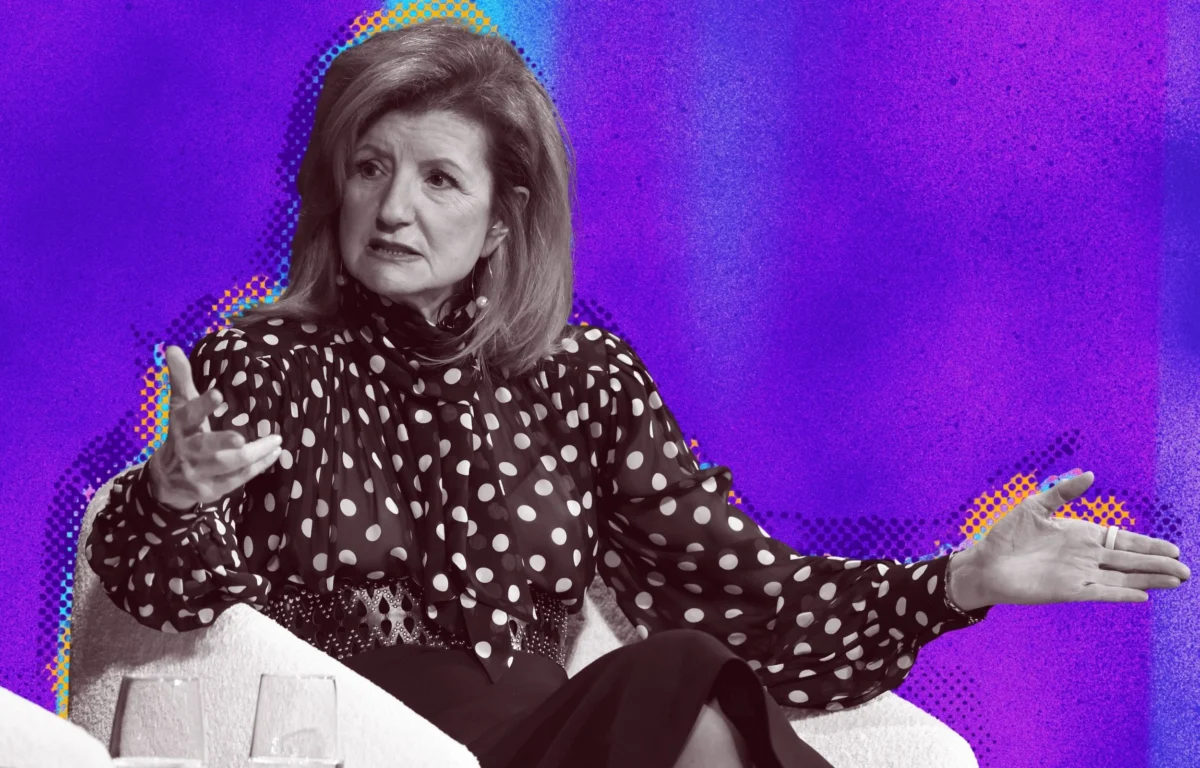
In an era defined by the rise of "quiet quitting," the four-day workweek movement, and a growing emphasis on setting rigid boundaries, media mogul and Thrive Global founder Arianna Huffington is pushing back against the prevailing narrative of work-life balance. In a candid recent interview with Fortune, Huffington challenged the modern obsession with the 5:00 p.m. laptop shutdown, arguing that for those seeking high-impact, meaningful careers, the traditional 9-to-5 framework is not only obsolete—it is a hindrance to actual fulfillment.
The Myth of the Hard Stop
Huffington’s perspective is rooted in a fundamental observation of the contemporary professional landscape: the nature of "interesting" work is rarely compartmentalized. For leaders, entrepreneurs, and creatives, the boundary between professional ambition and personal intellectual engagement is often porous.
"I don’t think there is anybody with an interesting job who can do that," Huffington stated, referring to the common Gen Z aspiration of completely disconnecting the moment the clock strikes five. "For you, or me, or most people with interesting jobs, there is never a time when you have a natural ending to the day."
Her argument suggests that the desire to "leave work at work" is a sign of a fundamental mismatch between the individual and their role. She went so far as to suggest that if a professional finds their tasks consistently "complete" by bedtime, they may be in the wrong position—one that lacks the depth and creative challenge required to sustain long-term professional growth.
A History of Lessons Learned: The 2007 Turning Point
To understand Huffington’s stance, one must look at her own trajectory. Her evolution from a high-octane media executive to a vocal advocate for well-being was not born of theory, but of a traumatic physical collapse.
In 2007, while serving as the editor-in-chief of The Huffington Post, she was routinely working 18-hour days, fueled by a culture that equated exhaustion with dedication. The result was a catastrophic physical breakdown: she fainted in her home office due to severe sleep deprivation and hit her head on her desk, resulting in a fractured cheekbone and several stitches.
This incident served as a wake-up call that fundamentally altered her philosophy. It did not, however, lead her to abandon hard work. Instead, it led her to professionalize recovery. Huffington realized that the "hustle culture" that glorified burnout was not just unsustainable—it was mathematically inefficient. By failing to prioritize the body’s basic biological requirements, she had sabotaged the very work she was trying so hard to produce.
The Science of Sustainability: Sleep and Nutrition
While critics might interpret her comments as a call to return to toxic overwork, Huffington maintains that she is advocating for the exact opposite. She argues that the solution to high-stakes, demanding work is not to do less, but to optimize the machine—the human body—that performs it.
The Sleep Imperative
At the core of her prescription is sleep. Huffington frequently cites the medical consensus that adults require seven to nine hours of quality rest per night. For her, sleep is not a "luxury" or a "soft skill"; it is a physiological necessity that dictates cognitive performance, emotional regulation, and decision-making capabilities.
"If you get your optimal number, that’s critical for how effective you are at work," she noted. She views sleep as the foundation upon which all other high-performance behaviors are built. Without it, the "life-work integration" she advocates for becomes impossible because the individual lacks the capacity to be fully present in either sphere.
The Role of Physical Maintenance
Beyond sleep, Huffington emphasizes the importance of nutrition and movement. She encourages professionals to view exercise—whether it be strength training, walking, or yoga—as a non-negotiable part of their professional development. By maintaining the physical vessel, the worker becomes more resilient against the inevitable stresses of a high-impact career.
Redefining the Paradigm: "Life-Work Integration"
Perhaps the most significant aspect of Huffington’s recent commentary is her rejection of the term "work-life balance." She argues that the phrase itself is inherently divisive, suggesting that work and life are opposing forces competing for a finite amount of time.
"In fact, they are on the same side," she explained in a previous interview with Great Place to Work.
By replacing "balance" with "integration," Huffington proposes a model where work and personal life are woven together in a way that respects the fluidity of the modern age. This is not a call to work 24/7, but rather an invitation to stop viewing professional tasks as an intrusion on "real life." When work is meaningful and aligned with personal values, the anxiety of "shutting off" is replaced by the satisfaction of progress.
The Generational Divide: Gen Z and the Future of Work
Huffington’s remarks arrive at a time when Gen Z is fundamentally reshaping workplace expectations. Having entered the workforce during a period of extreme uncertainty and witnessing the burnout of previous generations, many young workers are prioritizing mental health and personal time over the traditional corporate ladder.
The "Quiet Quitting" trend—the practice of doing exactly what is required and nothing more—is, in many ways, the antithesis of the philosophy Huffington promotes. While she acknowledges the validity of the desire for mental health, she worries that young people are swinging the pendulum too far toward disengagement.
The challenge for modern employers, therefore, is to create environments that are both "interesting" and "sustainable." If the goal of work is purely transactional—a paycheck for hours rendered—then the 5:00 p.m. clock-out is logical. However, for organizations that want to foster innovation and deep work, they must create a culture where the integration of life and work feels rewarding rather than exploitative.
Implications for the Modern Workforce
The implications of this shift are profound for both employers and employees:
- For Employers: The focus must shift from hours worked to outcomes achieved. If companies want their employees to be engaged beyond the 9-to-5, they must provide the support systems—such as flexible schedules, wellness stipends, and, most importantly, a culture that rewards recovery as much as results.
- For Employees: The responsibility lies in self-advocacy. If an employee finds themselves "checking out" at 5:00 p.m. to survive, it is a sign of burnout that needs to be addressed. By prioritizing personal health, sleep, and physical activity, workers can gain the energy required to pursue roles that are intellectually and emotionally fulfilling.
- The End of "Balance": The industry must move away from the binary of work versus life. The future belongs to those who can integrate their professional pursuits into a life that is, by design, healthy and sustainable.
Conclusion: A Call to Intention
Arianna Huffington’s message is a provocative one: stop looking for the "off" switch and start building a life you don’t need to escape from. While her critique of the 9-to-5 may seem out of touch to some, it strikes at the heart of a deeper existential question: What is the purpose of our work?
If work is merely a burden to be endured, the goal of leaving at 5:00 p.m. is entirely rational. But if we seek to build lives of impact, the path forward is not to work less, but to recover more effectively, prioritize the body, and engage in work that is worth the energy we pour into it. As Huffington suggests, the most successful people are not those who balance their lives, but those who integrate their work into a whole, healthy, and high-performing existence.
