

By Esther Surden
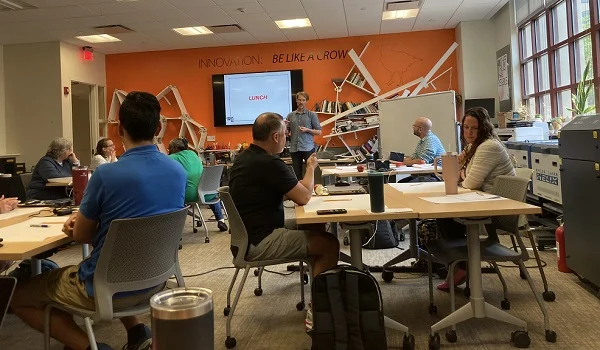
In an era where the boundary between the physical and digital worlds is increasingly porous, the role of educators is shifting from being mere transmitters of facts to being architects of innovation. This past August, NJTechWeekly.com visited Montclair State University (MSU) to observe a transformative workshop led by Jason Frasca and Iain Kerr, the visionaries behind the university’s renowned MIX Lab. The workshop, designed for K-12 educators, served as a masterclass in 3D printing, digital design, and the pedagogical shift required to foster true student agency in the 21st-century classroom.
The initiative represents a strategic alliance between the Picatinny Arsenal—a prestigious U.S. Army research facility in Rockaway—and the MIX Lab at MSU. By funding the attendance of New Jersey educators, the Picatinny Arsenal is effectively investing in the next generation of engineers, designers, and creative thinkers.
The Mission: Empowering Educators Through Innovation
The primary objective of the collaboration is to equip teachers with the technical proficiency needed to utilize 3D printers and sophisticated computer-aided design (CAD) software. However, the curriculum extends far beyond the mechanics of hardware. The workshop is fundamentally about changing how educators teach, aiming to instill a culture of creativity, resilience, and iterative problem-solving in K-12 students.
“Picatinny Arsenal supports STEM [science, technology, engineering, math] and STEAM [science, technology, engineering, arts, math] education in New Jersey K-12 school systems by providing 3D printers and support for 3D printing and robotics teams in high schools,” explained Jason Frasca. “They engaged us many years ago to teach the teachers how to use their 3D printers. The workshops now go beyond just instruction in how to use the printers. Educators learn how to use digital-design software to teach creativity and 21st-century skills in the classroom.”
By modeling autonomy and agency for the teachers, Frasca and Kerr believe they can replicate that same student-centered environment in classrooms across the state. The ultimate goal is to move away from rigid, instruction-manual-based learning and toward a framework where students have the confidence to manifest their own unique visions in a physical space.
A Chronology of the Workshop: From Analog Roots to Digital Realities
The workshop structure follows a carefully curated trajectory, designed to dismantle the intimidation factor often associated with professional design software.
Morning Session: The Analog-Digital Bridge
The day began not with a computer screen, but with a physical exercise. Iain Kerr led the educators through rudimentary design tasks that required them to use their entire bodies. By engaging in physical drawing and conceptualization, the participants were encouraged to "think big" without the fear of software constraints.
Frasca argues that this analog grounding is essential. "Bridging the gap between the analog and the digital allows people to ground themselves in what they’re trying to create and design," he noted. By connecting basic geometric shapes—the ubiquitous rectangles and circles that form the building blocks of both CAD software and the physical world—teachers began to develop a "muscle memory." This physical connection to design allows for a deeper engagement with software later in the day, transforming the computer from a daunting tool into a fluid extension of the designer’s intent.
The 25-Minute Threshold: Rapid Prototyping
One of the most radical aspects of the MIX Lab’s pedagogy is the rejection of the "six-month tool mastery" model. Traditional technical education often forces students to learn every nuance of a software program before they are allowed to create.
"Our approach is to, within 25 minutes, get everybody actually creating something that they could 3D-print," Frasca explained. "So that very quickly, with basic tools, they can create a cube which can be manipulated into a sphere. We show how one object can be made into virtually anything they want to make." This rapid success loop is critical for maintaining student engagement and proving that innovation does not require infinite knowledge—only the courage to start.
Afternoon Session: Independent Exploration and Design Pathways
As the workshop progressed into the afternoon, the focus shifted to the philosophy of discovery. Kerr emphasized that educators should encourage students to find their own solutions rather than relying on direct, step-by-step instruction.
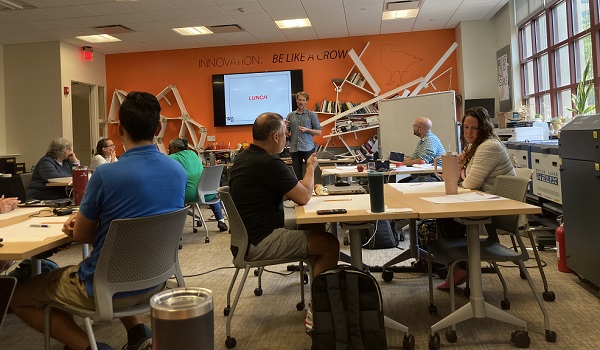
The session covered advanced techniques, such as the "loft" command, which allows for complex transitions between shapes, providing students with greater flexibility. A recurring theme of the afternoon was that there is no single "right" way to design. Kerr encouraged the educators to teach their students to keep multiple tools and design tabs open simultaneously, fostering a "bouncing" workflow that promotes creative fluidity. By allowing students to explore different pathways, teachers empower them to view software as a creative landscape rather than a rigid set of rules.
The Science of Innovation: Beyond Ideation
One of the most compelling arguments put forth during the workshop was the distinction between traditional "ideation" and true innovation. Frasca challenged the standard educational approach to brainstorming, noting that humans are inherently limited by their past experiences.
"We can only ideate what we know, what you’ve already seen and been exposed to, heard or engaged with," Frasca stated. "Therefore, we can never ideate anything novel or unique. Novelty requires approaches and tools and frameworks to actually get to some different, innovative place."
By providing these frameworks within the CAD software, the workshop teaches participants to "design beyond what they can imagine." It is a process of using the tool as a partner in creation, allowing the technology to suggest possibilities that the human brain might not have reached on its own. This is the essence of 21st-century skill-building: learning how to leverage technology to expand the limits of human creativity.
Supporting Data and Collaborative Dynamics
The success of the workshop was measured not just by the final objects printed, but by the collaborative atmosphere generated among the educators. The "gallery walk"—an exercise where participants showcased their designs to their peers—was a highlight of the session.
This social learning component is vital for the classroom. When students walk through a "gallery" of their classmates’ work, they are exposed to different design philosophies and problem-solving techniques. It turns the classroom into a studio, where critique and inspiration flow horizontally among students, rather than vertically from teacher to student.
Implications for the Future of K-12 Education
The implications of the MIX Lab’s work with the Picatinny Arsenal are significant for the future of the New Jersey workforce. By integrating 3D printing and advanced design thinking into K-12 curricula, the state is preparing its youth for a manufacturing and design landscape that is increasingly digitized.
1. Fostering Student Agency
By teaching teachers to move away from prescriptive instructions, the workshop encourages student autonomy. When a student learns that they can manipulate a cube into a sphere, they realize that they have the power to alter their environment. This is a profound shift in mindset that carries over into all academic disciplines.
2. Demystifying Technology
The "25-minute" approach removes the "tech-fear" that often prevents students from pursuing STEAM pathways. By making the barrier to entry low, the program ensures that students from all backgrounds can engage with high-level technology.
3. Creating a "Maker" Culture
The partnership between a high-level research facility like Picatinny Arsenal and a university lab creates a pipeline of innovation. Educators who attend these workshops return to their districts with a renewed sense of purpose and a toolkit that allows them to turn abstract concepts into tangible, physical reality.
Conclusion: A Blueprint for Empowerment
As the workshop concluded, the enthusiasm in the room was palpable. Teachers who had walked in with little to no experience in CAD were leaving with the ability to design and produce custom objects. They had learned that 3D printing is not just about the machine, but about the cognitive process behind the object.
Through the dedicated efforts of Jason Frasca, Iain Kerr, and the support of the Picatinny Arsenal, Montclair State University is providing more than just technical training. They are providing a blueprint for a new way of learning—one that values curiosity, persistence, and the courage to iterate. As these teachers return to their classrooms, they carry with them the potential to transform the way a new generation perceives its own capacity to innovate. In the quiet hum of a 3D printer, we are hearing the sound of the future being built, one layer at a time.
