

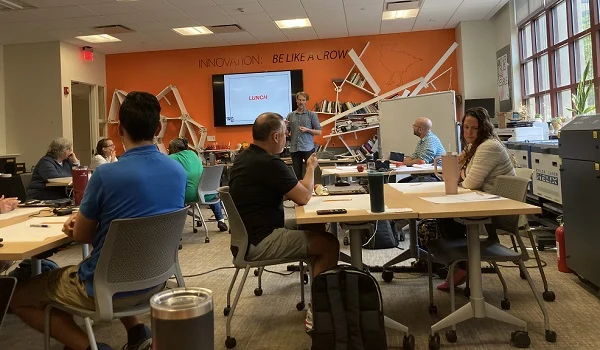
In an era defined by rapid technological shifts and the urgent need for a workforce fluent in digital fabrication, the gap between theoretical education and practical application remains a critical hurdle for K-12 school systems. This past August, a partnership between the U.S. Army’s Picatinny Arsenal and Montclair State University’s (MSU) MIX Lab sought to bridge that divide. By hosting a specialized workshop for educators, the initiative aimed to equip teachers with more than just technical proficiency; it sought to instill a pedagogical philosophy of autonomy, agency, and creative innovation.
The Intersection of Defense and Education: A Strategic Partnership
The collaboration between Picatinny Arsenal, a premier U.S. Army research and engineering facility based in Rockaway, New Jersey, and the MIX Lab at Montclair State is rooted in a long-term commitment to STEM (science, technology, engineering, math) and STEAM (science, technology, engineering, arts, math) education.
Recognizing that the defense sector relies heavily on a pipeline of creative problem-solvers, Picatinny Arsenal has spent years fostering partnerships with New Jersey high schools. By providing funding for the educators to attend these MSU workshops, the Arsenal ensures that teachers are not just receiving hardware, but the intellectual framework required to maximize its use.
“Picatinny Arsenal supports STEM and STEAM education in New Jersey K-12 school systems by providing 3D printers and support for 3D printing and robotics teams in high schools,” explains Jason Frasca, a professor at Montclair State and a primary facilitator of the program. “They engaged us many years ago to teach the teachers how to use their 3D printers, but the scope has evolved significantly since then.”
Chronology of an Immersive Learning Experience
The workshop, led by professors Jason Frasca and Iain Kerr, moved away from traditional "sit and listen" instructional models. Instead, it was structured as an intensive, experiential journey designed to mirror the pedagogical methods teachers would eventually employ in their own classrooms.
The Morning Session: Bridging the Analog and Digital
The day began with a focus on deconstructing the fear of design software. Iain Kerr facilitated exercises designed to help educators translate their internal creative impulses into digital realities. By using rudimentary drawing skills, participants were encouraged to connect basic shapes—the building blocks of both analog sketches and computer-aided design (CAD) software.
Frasca describes this as building "muscle memory." By allowing teachers to physically map out their ideas before touching a computer, they ground themselves in the creative process. "Bridging the gap between the analog and the digital allows people to ground themselves in what they’re trying to create," Frasca noted. This tactile approach serves to demystify software that can often feel intimidating to beginners.
The Afternoon Session: Autonomy and Exploration
As the afternoon progressed, the focus shifted from technical proficiency to instructional philosophy. Kerr emphasized that the goal was not to dictate a "correct" way to design, but to teach students how to find their own tools and solutions independently.
The workshop participants explored advanced design techniques, such as the “loft” tool, which allows for greater flexibility and organic design modifications. Kerr encouraged the educators to embrace the "messy" side of learning: keeping multiple tabs and tools open, iterating rapidly, and understanding that there are multiple pathways to any given design goal.
The session concluded with a “gallery walk,” an interactive exercise where teachers moved around the room to examine and critique each other’s work. This exercise served a dual purpose: it celebrated individual innovation and modeled a collaborative environment where students can learn from the techniques and successes of their peers.
Challenging Traditional Paradigms of Innovation
One of the most profound aspects of the workshop was the critique of traditional design education. Frasca pointed out that most CAD courses are taught by having students memorize toolbars and commands for months before they ever create a tangible object.
“Our approach is to, within 25 minutes, get everybody actually creating something that they could 3D-print,” Frasca explained. “We show how one object can be made into virtually anything they want to make.”
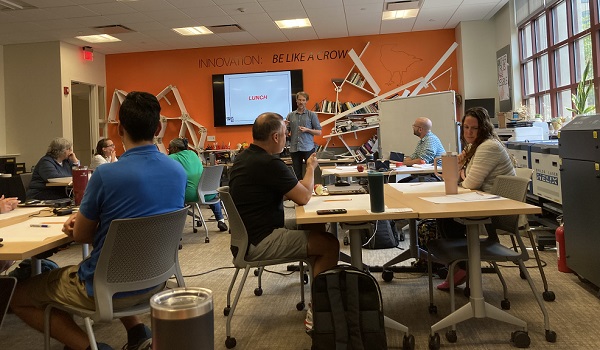
This philosophy is at the core of the “agency” model. By focusing on the capability to create rather than the memorization of features, educators learn to empower their students. Frasca argues that true innovation is not just about ideation, but about the tools used to reach novel conclusions.
“We can only ideate what we know, what you’ve already seen and been exposed to,” Frasca argued. “Novelty requires approaches and tools and frameworks to actually get to some different, innovative place. We demonstrate these frameworks and approaches within the design software, so teachers, and ultimately their students, are simultaneously learning how to design beyond what they can imagine.”
Implications for K-12 STEAM Education
The implications of this training extend far beyond the walls of the MIX Lab. As school districts across New Jersey and the nation struggle to keep pace with the demands of a 21st-century economy, the lessons from the MSU workshop offer a blueprint for success.
1. Moving Beyond Hardware
Many schools have purchased 3D printers, only to have them sit idle due to a lack of pedagogical training. By focusing on the teaching of the tools—rather than just the tools themselves—the Picatinny-MSU partnership ensures that equipment translates into student outcomes.
2. The Shift to "Designerly" Thinking
By treating CAD as a language rather than a technical chore, the workshop encourages "designerly" thinking. This involves identifying problems, prototyping solutions, failing fast, and iterating. These skills are highly transferable, preparing students not just for engineering careers, but for any field that requires complex problem-solving.
3. Fostering Agency
Perhaps the most significant takeaway for the teachers was the concept of student agency. By moving away from step-by-step tutorials and toward open-ended problem solving, teachers allow students to take ownership of their work. This agency builds confidence and resilience, two traits that are essential for the next generation of innovators.
Looking Forward: A Culture of Continuous Learning
The enthusiasm exhibited by the teachers throughout the workshop was palpable. As they moved from basic cube manipulation to complex, multi-layered designs, the atmosphere in the room shifted from tentative exploration to confident creation.
For Montclair State University, the collaboration with Picatinny Arsenal serves as a proof-of-concept for how universities can support the K-12 pipeline. By acting as a hub for professional development, the university helps ensure that the "innovation gap" is closed, one teacher at a time.
As these educators return to their classrooms, they take with them more than a list of software commands. They bring a new pedagogical framework—a way of teaching that values the process over the product, encourages the integration of analog and digital mediums, and fosters an environment where students feel empowered to create things that have never been seen before.
In the final assessment, the workshop succeeded because it treated teachers as creators. By validating their potential to innovate, Frasca and Kerr ensured that this ripple effect would be felt in classrooms across the state, ultimately equipping the next generation with the agency to design the future.
About the Author: Esther Surden is the Founder and Editor-in-Chief of NJ Tech Weekly, a publication dedicated to tracking the pulse of innovation, startups, and technology education throughout the state of New Jersey.
