

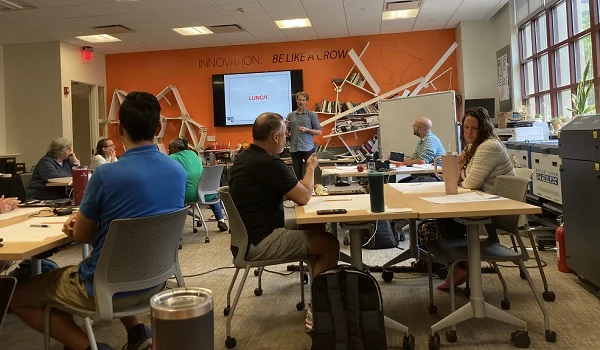
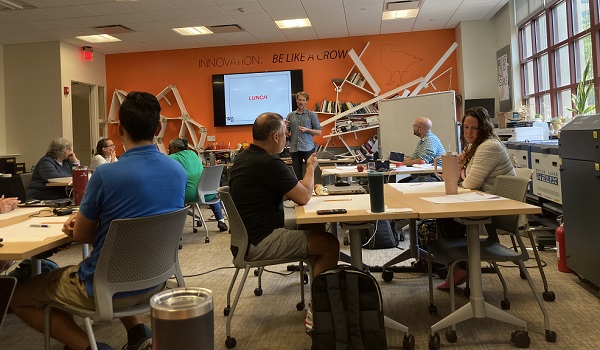
In the landscape of modern education, the gap between theoretical knowledge and practical application has often hindered the development of true innovation. However, a transformative initiative at Montclair State University (MSU) is bridging this divide. This past August, NJTechWeekly.com visited the campus to observe a specialized workshop led by professors Jason Frasca and Iain Kerr, designed to equip K-12 educators with the tools, philosophies, and pedagogical frameworks necessary to bring 3D printing and digital design into the classroom.
The workshop, a strategic collaboration between the U.S. Army’s Picatinny Arsenal research facility in Rockaway and MSU’s MIX Lab, represents a concerted effort to foster STEM (Science, Technology, Engineering, Math) and STEAM (which incorporates the Arts) literacy across New Jersey. By training the trainers, this initiative seeks to dismantle the intimidation factor associated with complex software and hardware, replacing it with a culture of autonomy, agency, and creative confidence.
The Genesis of the Collaboration
The partnership between Picatinny Arsenal and the MIX Lab is rooted in a long-term commitment to regional educational development. Picatinny Arsenal, a premier research and development facility for the U.S. Army, has long recognized that the future of defense and national technology depends on a robust pipeline of talent.
"Picatinny Arsenal supports STEM and STEAM education in New Jersey K-12 school systems by providing 3D printers and support for 3D printing and robotics teams in high schools," Jason Frasca explained during the session. "They engaged us many years ago to teach the teachers how to use their 3D printers."
While the initial focus was purely on hardware maintenance and operation, the scope of the program has evolved significantly. Today, the collaboration serves as a comprehensive professional development hub. Picatinny Arsenal funds the participation of educators, ensuring that financial barriers do not prevent teachers from accessing the latest in pedagogical design and technological training.
Pedagogical Philosophy: From Analog to Digital
The core of the workshop’s methodology is a departure from traditional "textbook-first" instruction. When asked how they approach teaching software that is often perceived as daunting—such as Computer-Aided Design (CAD)—Frasca and Kerr emphasize a hands-on, accelerated approach.
The Problem with Traditional Software Instruction
"Most design software is taught by introducing every single tool for six months, without the students ever making anything," Frasca noted. This conventional model, while thorough, often leads to disengagement. Students become overwhelmed by menus, icons, and commands before they ever see the tangible outcome of their labor.
In contrast, the MIX Lab approach is radical in its efficiency. Within 25 minutes of starting the workshop, attendees are actively creating a 3D-printable object. By starting with basic geometric primitives—a cube, for example—teachers learn how to manipulate these forms into spheres or complex, functional parts. The lesson is clear: one object can be transformed into virtually anything through simple, iterative modifications.
Bridging the Physical and the Digital
A highlight of the morning session involved Iain Kerr teaching rudimentary design skills that utilized the participants’ physical movement. By encouraging educators to use their whole bodies to conceptualize designs, Kerr helped them overcome the "blank screen" anxiety that often plagues new designers.
Frasca explained that this technique bridges the gap between analog and digital spaces. By drawing shapes on paper and connecting rectangular and circular forms, educators build a "muscle memory" that translates directly to the screen. "It allows them to ground themselves in what they are trying to create," said Frasca. "Once you understand the logic of the shape in the physical world, navigating the software becomes a natural extension of your own intent."
Fostering Autonomy and Agency
A central pillar of the workshop is the intentional cultivation of "agency." Educators are not just taught how to use a machine; they are taught how to teach students to find their own solutions.
Moving Beyond Ideation
One of the most profound insights shared by Frasca during the workshop was the limitation of traditional ideation. "We can only ideate what we know, what you’ve already seen and been exposed to, heard or engaged with," he argued. "Therefore, we can never ideate anything truly novel or unique simply by sitting in a room and ‘brainstorming.’ Novelty requires frameworks and tools to push you into different, innovative places."
By providing students with the technical framework to design beyond their existing mental library, the MIX Lab empowers them to manifest ideas that previously existed only as vague concepts.
The "No Single Way" Paradigm
During the afternoon session, the emphasis shifted toward self-directed learning. Kerr encouraged teachers to move away from the role of the "all-knowing instructor" who dictates a single path to a finished design. Instead, he championed the idea of allowing students to keep multiple tools, software tabs, and design pathways open simultaneously.
"There is not one right way to create a design, but multiple ways," Kerr emphasized. By allowing students to experiment with different design processes—such as using the "loft" tool for flexible, organic modeling—educators foster an environment where trial, error, and discovery are valued more than following a pre-set manual.
The "Gallery Walk": Community and Peer Review
A crucial component of the workshop is the "gallery walk." This exercise requires participants to circulate around the room, observing the work of their peers. This is not merely a social activity; it is a vital part of the design process.
When teachers implement the gallery walk in their own classrooms, they are teaching students to:
- Articulate their process: Explaining the "how" and "why" behind a design choice.
- Analyze alternative techniques: Seeing how a classmate achieved a similar goal using different software commands.
- Normalize iteration: Viewing design as a social, collaborative process rather than a solitary, high-stakes test.
The energy in the room during this segment was palpable. Teachers who arrived in the morning with little to no experience in CAD were suddenly debating the merits of different design geometries, clearly excited by the objects they had brought into existence.
Implications for the Future of Education
The work being done at Montclair State University carries significant implications for the broader K-12 landscape. As the economy shifts toward automation, artificial intelligence, and advanced manufacturing, the ability to translate conceptual ideas into physical prototypes is becoming a "21st-century skill" akin to literacy or numeracy.
The Role of STEAM
By integrating the "Arts" into the traditional STEM curriculum, this program recognizes that design is inherently human. It is not enough to build a functional object; one must understand the aesthetic, ergonomic, and creative potential of the tool.
Preparing for the Workforce
The educators attending these workshops are returning to their schools not just with a 3D printer, but with a new philosophy of teaching. They are moving away from passive consumption and toward active creation. By equipping students with the autonomy to troubleshoot their own technical issues and the agency to design solutions to real-world problems, these teachers are preparing a generation of students who are not just prepared for the workforce—they are prepared to define it.
Conclusion: A Ripple Effect
The initiative led by Jason Frasca and Iain Kerr, supported by the ongoing investment from Picatinny Arsenal, is a testament to the power of targeted professional development. As these educators return to their classrooms across New Jersey, they carry with them the ability to transform a student’s relationship with technology.
What began as a workshop on how to operate a 3D printer has evolved into a masterclass on teaching creativity, resilience, and independent thought. As long as this partnership continues, the students of New Jersey will have access to a classroom environment that values the process of creation as much as the final product, ensuring that the next generation of thinkers, engineers, and artists will be ready to navigate the complexities of the modern world.
