

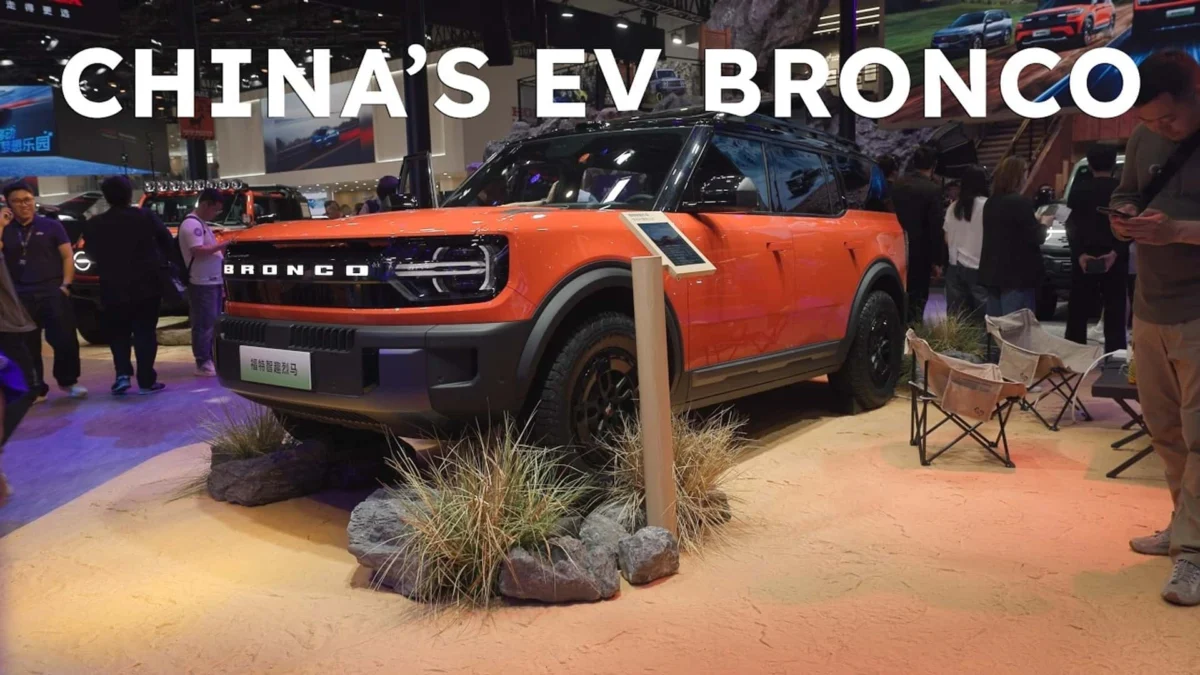
For decades, the Ford Motor Company stood as a titan of the Chinese automotive landscape. However, the last decade has been a sobering exercise in market contraction. Once a dominant player, Ford has seen its sales figures in the world’s largest automotive market crater—plummeting from a peak of 1.2 million units in 2016 to fewer than 300,000 projected for 2025. This dramatic slide has been attributed to a variety of factors, but none looms larger than the company’s sluggish transition to an electrified lineup.
In a nation where plug-in models now account for more than 50% of all new car sales, Ford has remained largely reliant on traditional internal combustion engines. Its primary "green" offering, the Mustang Mach-E, has struggled to carry the weight of the brand’s electrification ambitions in a hyper-competitive market. Yet, a potential turning point has arrived in the form of the Ford Bronco New Energy. Developed specifically for the Chinese consumer, this mid-sized SUV represents a bold shift in strategy—one that raises questions about whether the Blue Oval should be importing its own innovation back to North American shores.
The Chronology of a Sales Decline
To understand the necessity of the Bronco New Energy, one must look at the timeline of Ford’s recent history in China.
- 2016: Ford hits its zenith in China, selling 1.2 million vehicles. The portfolio is heavy on traditional sedans and SUVs, which were then in high demand.
- 2018–2020: The rapid rise of domestic EV manufacturers—such as BYD, Nio, and Li Auto—begins to shift consumer preference toward "New Energy Vehicles" (NEVs). Ford’s reliance on gas-powered models leaves it vulnerable to changing government mandates and consumer tastes.
- 2021: Ford introduces the Mustang Mach-E to the Chinese market, but it struggles to capture the segment share held by tech-heavy, locally produced rivals.
- 2024: Sales continue to languish as the market officially tips past the 50% threshold for plug-in vehicle dominance.
- 2025: Ford pivots toward localized partnerships, unveiling the Bronco New Energy, a vehicle developed in conjunction with Jiangling Motors Corporation (JMC).
Anatomy of the Bronco New Energy
The Bronco New Energy is a fascinating departure from the American-market Bronco. While it bears the rugged, iconic aesthetic of the U.S. version, it is fundamentally a different beast. Unlike the body-on-frame construction that defines the American Bronco, the New Energy model is built on a unibody platform. In terms of architecture and driving dynamics, it shares more DNA with a Kia EV9 or a Chevrolet Blazer EV than with the trail-hardened Broncos found in a Ford dealer’s lot in Michigan.
Powertrain and Technical Specifications
The vehicle is offered in two configurations designed to meet the diverse needs of the Chinese market:
- Extended-Range Electric Vehicle (EREV): This model features a 1.5-liter turbocharged engine that functions exclusively as a generator to feed a 43.7 kWh battery pack. It offers an impressive 137 miles of pure electric range, which extends to a staggering 748 miles when the generator is active (based on China’s CLTC cycle).
- Full Battery Electric Vehicle (BEV): This variant replaces the combustion generator with a high-capacity 105 kWh battery. It produces 445 horsepower and delivers a range of approximately 404 miles.
The EREV model, while slightly less powerful at 415 horsepower, provides a solution to the "range anxiety" that still plagues many potential EV buyers in both China and the United States.
A Design Philosophy for the Modern Overlander
In person, the Bronco New Energy strikes a balance between retro-inspired ruggedness and contemporary, tech-forward aesthetics. While the U.S.-spec Bronco Raptor can often feel like a specialized tool—bulky and aggressive—the New Energy model feels more refined, sleek, and family-oriented.
The interior design addresses the primary criticism of many Chinese-built crossovers: the tendency to prioritize soft-touch, fragile materials over durability. The cabin of the Bronco New Energy feels "hardy." The plastics are engineered to withstand the rigors of camping and off-road excursions without feeling cheap. The infotainment interface is responsive and modern, representing a significant leap forward in software integration compared to older Ford infotainment systems.

Perhaps the most ingenious aspect of the vehicle is its lifestyle versatility. It features a retractable glass roof reminiscent of the classic Westfalia campers. Coupled with fully reclining front seats and a custom-fitted inflatable mattress, the vehicle is essentially a turn-key overlanding machine.
The "What If" Scenario: Why Not the U.S.?
The question of whether the Bronco New Energy should make its way to the United States is complex. On paper, it seems like the "Goldilocks" vehicle for the American market: it fills the void between the small, limited-capacity Bronco Sport and the massive, fuel-thirsty full-size Bronco.
However, the barriers to bringing this vehicle to North America are substantial:
- Supply Chain and Geopolitics: The vehicle is built through a joint venture with JMC, and its supply chain is almost entirely contained within China. Importing it would be subject to massive tariffs that would likely render the competitive $32,000 price point impossible to maintain.
- Regulatory Hurdles: The vehicle was not designed to meet U.S. Federal Motor Vehicle Safety Standards (FMVSS) or EPA emissions certifications. Bringing it up to code would necessitate a multi-million dollar engineering overhaul.
- Legislative Restrictions: New regulations regarding the sourcing of software and hardware from specific foreign entities create a significant legal gray area for bringing Chinese-developed automotive tech into the U.S.
Implications for Ford’s Global Strategy
Despite these hurdles, the existence of the Bronco New Energy highlights a critical realization for Ford CEO Jim Farley. While Farley has been vocal about the potential threats posed by Chinese automakers to the North American market, he has also acknowledged the sheer efficiency and innovation coming out of Chinese design centers.
The cancellation of the F-150 Lightning—a move that surprised many—underscores the reality that the American public is not necessarily looking for "truck-sized" EVs, but rather vehicles that are practical, efficient, and technologically advanced. The EREV technology, which Ford is now exploring for its future trucks, is effectively a validation of the path already taken by the Bronco New Energy.
If Ford is to regain its footing, it may need to look past the "Not Invented Here" syndrome. The Bronco New Energy proves that the company has the capability to build a compelling, electrified, rugged vehicle; the challenge is no longer about the technology, but about global distribution and localized manufacturing.
Conclusion
The Ford Bronco New Energy is more than just a car; it is a symptom of a shifting global power dynamic in the automotive sector. While it is unlikely to grace a showroom floor in Ohio or California, its design and technical architecture offer a blueprint for what the next generation of American SUVs could look like.
For Ford, the lesson of the last nine years in China is clear: the market waits for no one. Whether the company chooses to adapt by leveraging its global assets or by reinventing the wheel in Detroit, the success of the Bronco New Energy in China serves as a reminder that the demand for electrified, adventure-ready vehicles is universal. Ford has the tools; now, it must determine if it has the appetite to deploy them across the Pacific.
