

Introduction: A Dialogue Between Craft and Conscience
In the bustling, ever-evolving landscape of Newark’s contemporary art scene, few voices resonate with the same tactile urgency as Patricia Dahlman. A featured artist in the Newark Museum of Art’s Studio Snapshot series, Dahlman has garnered significant acclaim for her ability to weave the anxieties, triumphs, and societal fractures of the current era into intricate textile works. Her practice, which bridges the gap between traditional craft and modern social commentary, serves as a poignant reminder of art’s role as a mirror to contemporary life.
The Studio Snapshot initiative, a digital exploration of Newark’s vibrant creative pulse, recently turned its lens toward Dahlman’s studio. The resulting feature highlights not only her technical mastery of canvas, fabric, and thread but also the intellectual rigor that underpins her work. By examining how she translates the chaotic news cycle into tangible, soft-sculpture artifacts, the museum offers audiences a unique look into the mind of an artist who refuses to remain silent in the face of political and social instability.
Main Facts: The Intersection of Craft and Commentary
Patricia Dahlman’s artistic identity is defined by a rigorous dedication to materials that are often historically sidelined as "domestic" or "utilitarian." By utilizing fabric, thread, and wood, she elevates these mediums into the realm of high-concept fine art.
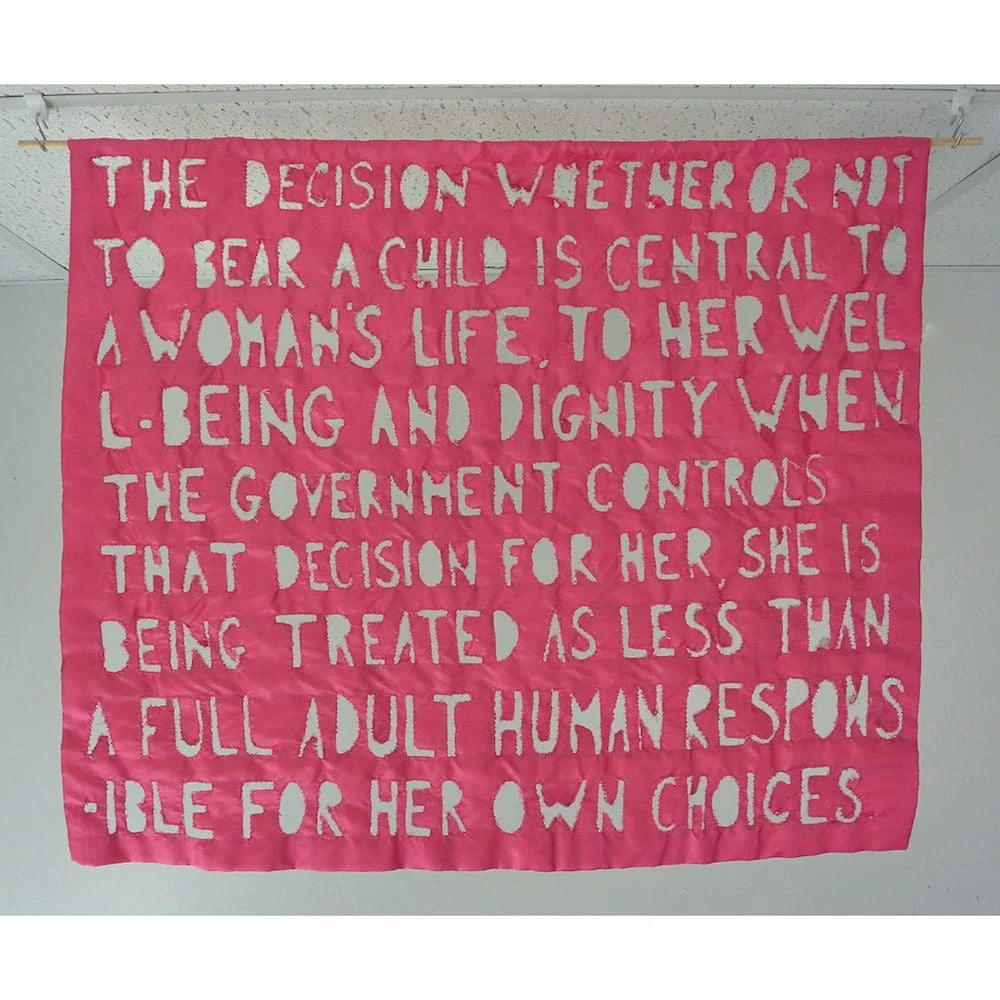
Her creative process is highly deliberate. She does not merely document events; she encapsulates them in fiber. The centerpiece of her recent work is a striking exploration of contemporary political discourse, specifically the legacy of the late Supreme Court Justice Ruth Bader Ginsburg. Her piece, Quote from Ruth Bader Ginsburg (2019), stands as a monumental 62-inch by 34-inch textile construction. It is a work that demands proximity, forcing the viewer to confront the literal, stitched reality of the words displayed upon it.
The primary facts of her practice can be summarized as follows:
- Mediums: Canvas, fabric, thread, and wood.
- Thematic Focus: Response to the current sociopolitical climate, the legacy of influential figures, and the power of language.
- Artistic Philosophy: The use of "soft" materials to address "hard" political truths, creating a sensory dissonance that encourages deeper contemplation.
- Institutional Connection: An active participant in the Newark arts community, with her work held and exhibited by institutions like the Newark Museum of Art.
Chronology: From Concept to Contemporary Resonance
The trajectory of Dahlman’s career is marked by a steady evolution from traditional textile exploration to a more pointed, investigative approach to art-making.
The Formative Years (Pre-2015)
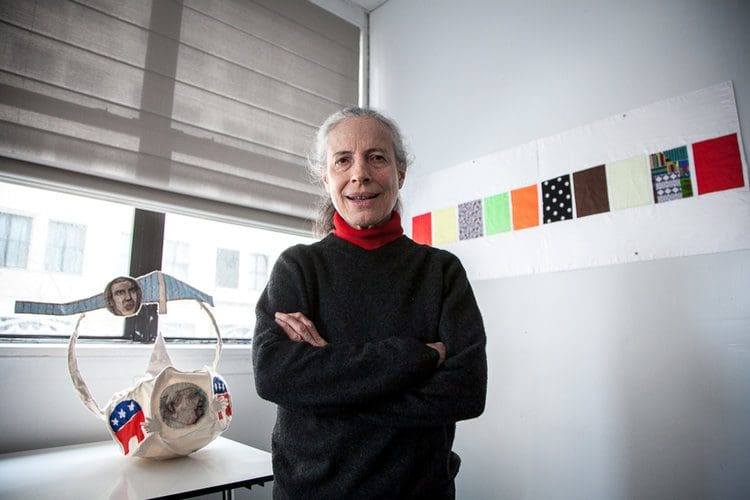
Long before she gained national attention, Dahlman was honing her craft in the private confines of her studio. Her early work focused on the structural integrity of fabric—how it folds, how it holds color, and how it can be manipulated to mimic the forms of everyday objects. This period was crucial for developing the tactile dexterity that now defines her work.
The Shift to Sociopolitical Engagement (2015–2019)
Around 2015, a palpable shift occurred in the American zeitgeist. Recognizing the increasing polarization of the public sphere, Dahlman began incorporating textual elements into her work. This era culminated in 2019 with the creation of her Ginsburg-inspired piece. During this time, she transitioned from abstraction to a more narrative-driven style, realizing that the medium of thread provided a unique "softness" that could make heavy political discourse more accessible and, paradoxically, more impactful.
The Newark Connection (2020–Present)
As Newark solidified its reputation as a burgeoning hub for contemporary artists, Dahlman’s integration into the local scene became more pronounced. She began collaborating with local galleries and institutions, including the Newark Museum of Art. Her inclusion in the Studio Snapshot series in 2024 represents a milestone in her career, marking her status as a vital contributor to the regional cultural fabric.
Supporting Data: The Anatomy of a Piece
To understand the labor-intensive nature of Dahlman’s work, one must look at the data behind her production. Her 2019 piece, Quote from Ruth Bader Ginsburg, provides a perfect case study:
- Dimensions: 62" H x 34" W x 1" D.
- Materials: Multi-layered canvas, high-tensile thread, industrial-grade fabric, and custom-cut wood backing for structural rigidity.
- Labor Time: A singular work of this complexity often requires several hundred hours of labor, involving pattern drafting, fabric cutting, and a meticulous, multi-stage embroidery process that ensures the legibility of the text while maintaining the integrity of the textile form.
This data underscores the "monumental" nature of the work. Unlike digital media or paint, which can be altered or applied quickly, fiber art is permanent and additive. Every stitch is a commitment, a physical manifestation of the artist’s focus on her subject.
Official Responses and Curatorial Perspectives
The Newark Museum of Art, through its Studio Snapshot series, has positioned Dahlman as a pivotal figure in modern New Jersey art. Curators have noted that her work satisfies a specific need in the museum’s collection: the ability to engage with contemporary political history through an unconventional, tactile lens.
"Patricia Dahlman’s work acts as a bridge," says one museum representative familiar with the series. "She takes the sterile, often aggressive nature of political headlines and softens them through the human touch. When a visitor stands in front of a piece by Dahlman, they aren’t just reading a quote; they are feeling the weight of the needle and the intentionality of the thread. It changes the interaction between the viewer and the message."
Critics have similarly praised her ability to maintain a neutral yet firm stance. By focusing on the words of public figures rather than caricaturing them, she creates a space for reflection that is inclusive rather than alienating, a difficult balance in the current era of hyper-partisan art.

Implications: The Future of Textile Art
Dahlman’s work carries significant implications for the future of textile art as a medium for protest and historical record.
The Revival of Craft in Fine Art
For decades, textile art was relegated to the category of "craft"—a distinction that often stripped it of the critical weight afforded to painting or sculpture. Dahlman’s success, and the success of similar artists in the contemporary space, suggests that the art world is undergoing a long-overdue reevaluation. The "tactile turn" in art—a move toward works that emphasize texture, materiality, and the physical labor of the artist—is becoming a dominant trend.
Art as a Historical Anchor
In a digital age where information is ephemeral, Dahlman’s textile works serve as anchors. Her pieces do not disappear when a browser tab is closed. They are physical, enduring, and capable of lasting for generations. The implication is clear: if we want to record the current state of our society, we must do so in ways that are tangible and resistant to the digital noise that dominates our daily lives.
The Role of Local Arts Communities
The Studio Snapshot series highlights a broader reality: the necessity of supporting local artists. By fostering talent like Patricia Dahlman, Newark is positioning itself as a leader in the discourse on how local art can address global issues. The community-centric model of the Newark Museum of Art serves as a template for other institutions, proving that the most profound insights often come from the studios located just around the corner.
Conclusion: Weaving a Legacy
Patricia Dahlman’s inclusion in the Studio Snapshot series is not just a recognition of her past work; it is an endorsement of her ongoing relevance. Her ability to synthesize the complexities of the modern world into the quiet, meticulous language of thread is a testament to the enduring power of the human spirit.
As we move forward into an increasingly uncertain future, artists like Dahlman provide us with the tools to process our experiences. They remind us that while the world may be chaotic, we have the capacity to create order, beauty, and meaning from the scraps of our lives. Whether through the bold, stark letters of a Ginsburg quote or the subtle textures of a carefully crafted canvas, Dahlman invites us to stitch together our own understandings of the world. Her work is a reminder that even in the face of the most daunting social challenges, the act of creation remains one of the most potent forms of resistance and connection available to us.
Through the lens of her studio, we are not just seeing a collection of fabrics and threads; we are seeing a portrait of our time, meticulously documented, stitch by deliberate stitch. As the Newark arts scene continues to grow, it is artists like Patricia Dahlman who ensure that this growth is rooted in substance, empathy, and an unwavering commitment to the truth.
