

When the opportunity arose to profile Michael E. Smith—an artist whose reputation is built as much on his deliberate silence as on his enigmatic, skeletal sculptures—I was met with an immediate, cognitive dissonance. How does one interview a man whose work is defined by its withholding nature? His pieces, often comprised of found objects, possess a vernacular, almost tactile quality that renders traditional critique—that "what does this mean?" variety—not only redundant but structurally inappropriate. To explain a Michael E. Smith piece is to dim its light; his work demands a visceral, rather than intellectual, surrender.
Yet, after traveling to the Massachusetts Museum of Contemporary Art (Mass MoCA) to experience his latest solo exhibition, on view through February 21, 2026, my understanding of his "withholding" shifted. Smith’s work does not elide language; it mimics its architecture. By stripping ordinary objects of their utility and recontextualizing them through rhythm, repetition, and semiotic scrambling, he functions less like a sculptor and more like a poet.
The Anatomy of Absence: A Chronology of the Aesthetic
Smith’s trajectory from his Detroit origins to his current life in New England has long been framed by the trope of the "post-industrial scavenger." Critics often point to his use of discarded refuse as a commentary on the decay of the American manufacturing heartland. However, this narrative fails to account for the decade of development that has led to his current, more refined practice.
Living in Providence, Rhode Island, for the better part of the last twenty years, Smith has moved away from the overtly political toward the profoundly existential. The Mass MoCA exhibition serves as a retrospective of this shift. Upon entering the gallery, one is greeted by two long, rolled tubes of yellow paper resting on the floor. The initial instinct is to categorize them as legs, a testament to the human mind’s desperate need for anthropomorphism. Yet, their singular, unnatural bend against the wall denies the viewer the comfort of anatomy.

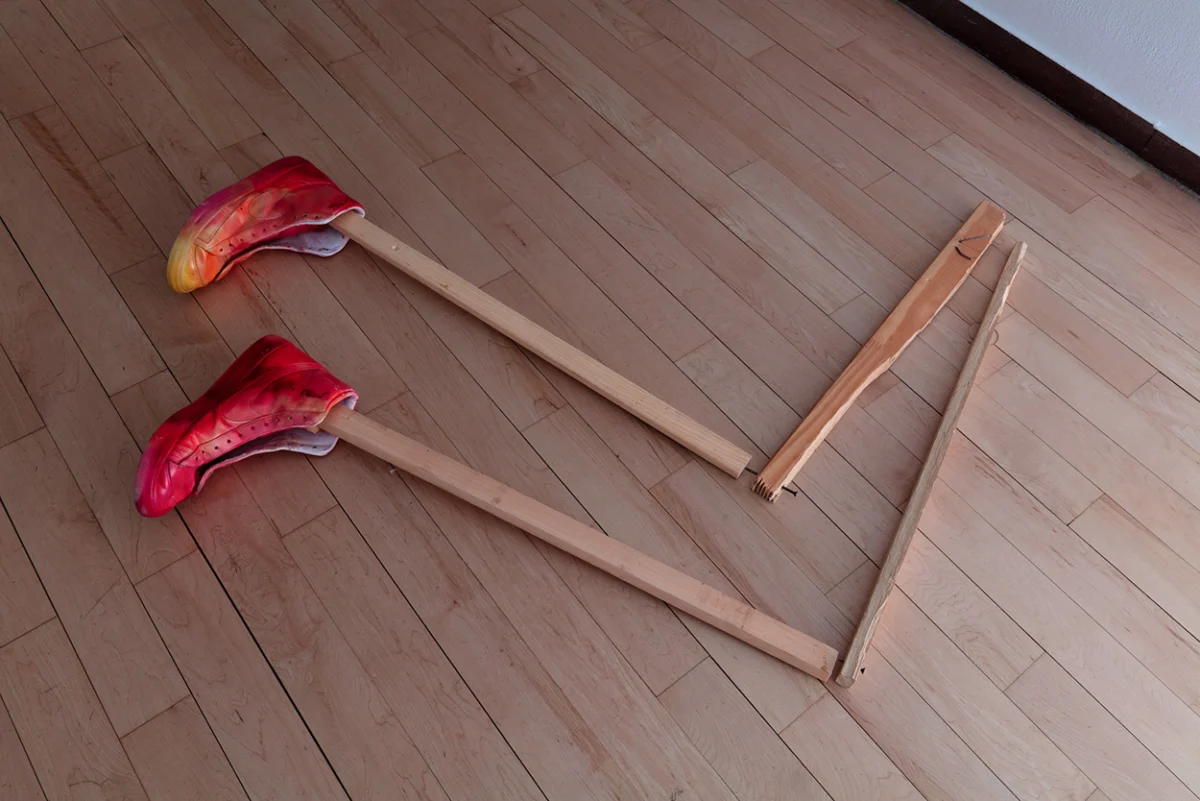
As the viewer moves through the space, this motif of "limbs" repeats—wooden sticks adorned with shoes, wire structures suspended from the ceiling—until the repetition creates a haunting, rhythmic cadence. This is the hallmark of Smith’s current era: the creation of a visual meter that dictates how the viewer experiences the space, much like the beat of a song or the stanza of a poem.
Supporting Data: The Methodology of the "Spiritual Detective"
Smith’s process is rooted in a pragmatic, almost blue-collar approach to the abstract. During our interview, conducted from his Providence studio, Smith reflected on his transition from a notoriously guarded figure to a more communicative participant in the art world.
"For ten years, I avoided interviews," Smith admitted, noting that his decision to open his process to curator Emma Poveda was a deliberate attempt to subvert the traditional, dry nature of institutional collaboration. "I’m actually weirdly super talkative if you get me going."
This communicativeness is mirrored in his material choices. When discussing his work, Smith emphasizes that his objects "choose him." His, he argues, is a life of "spiritual detection." He navigates the practicalities of a professional art career—shipping, scheduling, and site-specific installations—by folding these logistical burdens directly into the art.

Consider his 2019 installation at the Venice Biennale, where he was tasked with working in the prestigious Scarpa Garden. "I was waking up in a panic," he recalled. "How do I live up to this opportunity? I had no ideas." The breakthrough came through the most mundane of channels: his son received an anvil as a gift. That singular object unlocked a cascade of associations—heaviness, history, and the physical endurance of materials—that defined the entire project.
The Role of the "Lists" and the Architecture of Meaning
One of the most striking elements of the Mass MoCA show is the presence of lists on stacked canvases. For Smith, these lists serve as a psychological anchor, a method for managing the "neurosis" of creation.
"Rather than saying ‘stork beak,’ the list will just say ‘bird,’" Smith explained. "You have to put together the rest of the bird that’s missing in your head."
This strategy forces the viewer to become an active participant. By withholding the full image, by stacking canvases like pizza boxes and leaving boxes sealed in cellophane, Smith creates a space where the viewer’s consciousness must fire in tandem with his own. He is not merely presenting an object; he is presenting an invitation to a durational, immersive experience.

His obsession with rhythm extends to his curation. He expresses frustration with the traditional museum experience, where visitors are expected to consume art in a disjointed, rapid-fire fashion. "You would never listen to six songs simultaneously," he remarked. By controlling the flow of his exhibitions, he forces a slower, more musical engagement with the work.
Official Responses and Thematic Implications
The exhibition at Mass MoCA is not merely a collection of objects; it is a profound commentary on the human condition under the pressures of modern capitalism. Smith draws a sharp line between "having a job" and "doing work." His admiration for blues musician Son House—specifically the line, "I’m gonna join the Baptist Church… so I won’t have to work"—serves as a North Star for his own practice.
"Having a job is an oppressive experience for 99.9% of the planet," Smith stated. His art, while produced within the machinery of the global art market, is an attempt to carve out a pocket of existence that remains "harmless."
This concept of "harmlessness" is perhaps the most significant takeaway from Smith’s current philosophy. In a world defined by competition—what he calls the "basal impulse to collect acorns"—Smith seeks to step off the board. His work with young artists, his collaboration with his own children, and his rejection of the "artist-as-competitor" model are all extensions of this ethos.

Conclusion: The Grace of the Minimalist
As our conversation concluded, it became clear that Smith’s reticence was never a lack of something to say, but rather a protection of the sacredness of the work. The arrogance required to claim "understanding" of such a complex, swirling world is, in his view, a failure of the imagination.
"At best, I try not to do any harm, and if I get there, that’s pretty cool," Smith said.
In the quiet, austere halls of Mass MoCA, among the unplugged light fixtures and the ghost-like wires, that sentiment resonates with surprising force. Michael E. Smith is not asking for our interpretation; he is asking for our presence. He is a poet of the pedestrian, turning the heavy, forgotten detritus of our lives into something that, for a brief moment, feels weightless. Through his rhythmic, repetitive, and deeply personal arrangements, he proves that sometimes the most profound statements are the ones that refuse to speak at all.
