

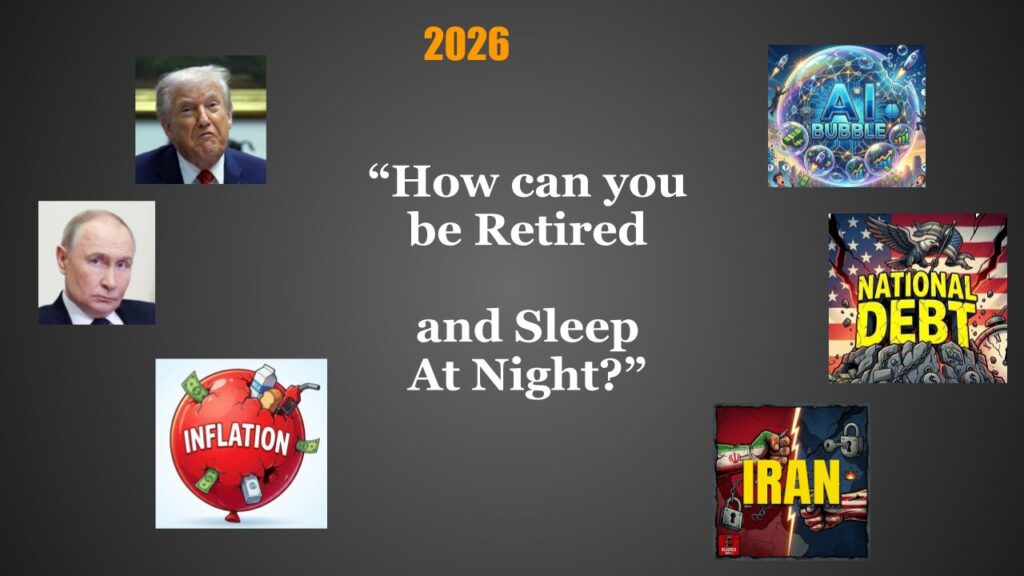
In the fast-paced world of modern finance, the "stock market anxiety" cycle is a familiar, recurring fever. As we navigate the complexities of 2026, the global investor base finds itself gripped by a singular, all-consuming narrative: the Artificial Intelligence (AI) boom. While the stock market continues to reach historic valuations, a pervasive sense of dread—a fear that a catastrophic correction is imminent—has begun to cloud the retirement outlook for millions.
However, a closer examination of historical economic cycles and the fundamental drivers of human prosperity suggests that the current anxiety may be less about the market itself and more about the innate human tendency toward fear-based decision-making.

The Chronology of Worry: From 2006 to 2026
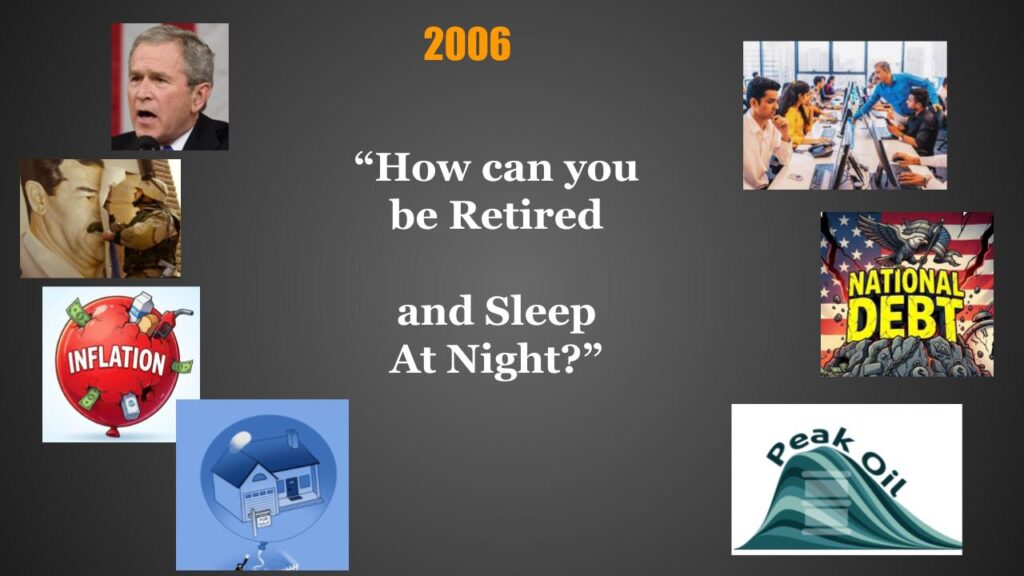
To understand our current state of unease, we must look at the past. Two decades ago, in 2006, the investor mindset was remarkably similar to today’s, though the "bogeymen" were different.
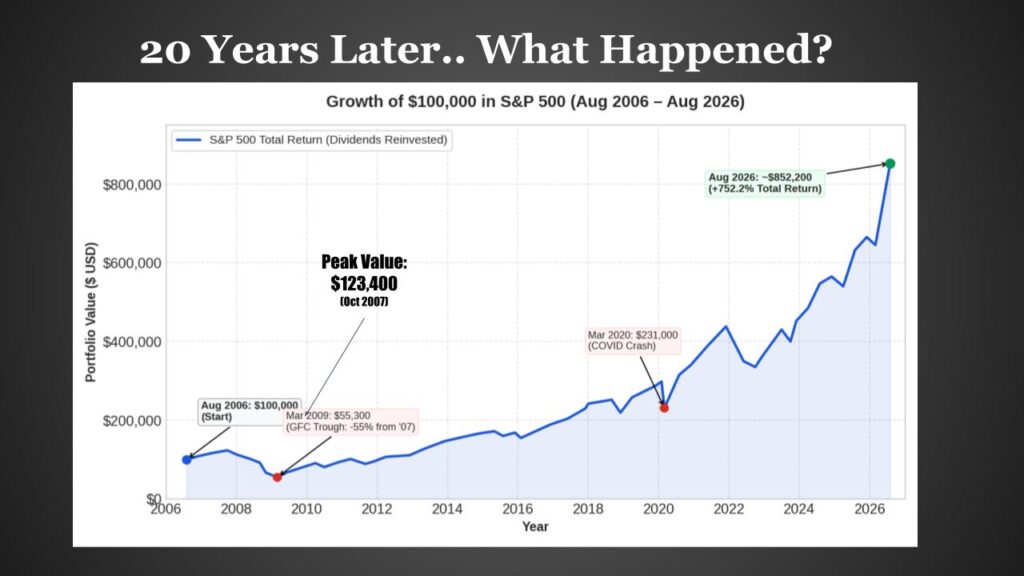
Back then, the world was preoccupied with the geopolitical instability of the Iraq War, the looming specter of peak oil, and the fear that massive outsourcing to emerging markets would hollow out the Western middle class. Investors were terrified of a housing bubble that seemed to defy the laws of gravity. When that bubble eventually burst, triggering the Great Financial Crisis—the most significant market downturn since the Great Depression—the panic was palpable.
Yet, viewed through the lens of a 20-year timeline, that catastrophic crash appears as a mere blip on a chart of long-term growth. An investment of $100,000 made in 2006 would have matured into roughly $852,000 by 2026. This data serves as a stark reminder that market volatility is the price of admission for long-term wealth creation, and that "doom-scrolling" through contemporary headlines rarely captures the true trajectory of human progress.
Supporting Data: The Quiet Progress of the Last Two Decades
While media outlets fixate on debt ceilings and geopolitical tensions, the underlying data paints a picture of a world that is objectively more prosperous than it was twenty years ago.

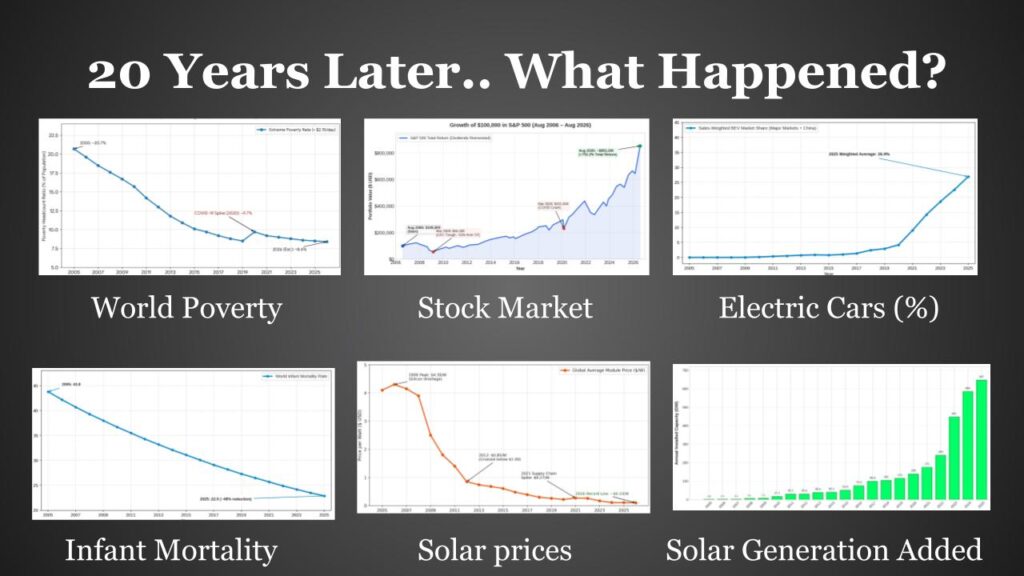
- Poverty Reduction: The global rate of extreme poverty has plummeted from 20% in 2005 to roughly 8% today.
- Healthcare Improvements: Infant mortality rates have been effectively halved on a global scale.
- The Energy Transition: Solar energy, once viewed as a niche alternative, has seen costs collapse to the point where it now accounts for the vast majority of new energy infrastructure. Similarly, electric vehicle (EV) adoption has surged, moving from a theoretical concept to nearly 25% of global new car sales, with countries like Norway already reaching near-total electrification.
These metrics demonstrate that while financial markets are inherently "choppy" and prone to irrational exuberance, the real economy—driven by human ingenuity and technological adoption—continues to push the standard of living upward.
The Core of Prosperity: Productivity Over Sentiment
The prevailing fear regarding the "AI Bubble" is that it represents an unsustainable departure from reality. However, skeptics often miss the fundamental engine of capitalism: Productivity.
Financial systems, stock tickers, and interest rates are, at their base, human inventions—numerical representations of value. If these systems face a correction, the underlying capacity for human work and innovation remains unchanged. Productivity is the true source of wealth. Whether it was the steam engine, the assembly line, or the internet, every transformative technology has been met with skepticism and fear of displacement. Yet, historically, these technologies act as "cognitive force multipliers."
AI, in this context, should be viewed as a "cognitive nail gun." Just as a nail gun allows a carpenter to do the work of three, AI allows workers to accelerate output, solve complex problems, and innovate at unprecedented speeds. While this inevitably leads to labor displacement in specific sectors, it simultaneously lowers costs and creates entirely new industries that were previously unimaginable.
Implications: The Psychology of "Danger Detection"
Why, then, do we remain so anxious? The answer lies in human evolutionary biology. As a species, we are wired to be "Danger Detection Machines." In prehistoric times, this trait was essential for survival against predators. In the modern world, where physical predators are largely managed, the brain continues to scan the horizon for threats.
When we eliminate poverty and physical danger, our "fear machinery" doesn’t switch off; it simply moves the goalposts. We shift our anxiety toward tax strategies, the performance of an IRA, or the aesthetic choices of our neighbors. This is known as "anchoring bias"—the tendency to rely on the most recent or most emotionally charged information to judge the future.
The Antidote to Fear: Action and Resilience
To navigate the current AI-driven market environment without succumbing to paralyzing anxiety, individuals must adopt a more strategic framework:
- Understand Your History: Often, our financial fears are rooted in childhood experiences or familial "scarcity mindsets." Recognizing that these fears are a legacy of the past, rather than an objective analysis of the present, is the first step toward clarity.
- Everything is an Experiment: Rather than viewing AI or market volatility as a threat, treat them as variables in an experiment. A "scientific" approach to life reduces the emotional weight of uncertainty. If a new technology or market condition arises, do not ask if it will "ruin" you; ask how you can learn from it, adapt to it, and use it to your advantage.
- Tune Out the Noise: The daily news cycle is incentivized to monetize fear. By shifting your mental diet from sensationalist headlines to foundational learning, you gain a sense of agency.
- Focus on Positive Behaviors: Prosperity is rarely the result of a single market move; it is the result of consistent, productive, and healthy habits. Engaging in meaningful work, cultivating close relationships, and maintaining physical health are the true pillars of a high-quality life.
The Path Forward
The fear surrounding the AI bubble is likely to persist as long as the market remains in a phase of rapid expansion. However, the lesson of the last twenty years remains clear: those who allowed fear to dictate their investment strategy in 2006 missed out on one of the greatest periods of wealth creation in history.
The AI era is not an ending; it is a continuation of the human experiment. The technology will disrupt, it will displace, and it will challenge our current understanding of labor. But it will also provide tools that make life more efficient, more productive, and more abundant.
Ultimately, everything you want—whether it is financial independence, a career transition, or the peace of mind to enjoy your retirement—lies on the other side of fear. The "bubble" may burst, as all bubbles eventually do, but the underlying drive toward human progress is not a bubble. It is a constant. By choosing to focus on productivity, action, and long-term resilience rather than the ephemeral fluctuations of the stock market, you can ensure that you are not just a spectator to the future, but a participant in it.
