

In the high-stakes world of global luxury, where heritage and exclusivity have traditionally been defined by material opulence, a quiet revolution is taking place. Kering, the $14.5 billion French powerhouse behind iconic houses such as Gucci, Saint Laurent, and Bottega Veneta, has emerged as an unlikely vanguard of corporate environmentalism. According to its latest impact report, the group has achieved a significant milestone: a one-third reduction in absolute greenhouse gas (GHG) emissions since 2022.
This reduction is not merely a byproduct of market fluctuations or administrative accounting; it is the result of a deliberate, systemic overhaul of the luxury supply chain. By integrating sophisticated data modeling with radical changes in procurement and design, Kering is attempting to prove that the "business of desire" can coexist with planetary boundaries.
The Data-Driven Foundation: Measuring the Invisible
At the heart of Kering’s decarbonization strategy lies its Environmental Profit and Loss (EP&L) accounting system. Introduced in 2014, long before ESG (Environmental, Social, and Governance) reporting became a standard corporate mandate, the EP&L serves as a rigorous diagnostic tool. It catalogs the group’s total footprint—encompassing water usage, land degradation, waste, and pollution—and assigns a monetary value to these impacts.
The data reveals a stark reality: 63% of Kering’s emissions are tethered to the production and processing of raw materials, with manufacturing contributing an additional 8%. By pinpointing these "carbon hotspots," Kering has been able to move beyond surface-level pledges.
The most recent report highlights a 28% reduction in emissions related to land use and agriculture, alongside a 4% decrease in direct operations and energy consumption. For a company that relies heavily on natural fibers and leather, these figures represent a fundamental shift in how the group sources its inputs.
A Chronology of Change: From Vision to Execution
Kering’s sustainability journey is not a recent reaction to climate pressure; it is a decade-long exercise in corporate governance.
- 2012: Marie-Claire Daveu, formerly a key figure in the French government, is appointed Chief Sustainability and Institutional Affairs Officer. Her mandate: to embed sustainability into the business model rather than treating it as a philanthropic sideline.
- 2014: The formal launch of the EP&L accounting system, providing the first granular look at the group’s environmental impact.
- 2017: The implementation of a centralized purchasing program for precious metals. By aggregating demand, Kering mandates that gold used across its brands must be either recycled or sourced from artisanal, Fairtrade-certified mines.
- 2019: The formation of Kering Ventures, a strategic investment arm focused on funding biotechnology and material science startups, such as VitroLabs and Sqim, which focus on non-animal leather alternatives.
- 2024: The launch of the Kering Accelerator for Regenerative Materials, a multi-million dollar commitment to transition cotton, wool, and cashmere supply chains to regenerative agricultural practices.
Governance: Sustainability as a Business Imperative
Marie-Claire Daveu, reporting directly to CEO Luca de Meo, has spent over a decade dismantling the notion that sustainability is a "constraint" on luxury.
"Governance is key because if sustainability is not at the right level, and you don’t have the right governance to manage sustainability, it’s only a word," Daveu notes. "The real sustainability is to change the business model and continue to develop our business for the long run."
This governance structure is unique in its duality: while the group sets overarching environmental standards and coordinates centralized purchasing, it empowers individual brands—Gucci, Saint Laurent, Balenciaga—to appoint their own sustainability champions. This allows the group to maintain high-level impact targets while respecting the creative autonomy and distinct supply chains of each house.
Material Innovation: The Milan Laboratory
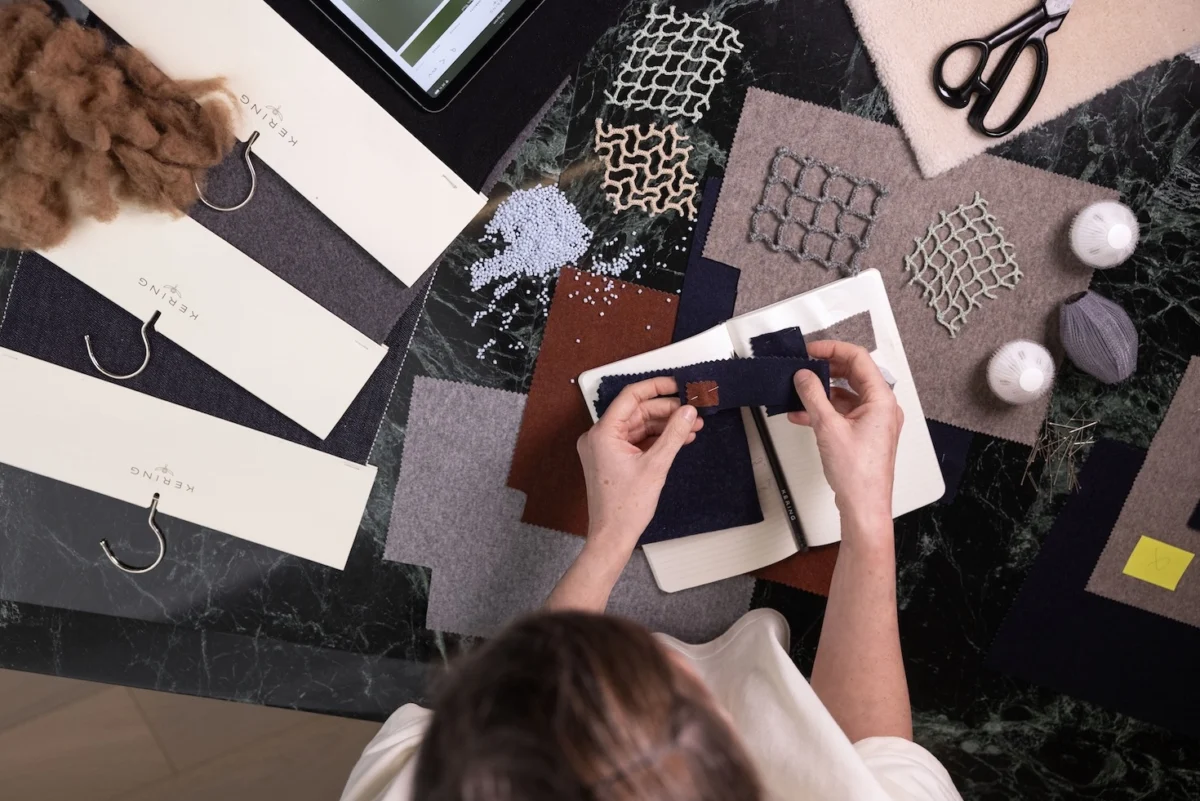
One of the most concrete manifestations of Kering’s strategy is the Material Innovation Lab (MIL) in Milan. The MIL acts as a library and a laboratory for the group’s designers, offering a curated selection of over 600 lower-impact material options.
By providing designers with vetted, sustainable alternatives—such as recycled fabrics or innovative bio-based textiles—Kering removes the technical barrier to sustainable design. Instead of designers having to hunt for eco-friendly suppliers, the lab brings the supply chain to them, ensuring that the transition to sustainable materials does not come at the cost of aesthetic quality.
Furthermore, the group’s investment in regenerative agriculture is transforming the "upstream" supply chain. By pre-reserving harvests of regenerative wool and cashmere, Kering provides farmers with long-term financial stability, effectively de-risking the transition from industrial to regenerative farming. This model has already achieved 98% traceability for these materials, a critical metric in an industry often plagued by opaque sub-contracting.
Circularity: The Second Life of Luxury
For Kering, the future of luxury is not just in the creation of new goods, but in the longevity of the existing ones. The group has taken a proactive stance on the circular economy, most notably through its 5% stake in Vestiaire Collective, the world’s leading luxury resale marketplace.
"When you restart a new life for products, we think it’s a good example of where sustainability and luxury go hand in hand," says Daveu. "It’s not only an environmental topic. It’s a social advantage because you can sell quality products to younger people, to a generation that may not be able to buy new products."
At the manufacturing level, Gucci has pioneered the "Circular Hub" in Tuscany. This facility serves as a blueprint for the future of luxury production, focusing on shared research, logistics networks, and, most importantly, "design for disassembly." By training designers to construct products that can be easily repaired or broken down into their base components, Kering is addressing the end-of-life impact of its products before they even leave the atelier.
Implications: A New Standard for the Industry
Kering’s progress offers a roadmap for the broader fashion industry, yet it also highlights the magnitude of the challenges ahead. As the group moves toward its goal of further reducing its environmental footprint, several key implications emerge for the luxury sector:
- The Rise of Regenerative Supply Chains: Kering’s move toward regenerative agriculture suggests that the next frontier of sustainability will not be in the factory, but in the soil. Scaling these practices will require deeper integration between fashion houses and farming communities.
- The Professionalization of Circularity: The shift from "vintage" to "certified circularity" will likely see luxury brands taking direct control over the resale of their own products, ensuring authenticity and maintaining brand value while extending product life.
- Collaborative Innovation: The success of the MIL and the Kering Accelerator proves that no single brand can solve the climate crisis alone. Pre-competitive collaboration—sharing research and supply chain networks—will become the new prerequisite for survival.
- Academic Integration: By embedding sustainability into the curricula of institutions like the London College of Fashion and Parsons, Kering is effectively "training the next generation" to think in terms of life-cycle assessment and circular design.
Conclusion
Kering’s reduction of its absolute GHG emissions by one-third is a significant achievement, but the group frames it as merely the beginning. By utilizing the EP&L to hold itself accountable, and by treating the design process as a laboratory for circularity, Kering is signaling that the era of "take-make-waste" luxury is ending.
The true test for Kering—and for the luxury industry at large—will be whether these innovations can be scaled across the entire global economy without sacrificing the margins or the magic that defines the sector. As Daveu aptly puts it, the goal is to make sustainability a driver of creativity rather than a restriction. If Kering succeeds, it will have done more than just lower its carbon footprint; it will have redefined what it means to be a luxury brand in the 21st century.
