

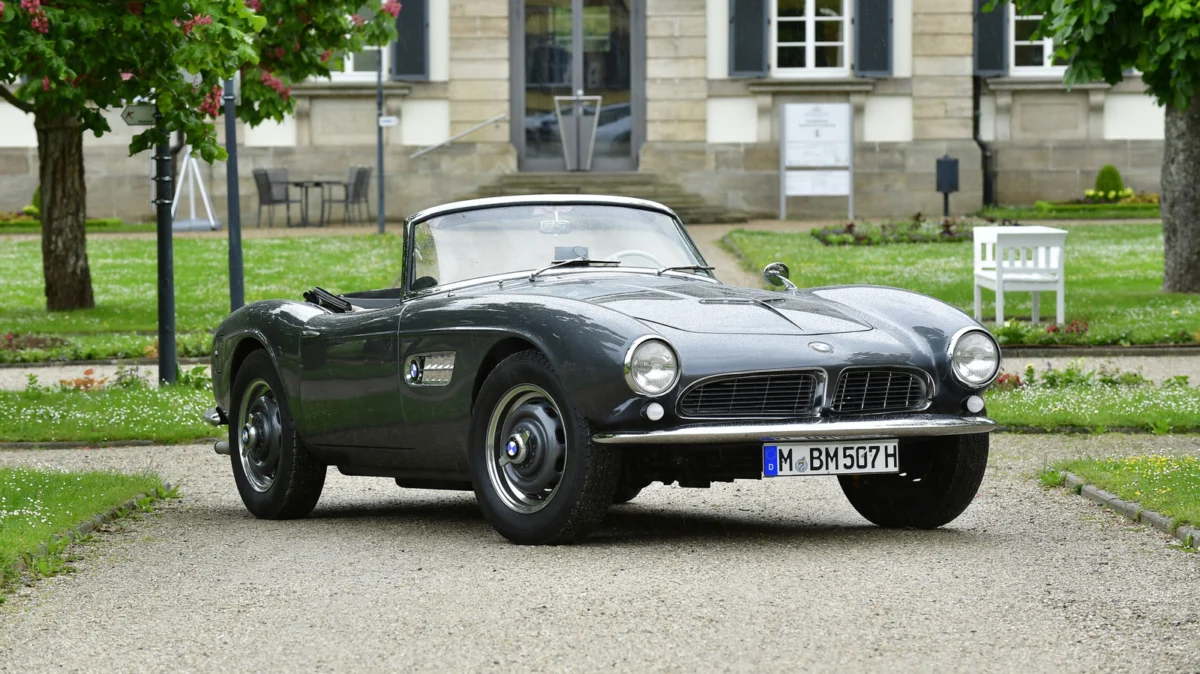
In the annals of automotive history, few vehicles occupy a position as paradoxical as the BMW 507. To the modern collector, it is a blue-chip asset, a seven-figure masterpiece of mid-century design, and the spiritual anchor of the Bavarian marque’s roadster lineage. Yet, for the architects of the car in the late 1950s, the 507 was a catastrophe of near-existential proportions. It was a project that hemorrhaged 15 million Deutschmarks, brought a legendary manufacturer to the brink of a hostile takeover by its greatest rival, and ultimately proved that in the world of high-end manufacturing, beauty—when divorced from economic reality—can be a lethal liability.
The Genesis of an Impossible Dream: Max Hoffman’s Vision
The story of the 507 is fundamentally one of misaligned ambition. In the early 1950s, BMW was a company in search of an identity. Having recovered from the total devastation of World War II, it was producing modest motorcycles and small, utilitarian cars. Enter Max Hoffman, the Austrian-born, New York-based importer who possessed an almost supernatural intuition for the American luxury car market.
Hoffman had already tasted success by convincing European manufacturers to tailor their products for the burgeoning post-war American appetite. He saw a gaping hole in the U.S. market: there was the ultra-expensive Mercedes-Benz 300SL, and there were the affordable, mass-produced British sports cars like the MG and Triumph. Hoffman believed American buyers were hungry for something in between—a sophisticated, powerful, and breathtakingly beautiful German roadster that could bridge the gap. He projected that if BMW could produce such a car, they could easily move 5,000 units annually at a price point of $5,000.
Design and Development: The Albrecht von Goertz Aesthetic
To realize this vision, BMW enlisted the talents of Count Albrecht von Goertz, an industrial designer with an impeccable eye for proportion. What von Goertz delivered was, by any objective measure, a triumph of automotive art. The 507 featured long, sweeping hood lines, a shark-like front fascia, and a silhouette that defined the "coke-bottle" styling trend of the era.
However, the design was a triumph of form over function—or, more accurately, form over feasibility. The bodywork was designed with such complexity that it defied the industrial manufacturing techniques of the time. Every single panel of the 507 had to be painstakingly hand-formed by master craftsmen. There was no assembly line efficiency to be found here; each unit was essentially a bespoke commission, built with an artisanal level of detail that made the projected $5,000 price point a mathematical impossibility.
The Economic Collapse: A Reality Check
By the time the first 507s arrived in American showrooms in 1956, the dream had curdled. The reality of hand-crafting an aluminum-bodied roadster pushed the actual production cost far beyond original estimates. To recoup their investment, BMW was forced to price the 507 at approximately $10,000.
This price tag was a death knell. It placed the 507 in direct competition with the Mercedes-Benz 300SL, a car that already had a reputation for track-proven performance and engineering pedigree. It was also double the price of the Chevrolet Corvette or the Jaguar XK150. American consumers, despite being enamored with the 507’s looks, were unwilling to pay a premium for a car that lacked the established racing heritage and performance backing of its competitors. The projected 5,000-unit sales goal evaporated, replaced by a trickle of orders that barely kept the lights on at the Munich factory.
Engineering the 507: Technical Specifications
Under the hood, the 507 was not a slouch, even if it wasn’t quite the track weapon the 300SL was. It was powered by a 3.2-liter aluminum V8 engine featuring overhead valves. In its initial 1956 Series I iteration, it produced around 140 horsepower, which was bumped slightly in the 1957 Series II.
The car was engineered for the "Gran Turismo" experience—long-distance touring in total luxury. With a top speed just north of 120 mph, it was quick for the era, but its chassis was tuned for stability and elegance rather than the razor-sharp cornering required by serious competitors. The car utilized a four-speed manual transmission and front disc brakes on later models, providing a refined, if somewhat heavy, driving experience.
The Chronology of Crisis (1956–1959)
- 1956: The Series I BMW 507 is officially launched. Initial reception is warm, but sales are stifled by the $10,000 price tag.
- 1957: Series II production begins with minor refinements to the interior and rear packaging to improve fuel tank capacity.
- 1958: Financial losses mount. BMW’s board realizes the project is a systemic failure that threatens the company’s solvency.
- 1959: After producing only 252 units (including prototypes), BMW pulls the plug on the 507. The company reports a devastating loss of 15 million Deutschmarks.
- Late 1959: Daimler-Benz initiates discussions for a hostile takeover of BMW, aiming to absorb the company’s remaining assets and factory capacity.
The Rescue: Herbert Quandt and the Saving of BMW
The 507 almost ended BMW as an independent entity. As the company teetered on the edge of bankruptcy, a boardroom battle ensued regarding the potential sale to Daimler-Benz. The company was saved not by a government bailout or a corporate merger, but by the intervention of Herbert Quandt, a major shareholder.
Quandt, having analyzed the company’s potential, made the fateful decision to inject his own personal capital into BMW. His commitment to maintaining the firm’s independence changed the course of automotive history. With the 507 finally behind them, BMW pivoted toward the "Neue Klasse" sedans, which would eventually establish the company as the world leader in premium performance vehicles.
The Revaluation: From Liability to Asset
The transformation of the 507 from a financial ruin to a collector’s holy grail is one of the most dramatic arc-shifts in the history of the industry. The very factors that caused its demise—its rarity, its hand-built nature, and its exorbitant cost—are the exact reasons it is so coveted today.
The Goodwood Effect and Auction Records
The market value of the 507 has seen a meteoric rise. In 2018, the Goodwood Festival of Speed saw a 1957 model formerly owned by Formula 1 legend John Surtees sell for over $4 million. This, along with the high-profile restoration of Elvis Presley’s own 507—which had sat in a barn for decades before BMW’s classic department took on the project—has cemented the car’s status as an investment-grade masterpiece. Today, finding a clean example under the $2 million mark is considered a rarity.
The Spiritual Successor: The Z8
BMW was not shy about acknowledging the 507’s role in their heritage. When the company launched the Z8 in 2000, they leaned heavily into the 507’s design language. The Z8, designed by Henrik Fisker, borrowed the side vents, the long hood, and the interior layout directly from the 507. The Z8 served as a formal "thank you" to the original roadster, proving that while the 507 was a failure as a business model, it was an overwhelming success as a brand ambassador.
Implications for Modern Luxury Manufacturing
The saga of the BMW 507 serves as a cautionary tale for modern luxury manufacturers. It demonstrates the precarious balance between aesthetic purity and industrial viability. In the 1950s, BMW lacked the modular manufacturing techniques that allow today’s luxury brands to produce stunning, limited-run "halo" cars without jeopardizing their bottom line.
Ultimately, the 507 is remembered not for the millions it lost, but for the millions it is now worth. It is a testament to the fact that greatness is rarely understood in the present tense. By being "too ambitious" and "too expensive," BMW inadvertently created a piece of art that transcended the automotive industry. The 507 is no longer a car; it is a legacy, proof that even when a product fails to survive its own market, it can still win the war of history.
