

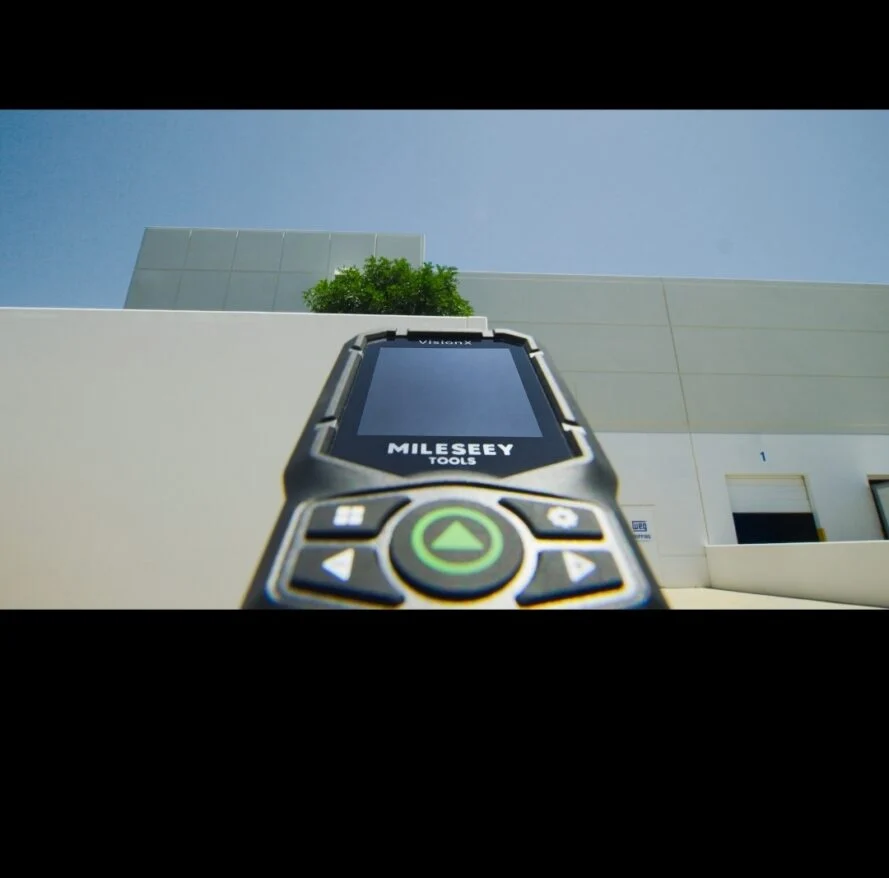
As the architecture, engineering, and construction (AEC) industry faces increasing pressure to minimize its environmental footprint, the focus has shifted toward efficiency at the source. While sustainable building often highlights materials and energy-efficient systems, a quiet revolution is occurring in the way professionals capture and manage site data. Leading this charge toward a more "digitally native" job site are the MILESEEY S50 and S50C laser distance meters, devices that are transforming raw measurements into actionable project intelligence.
Main Facts: A New Era of Site Documentation
In the traditional construction workflow, the measurement phase was often an isolated, manual process. Professionals would visit a site, record dimensions in a notebook, take disparate photographs, and later attempt to reconcile that information back at the office. This disconnected approach is a notorious source of inefficiency, leading to "rework"—the costly process of correcting errors caused by inaccurate data or miscommunication.
The MILESEEY S50 and S50C series represent a significant pivot in this workflow. By bridging the gap between hardware and cloud-based documentation, these tools allow for the immediate integration of spatial data into digital project files. The key facts of this technology include:
- Integrated Digital Workflow: Measurements are no longer siloed; they are automatically synced with mobile applications to create a cohesive digital record.
- Point-to-Point (P2P) Capability: The S50 series allows for the measurement of complex or hard-to-reach dimensions without the need for physical access to the point itself, increasing safety and reducing the need for specialized equipment like ladders or lifts.
- Context-Aware Data: The devices allow for the attachment of measurements directly to photographs and digital floor plans, ensuring that every dimension is tied to its physical location.
- Professional Versatility: The S50 is optimized for interior precision and compactness, while the S50C features camera-assisted targeting for outdoor visibility and long-range accuracy.
Chronology: The Evolution of Measurement Technology
To understand the impact of the S50 and S50C, one must look at the timeline of site documentation.
1. The Analog Era (Pre-1990s): The industry relied exclusively on physical tape measures. The process was time-consuming, highly susceptible to human error, and required multiple personnel for larger spans. Data storage was paper-based, making it difficult to share or update in real-time.

2. The First Wave of Laser Distance Meters (1990s–2010s): The introduction of laser technology provided a massive leap in accuracy and speed. However, these tools remained "standalone" devices. A laser could tell you a wall was 12 feet long, but the information remained disconnected from the architectural blueprints or the contractor’s estimate.
3. The Connected Phase (2015–2023): As smartphones and tablets became standard on-site, the first generation of Bluetooth-enabled laser meters emerged. While they offered basic data transfer, they often lacked the software ecosystem to make the data truly "smart."
4. The Modern Intelligent Ecosystem (2024–Present): With the introduction of the MILESEEY S50 and S50C, we have entered an era of "Contextual Measurement." The technology now acts as a hub for project data. The measurement is merely the first step; the tool’s true value lies in its ability to export that data into BIM (Building Information Modeling) environments and shared cloud platforms, ensuring that every stakeholder—from the architect to the HVAC installer—is working from the same, verified set of numbers.
Supporting Data: The High Cost of Inaccuracy
The industry-wide move toward smarter measurement is driven by cold, hard data. According to various AEC industry reports, errors in documentation are among the leading causes of project budget overruns.
- Rework Costs: Studies indicate that rework can account for anywhere from 5% to 20% of a project’s total cost. Much of this is attributed to "field conditions" not matching the initial blueprints.
- Material Waste: When measurements are off by even a few inches, it can lead to excess material ordering. In a large-scale project, this results in significant amounts of unused gypsum, lumber, or steel being sent to landfills, directly impacting the project’s carbon footprint.
- Site Efficiency: Time is a finite resource. By reducing the number of site visits required to verify a dimension or "double-check" a calculation, firms can significantly increase their throughput and reduce the carbon cost of travel associated with frequent site inspections.
The S50 and S50C address these metrics by providing a "single source of truth." When the measurement is digitally captured and tagged, the margin for manual transcription error drops to near zero.

Official Perspectives: The Value of Precision
Industry experts and sustainability advocates have long argued that "green building" begins with the first line drawn on a plan. By ensuring that the "as-built" conditions are perfectly understood, professionals prevent the need for demolition or site adjustment once the project is underway.
Representatives from the development side of the industry emphasize that the S50 series is not just about the laser; it is about the communication the laser facilitates. "When an architect and a contractor are looking at the same digital file, with the same verified measurements attached to the same site photos, the entire project dynamic changes," noted an industry consultant. "The adversarial relationship that often develops when plans don’t match the site disappears because the ambiguity has been removed."
Furthermore, the integration of these tools into standard mobile workflows supports the rise of "Remote Supervision." Senior project managers can now view data captured by junior staff on-site in real-time, providing immediate guidance and preventing errors before they are cast in concrete.
Implications for the Built Environment
The implications of adopting technology like the MILESEEY S50 and S50C extend far beyond individual project convenience. There are three primary long-term impacts:
1. The Circular Construction Model
For renovation projects, the ability to accurately document existing structures is the first step toward circularity. If we want to reuse existing buildings rather than demolish them, we must understand their exact dimensions and structural limitations. Smart measurement tools are the key to unlocking the potential of adaptive reuse by providing the precise data needed for structural retrofitting.

2. Democratization of Digital Literacy
By making sophisticated, connected measurement technology accessible, companies like MILESEEY are helping smaller renovation teams compete with larger firms. When small-scale contractors can provide the same level of digital documentation as major architectural firms, the standard of quality across the entire industry rises.
3. Reduced Environmental Impact
The environmental cost of construction is heavily influenced by inefficiencies. Every extra trip to the hardware store, every incorrect cut of material, and every piece of waste represents carbon emissions. While a laser meter is a small device, the aggregate effect of millions of precise measurements—leading to reduced waste and improved planning—is a substantial contribution to the industry’s sustainability goals.
Conclusion: A Foundation of Better Information
Technology, in its most effective form, acts as an invisible hand that guides human activity toward higher efficiency. The MILESEEY S50 and S50C are prime examples of this principle. They do not replace the expertise of the architect or the contractor; rather, they provide the foundation upon which that expertise can operate more effectively.
As the construction industry continues its digital transformation, the importance of "data integrity" will only grow. We are moving toward a future where every building has a "digital twin," and that twin begins its life with the measurements taken by tools on the ground. By prioritizing accurate, context-heavy documentation, we are not just measuring distances; we are measuring the future of a more efficient, sustainable, and collaborative built environment.
In the final analysis, building more sustainably is as much about the information we possess as it is about the materials we choose. With the integration of smarter, more connected measurement tools, the AEC industry is finally closing the loop between the physical site and the digital plan, ensuring that every project starts on solid—and accurate—ground.
