

For decades, the "base model" muscle car has occupied an awkward space in the automotive hierarchy. To the purist, a muscle car without a V8 is merely a shell—a marketing exercise designed to capture the aesthetic of power without the substance. Historically, entry-level variants were treated as afterthoughts, often saddled with uninspired, sluggish V6 engines pilfered from mass-market family sedans. These cars were the punchline of automotive discourse, offering the weight of a pony car with the performance of a grocery-getter.
However, a quiet revolution has taken place over the last decade. Automakers have pivoted away from the wheezing, naturally aspirated V6 engines of the 1990s and early 2000s in favor of sophisticated, turbocharged four-cylinder powerplants. While purists continue to lament the displacement deficit, the data paints a vastly different picture: modern base-model muscle cars are not only faster and more efficient than their V6 predecessors, but they are also objectively superior performance machines.
A Stagnant Past: The 1993 Camaro Reality Check
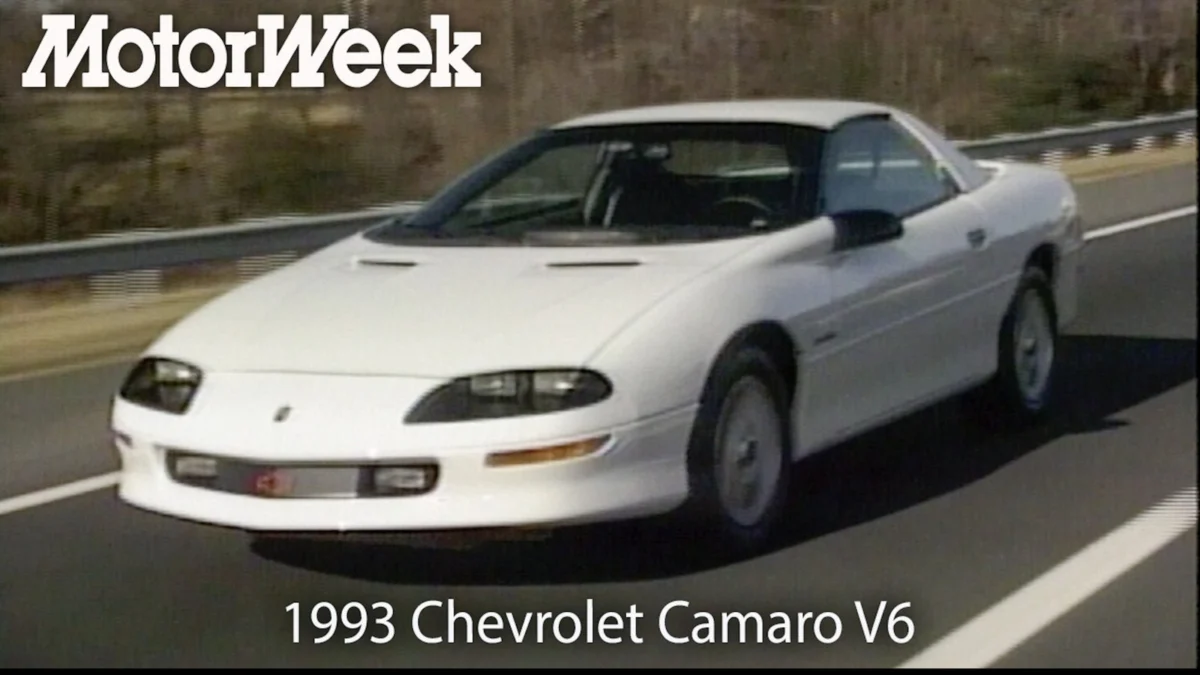
To understand the progress made by modern engineering, one must look back at the nadir of the base-model muscle car. A recent MotorWeek Retro Review of the 1993 Chevrolet Camaro V6 serves as a sobering reminder of just how lackluster these entry-level offerings once were.
In 1993, the base Camaro was a heavy, lumbering beast equipped with a powertrain that prioritized cost-cutting over character. When MotorWeek put the car through its paces, the results were, frankly, embarrassing for a brand that prided itself on performance. The car posted a 0-to-60 mph time of 8.8 seconds—a figure that, even by 1990s standards, was lethargic.
Even more jarring was the competitive landscape of the era. A manual-transmission 1993 Nissan Altima—a humble, mid-size family sedan—managed to out-sprint the base Camaro by over half a second in contemporary tests. In an era where the muscle car was supposed to represent the pinnacle of American "get up and go," having a pedestrian commuter car leave you at a stoplight was a public relations nightmare. The 4-speed automatic transmissions of the time, characterized by sluggish shifts and poor power delivery, only compounded the problem, turning the Camaro into little more than a badge-wearing cruiser.
The Chronology of Displacement vs. Density
The shift from V6 to turbo-four was not an overnight decision; it was a response to tightening emissions regulations, fuel economy mandates, and advancements in forced induction technology.
- The 1990s (The Era of the "Econo-V6"): The industry standard for base muscle cars was a naturally aspirated V6. These engines were designed for longevity and low manufacturing costs rather than peak performance. They were heavy, high-friction, and often lacked the low-end torque necessary to move the heavy chassis of a Mustang or Camaro with any sense of urgency.
- The Mid-2000s (The Transitional Phase): As technology improved, variable valve timing and better intake manifold designs allowed V6 engines to become more potent. However, the weight penalty remained, and fuel efficiency continued to be a significant pain point for consumers looking for a daily-drivable performance car.
- 2015–Present (The Turbo-Four Renaissance): With the introduction of the 2015 Ford Mustang EcoBoost and the 2016 Chevrolet Camaro 2.0T, the paradigm shifted. By utilizing turbochargers, engineers could extract V8-levels of torque from smaller displacements, significantly reducing the weight over the front axle and creating a more balanced, agile platform.
Supporting Data: Why the Turbo-Four Wins
The transition to forced-induction four-cylinders has yielded quantifiable improvements in nearly every performance metric.
When the sixth-generation Chevrolet Camaro debuted in 2016, it arrived with a 2.0-liter turbocharged four-cylinder producing 274 horsepower and 295 lb-ft of torque. Car and Driver tested the manual-transmission variant and clocked a 0-to-60 time of 5.4 seconds. This was not only a monumental leap over the 1993 model but also over half a second quicker than the V6-powered Nissan Altima of the 2013 model year. More importantly, the lighter engine resulted in superior weight distribution, giving the Camaro genuine handling dynamics that allowed it to compete with European sports coupes.
The Ford Mustang EcoBoost offers perhaps the most compelling evidence. Its 2.3-liter turbocharged engine generates an impressive 315 horsepower and 350 lb-ft of torque. In recent testing, the 10-speed automatic variant sprinted to 60 mph in just 4.5 seconds. To put this in perspective, that is a full second faster than the highly regarded Honda Accord 2.0T—a benchmark for the "sport sedan" category. When comparing this to MotorWeek’s 1997 test of a V6 Mustang convertible, which took a dismal 10.1 seconds to reach 60 mph, the contrast is staggering. Even the early 2015 EcoBoost convertible, which felt like a massive upgrade at the time, posted a 6.1-second sprint, illustrating how rapidly Ford has refined the platform.
The Efficiency Argument: Beyond the Stopwatch
Beyond pure acceleration, the turbo-four architecture offers a fundamental advantage in thermal efficiency and fuel management. Modern turbochargers allow for a "best of both worlds" scenario: off-boost, the engine acts as a small-displacement unit, sipping fuel during highway cruising. On-boost, the engine provides the immediate torque curve that V6 engines—which typically require high RPMs to reach their peak power—struggle to match.
While critics often argue that forced induction sacrifices the linear power delivery of a naturally aspirated engine, the reality is that the "torque wall" provided by modern turbochargers makes these cars feel significantly punchier in real-world driving conditions, such as passing on the highway or accelerating away from a stoplight.
Official Industry Stance and Market Realities
While the performance data is undeniable, the automotive industry has faced a delicate balancing act. Companies like Mercedes-AMG have learned that there is a limit to how far the "downsizing" trend can go. When AMG replaced their iconic V8 with a high-strung four-cylinder in the C63, the backlash from the enthusiast community was swift. Sales numbers suggested that, at the ultra-luxury price point, buyers were not just paying for performance—they were paying for the character, the sound, and the prestige associated with eight cylinders.
However, for the entry-level muscle car segment, the calculus is different. The target demographic for a base-model Mustang or Camaro often values a blend of style, modern tech, and accessible daily performance. Manufacturers have recognized that as long as the base model is "fast enough" and offers a driving experience that feels distinct from a standard sedan, the lack of two cylinders is a trade-off the market is willing to make.
Implications for the Future of the Segment
The era of the V6 base-model muscle car is effectively closed, and the industry is arguably better for it. By moving to turbocharged four-cylinders, automakers have created cars that are lighter, faster, and more efficient than anything that preceded them in the entry-level tier.
However, the future of this segment remains in flux. As the industry pushes toward full electrification, the "four-cylinder muscle car" may itself become a transitional technology. If the internal combustion engine is indeed on its way out, the current generation of turbocharged pony cars represents the final, perfected form of the traditional enthusiast machine.
Ultimately, the stigma attached to base-model muscle cars is a relic of the 1990s. When you can buy a four-cylinder car that outperforms the sports sedans and V6 muscle cars of the past while returning better fuel economy, the "base model" label ceases to be an insult. It becomes a badge of engineering competence. While nothing may ever truly replace the rumble of a big-block V8, the modern turbocharged four-cylinder has successfully transformed the base-model muscle car from a punchline into a legitimate performer.
