

In the hyper-competitive arena of boutique hypercar manufacturing, where the pursuit of astronomical horsepower and record-breaking top speeds has become the baseline, Texas-based Hennessey Performance has charted a radical new course. The American manufacturer, widely recognized for the raw, record-shattering performance of the Venom F5, has unveiled its third all-new model: the Blackbird.
Representing a pivot from the pursuit of absolute, unadulterated speed to the "maximum man-machine connection," the Blackbird is a love letter to the analogue era of motoring, wrapped in the high-tech skin of a modern-day aviation masterpiece.
Main Facts: Engineering the Analogue Dream
The Blackbird is not merely a successor to the Venom F5; it is a spiritual pivot. While the F5 was designed to punch a hole through the 300mph barrier, the Blackbird seeks to punch a hole through the sterile, digitized experience of modern performance cars.
The Powertrain: A Symphony of Combustion
At the center of this machine sits a bespoke, high-revving, naturally aspirated V8 engine. Developed in close collaboration with the legends at Ilmor Engineering—a name synonymous with NASCAR dominance and engineering excellence—the powerplant is designed to scream to a 9,000rpm redline. Eschewing the trend of forced induction, this atmospheric engine provides a linear, immediate throttle response that has become a rarity in the current market.
Transmission and Dynamics
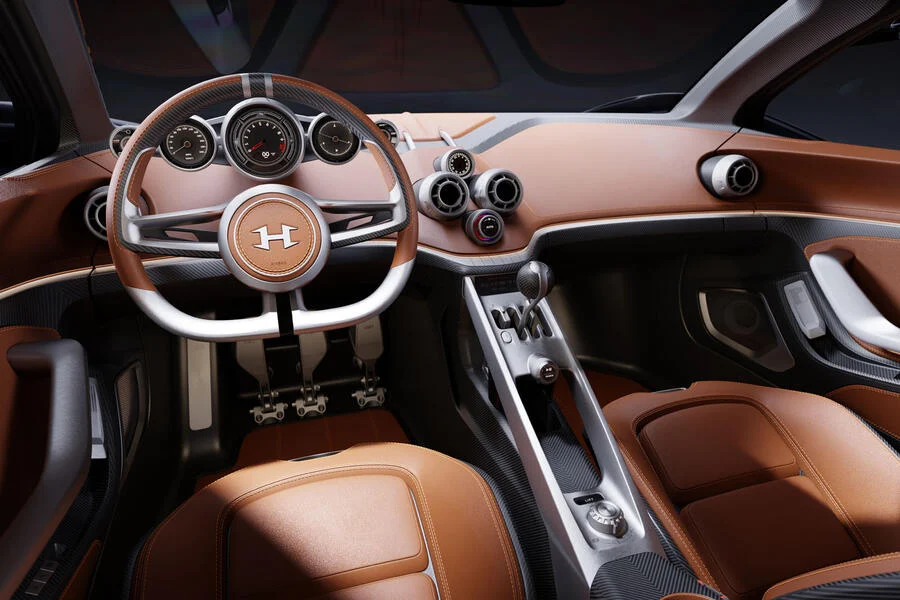
In an era of dual-clutch transmissions and lightning-fast paddle shifters, Hennessey has made the bold decision to equip the Blackbird with a traditional open-gate, exposed-linkage, six-speed manual gearbox. This is the heart of the "analogue" promise. Power is routed exclusively to the rear wheels, requiring a driver who is not only skilled but deeply attentive. While the car features modern safety nets, including active suspension, sophisticated anti-lock braking (ABS), and traction control, the philosophy remains clear: the electronics are there to assist, not to insulate.
Weight and Construction
Hennessey has targeted a dry weight of under 1,360kg (3,000lb). This lightness is achieved through an obsessive use of carbon fiber, forming both a bespoke monocoque tub and the exterior bodywork. By maintaining such a lean profile, Hennessey ensures that the 800-850bhp output translates into a power-to-weight ratio that rivals the most agile track cars on the planet, while still maintaining the comfort expected of a grand tourer.
Chronology: From Concept to Runway
The inception of the Blackbird project traces back to a desire within Hennessey to honor the golden age of aerospace innovation.
- Early Design Phase: Following the completion of the core development for the Venom F5, the design team at Hennessey began exploring a vehicle that balanced the F5’s intensity with the long-distance comfort of a grand tourer.
- Aviation Collaboration: The decision to lean into the SR-71 Blackbird aesthetic was not an afterthought; it was the foundation. Hennessey secured the legal rights to the name, ensuring the vehicle could carry the legacy of the Lockheed spy plane with legitimacy.
- The Ilmor Partnership: Engineering the high-revving V8 was a multi-year project, requiring Ilmor’s expertise to ensure reliability at 9,000rpm while maintaining the visceral sound profile expected of a naturally aspirated American V8.
- Final Prototyping: Throughout the latter half of 2023 and early 2024, the vehicle underwent rigorous testing to ensure that the active aerodynamics—modeled after the SR-71’s tail fins—functioned in perfect harmony with the chassis dynamics.
Supporting Data: By the Numbers
To understand the Blackbird’s standing in the industry, one must look at the performance benchmarks Hennessey has set for its latest creation:
| Specification | Target Metric |
|---|---|
| Engine Configuration | Naturally Aspirated V8 |
| Horsepower | 800 – 850 bhp |
| Redline | 9,000 rpm |
| 0-60 mph | < 3.0 seconds |
| Top Speed | 220 mph |
| Dry Weight | < 1,360 kg (3,000 lbs) |
| Aerodynamic Features | Active rear stabilizers (tilt up to 71 degrees) |
The vehicle’s "long-range" capability is a specific design mandate. Hennessey engineers aimed for a car capable of covering 800 miles in a single day—a feat that requires not just mechanical reliability, but significant cabin ergonomics. The inclusion of space for two full-size carry-on bags confirms that the Blackbird is intended to be a weapon for grand touring as much as a tool for track day domination.
Official Responses and Philosophy
In a statement regarding the vehicle’s development, the Hennessey team emphasized that the Blackbird is a rejection of the "screen-heavy" culture of modern automotive interiors.

"We wanted to build a car that remembers why we fell in love with driving," the company noted. By replacing digital displays with physical dials and clocks, and substituting integrated infotainment systems with a simple, functional smartphone mount, Hennessey has stripped away the distractions.
The steering wheel, conspicuously devoid of buttons or switches, is intended to be a tactile experience. "When you are behind the wheel of the Blackbird, you are not navigating a menu; you are navigating the road."
Regarding the tribute to the Bell X-1, the quad-exhaust layout serves as a visual and auditory nod to the first aircraft to break the sound barrier. Every crease in the carbon fiber bodywork has been wind-tunnel tested to mirror the aerodynamic efficiency that allowed the SR-71 to remain untouchable in the stratosphere.
Implications: A New Direction for Supercars
The introduction of the Hennessey Blackbird creates a fascinating dichotomy in the hypercar market. It arrives as a direct, analogue alternative to the McLaren W1 and other high-tech, hybrid-heavy machines.
The Analogue Renaissance
The market has seen an increasing demand for "pure" driving experiences. As manufacturers pivot toward electrification, the Blackbird stands as a final, high-octane celebration of internal combustion. Its reliance on a manual gearbox is a bold, almost defiant, statement in a world dominated by paddle-shift automatics.
Competitive Positioning
By targeting the 800-850bhp range, Hennessey is positioning the Blackbird in a "sweet spot." It is powerful enough to be terrifyingly fast, but not so cumbersome that it loses the agility that defines a true driver’s car. While its top speed of 220mph is "only" a fraction of the Venom F5’s potential, it is more than sufficient for any road-going environment.
The "Spy Plane" Legacy
The use of the SR-71 as a design motif is more than a marketing gimmick. By integrating active aerodynamics that respond to speed—specifically tilting to 71 degrees at speeds over 71mph—Hennessey has successfully bridged the gap between aerospace engineering and automotive performance. This level of technical thematic integration is rarely seen in the hypercar segment and establishes a new benchmark for "themed" vehicles.
The Future of Hennessey
The Blackbird signals that Hennessey is moving beyond the role of a pure "speed shop." They are now a comprehensive manufacturer capable of producing refined, comfortable, and highly nuanced automobiles. The shift from the raw, utilitarian focus of the Venom F5 to the polished, driver-centric ethos of the Blackbird demonstrates a maturity that will likely secure the brand’s position as a permanent fixture in the luxury performance space.
Conclusion: The Road Ahead
As the automotive industry faces an inevitable transition toward silent, electric powertrains, the Hennessey Blackbird arrives as a thunderous reminder of what is possible when human passion meets mechanical genius. It is a car that demands engagement, rewards skill, and refuses to apologize for its existence. For the collector who values the sensation of a mechanical link between their hands, their feet, and the tarmac, the Blackbird is arguably the most significant vehicle Hennessey has ever produced. It does not seek to conquer the world with numbers alone; it seeks to conquer the driver with an experience that is, in every sense, supersonic.
