

Editor’s Note: This is a sponsored posting.
In the ongoing effort to decarbonize the American household, few initiatives have seen as rapid an expansion as curbside organics collection. From dense urban centers to suburban cul-de-sacs, the "green bin" has become the latest frontier in municipal waste management. However, while the logistical infrastructure is expanding at breakneck speed, a quiet, unglamorous obstacle threatens the long-term viability of these programs: the "yuck factor."
According to BioCycle’s 2023 nationwide survey, 14.9 million U.S. households now have access to food waste collection services. That represents a staggering 49% increase from just two years prior, when access was limited to 10 million households. Yet, the existence of the service is only half the battle. Participation rates remain uneven, ranging from near-universal adoption in leading cities to under 30% in others. This participation gap is not merely a statistical curiosity; it is an environmental imperative.
Main Facts: The Environmental Stakes
Food waste represents approximately 24% of the total material entering U.S. municipal landfills. When buried in the anaerobic conditions of a landfill, this organic matter undergoes decomposition that releases significant quantities of methane—a greenhouse gas with a global warming potential significantly higher than carbon dioxide. The Environmental Protection Agency (EPA) estimates that food waste accounts for 58% of the fugitive methane emissions from landfills.
When a municipality rolls out a green bin program, the goal is to divert that waste to composting or anaerobic digestion facilities. However, an unused or abandoned green bin is not a neutral outcome; it represents a sunk cost in public infrastructure and a missed opportunity for climate mitigation. To bridge the gap between "access" and "adoption," municipalities and residents must confront the physical reality of the bin itself.

Chronology: The Evolution of Organic Collection
The push for organic waste diversion began as a niche environmental effort in the early 2000s, primarily in progressive West Coast and Canadian cities. The evolution of these programs has followed a distinct trajectory:
- 2000–2015 (The Pilot Phase): Early adopters experimented with various collection methods, often struggling with contamination and low participation due to the inconvenience of backyard composting.
- 2015–2020 (The Scale-Up): Municipalities began integrating organics into standard waste management contracts. "Green bins" became the industry standard for nomenclature, regardless of the bin’s actual color (e.g., Toronto’s Green Bin vs. New York’s brown carts).
- 2020–2023 (The Expansion): Driven by ambitious climate goals and landfill diversion mandates, cities across the U.S. accelerated rollout timelines.
- 2023–Present (The Optimization Phase): As programs mature, data is shifting focus from "getting the bins to the curb" to "ensuring the bins stay in use."
Supporting Data: Why Households Opt Out
Despite the environmental benefits, households frequently abandon organics collection. While confusion regarding acceptable materials and forgetting collection days are commonly cited reasons, there is an often-overlooked factor: the physical maintenance of the bin.
The "yuck factor"—the accumulation of decaying organic liquid, odor, and the subsequent need for frequent, unpleasant cleaning—is a significant deterrent. While comprehensive studies isolating "bin cleaning" as a primary reason for program abandonment are still emerging, anecdotal evidence from waste management coordinators consistently highlights it as a top complaint.
The efficacy of addressing this pain point was demonstrated in the UK’s 2023–24 Food Recycling Project in Essex. The council provided 375,000 households with a support package, including educational materials and, crucially, free compostable liners. Within three months, food recycling tonnage increased by 21%—more than double the council’s target. While this was a multi-faceted campaign, the inclusion of tools to manage the physical mess proved to be a catalyst for sustained behavior change.
The Mechanical Solution: Bridging the Gap
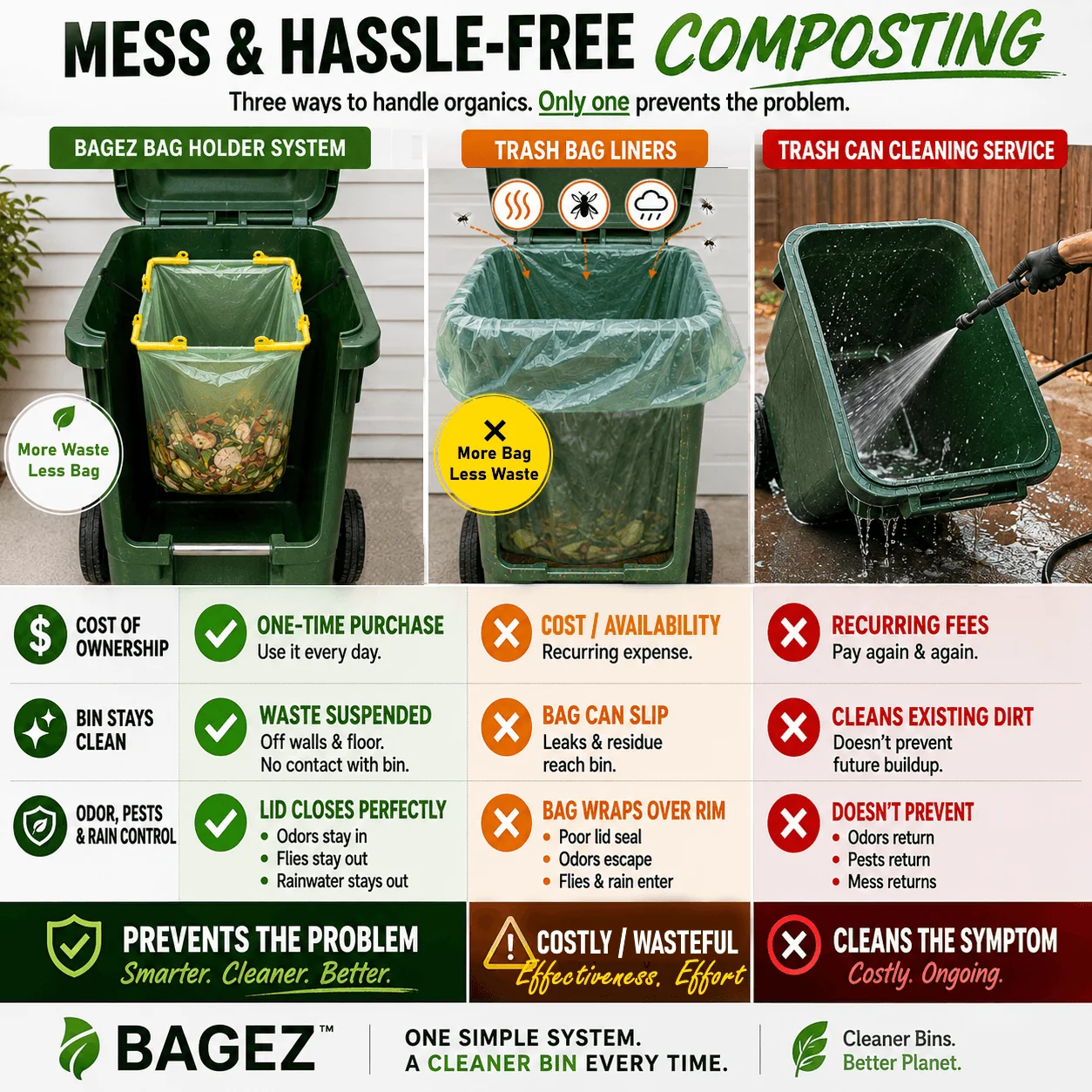
The question for most households remains: if the city isn’t providing free liners or cleaning services, how can they maintain a sanitary bin without it becoming a weekly chore? This is the niche that emerging solutions, such as the BagEZ system, seek to fill.

The logic is simple: if the waste never touches the bin, the bin never becomes a source of odors or pests. The BagEZ system utilizes a folding steel frame that locks a standard bag—any size from 13 gallons upward—in a suspended position inside the curbside cart. By holding the bag open and away from the bin walls, the system facilitates airflow.
This is not just about convenience; it is about physics. The "puddle" often found at the bottom of a bin is the result of trapped moisture. When organic waste breaks down, it releases water. In a traditional setup, this liquid leaks from bags or accumulates as condensation between the bag and the bin wall, creating a breeding ground for flies and bacteria. By suspending the bag, moisture evaporates, and the walls remain dry. This simple structural change effectively mitigates the odors that attract raccoons and rodents, turning a high-maintenance chore into a passive, sanitary process.
Official Responses and Municipal Perspectives
Waste management experts emphasize that there is no "one-size-fits-all" approach to bin management. However, there is a consensus that contamination and participation are the twin pillars of success.
"Contamination is the enemy of the composting process," says a spokesperson from a major municipal waste authority. "When residents are discouraged by the mess, they either stop participating or, worse, start throwing non-compostable items into the bin to mask the smell. Making the process cleaner and more manageable is a key component of our outreach strategy."
Municipalities generally advise residents to check local guidelines before adopting new liners. Some facilities are equipped to process certified compostable bags, while others strictly require loose collection or paper-based liners. Tools like the Earth911 recycling database have become essential for residents looking to navigate these varying local regulations.

Implications for the Future of Waste Management
The future of the green bin program relies on the normalization of organic waste as a standard household utility, much like recycling or trash. For this to occur, the "experience" of using the bin must be frictionless.
- Reduced Infrastructure Costs: When residents effectively manage their own bins, the demand for costly, city-subsidized bin cleaning services decreases.
- Higher Diversion Rates: As the "yuck factor" is removed, households are more likely to participate, leading to higher capture rates of food scraps that would otherwise end up in landfills.
- Improved Composting Quality: cleaner collection methods—specifically those that prevent the mixing of organic matter with contaminants—lead to a higher quality of finished compost, which is a valuable agricultural resource.
The path forward is clear: we must stop viewing the green bin as a static container and start viewing it as a component of a dynamic household system. By utilizing simple, mechanical solutions to keep waste contained, we can transform the green bin from a source of frustration into a seamless part of the modern, sustainable home.
Conclusion: A Simple Shift for Lasting Change
We are currently in a pivotal moment for urban sustainability. The infrastructure for massive waste diversion is largely in place; the challenge now lies in the human element. The transition to zero-waste living will not be won by complex technology alone, but by small, consistent improvements in how we manage our daily habits.
Whether through the use of mechanical frames to suspend waste, the strategic use of natural repellents like peppermint and cloves to deter pests, or simply selecting the right bag for the specific needs of a household, the goal is the same: to remove the barriers that prevent us from doing the right thing.
The green bin is more than just a cart on the curb; it is a commitment to a circular economy. By making that commitment easy, clean, and efficient, we ensure that the progress made in the last two years is just the beginning of a much larger, global shift toward a more sustainable future. For those looking to streamline their own participation, the technology is already here—it’s just a matter of changing how we use the space within the bin.

About the Author
This sponsored article was written by Sean Rana, the founder of BagEZ. A Canadian innovator dedicated to simplifying household waste management, Rana developed the steel hanging bag frame to empower residents to maintain clean and efficient waste systems without the need for expensive, ongoing, or specialized services. For more information on simplifying your household waste routine, visit bagez.com.
