

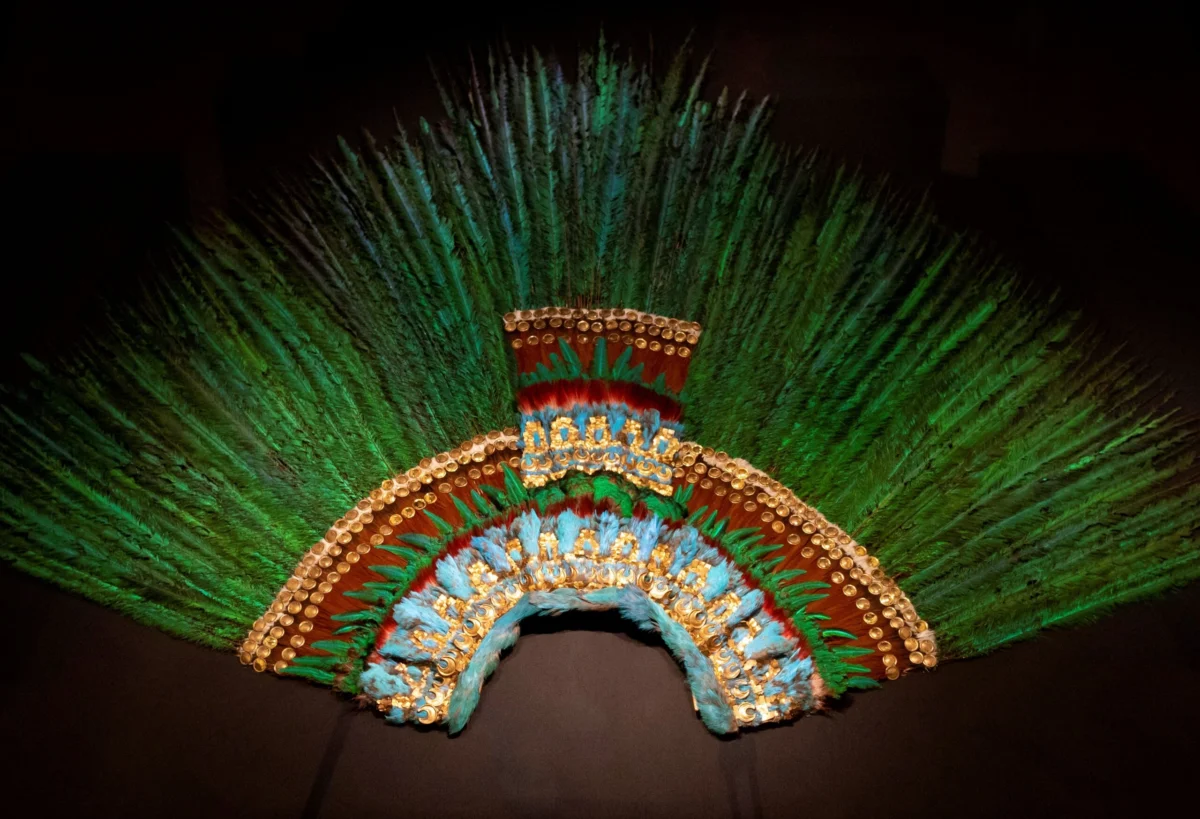
In an era defined by a global reckoning over the ethics of colonial-era acquisitions, the long-standing tug-of-war between Mexico and Austria over the Penacho de Moctezuma has found a new, unlikely catalyst. Gunther Fehlinger-Jahn, an Austrian economist, political analyst, and declared presidential hopeful for the 2028 cycle, has ignited a fresh diplomatic firestorm by pledging to repatriate the 16th-century Aztec headdress to Mexico should he ascend to the presidency.
The artifact—a breathtaking, four-pound masterpiece of quetzal feathers and gold ornamentation—is currently housed at the Weltmuseum in Vienna. For decades, it has served as the ultimate symbol of the complex, often fraught, relationship between European museums and the nations whose history they hold in trust. Fehlinger-Jahn’s promise is not merely a campaign talking point; it is a direct challenge to the status quo that has seen generations of Mexican leadership rebuffed in their efforts to recover one of their nation’s most sacred cultural relics.
The Artifact: A Masterwork of the Mexica
The penacho, often associated with the Aztec Emperor Moctezuma II, is a marvel of pre-colonial craftsmanship. Spanning approximately six by four feet, the headdress is composed of the iridescent, emerald-green feathers of the resplendent quetzal, once reserved for the highest echelons of Aztec royalty. These plumes are intricately set into a network of gold ornaments and secured by slender, delicate wooden rods.
Beyond its physical beauty, the headdress serves as a potent symbol of the Mexica civilization—the dominant power in the Valley of Mexico prior to the Spanish Conquest. Because of its historical weight, its presence in a European capital is viewed by many in Mexico as a lingering, tangible remnant of the colonial era. While the Weltmuseum presents it as a cultural treasure belonging to the world, the Mexican public and government view its continued presence in Vienna as an act of historical dispossession.
A Chronology of Contention
The dispute over the penacho is not a modern invention; it is a narrative that has unfolded over centuries.

- The 16th Century: Historical consensus suggests the headdress arrived in Europe sometime in the 1500s, likely sent as a gift or seized as spoils during the initial period of contact and conquest. How it arrived in the possession of the Habsburg dynasty remains a subject of intense scholarly debate.
- The 20th Century: As post-colonial nationalism took root in Mexico, the demand for the return of the headdress gained formal traction. Throughout the late 1900s, various Mexican administrations initiated quiet diplomatic channels to bring the penacho home.
- 2020–2021: The issue reached a fever pitch under former Mexican President Andrés Manuel López Obrador. In an ambitious bid to commemorate the 500th anniversary of the fall of Tenochtitlan, López Obrador personally requested that Austria loan the artifact to Mexico for a temporary exhibition.
- The 2021 Rejection: The Austrian government, citing the extreme fragility of the centuries-old feathers, refused the request. Austrian authorities argued that the structural integrity of the artifact was too precarious to withstand the stresses of transport.
- 2026: Gunther Fehlinger-Jahn, positioning himself as a candidate for the 2028 presidential race, made his landmark pledge to the Art Newspaper, signaling a shift toward a more conciliatory, bilateral approach to restitution.
The Fragility Defense vs. Scientific Skepticism
The cornerstone of Austria’s refusal to return or even loan the penacho has consistently been the scientific assessment of its fragility. A joint study conducted by Austrian and Mexican conservators years ago concluded that the movement of the artifact could lead to irreparable damage. The vibrant green quetzal feathers, sensitive to light, temperature, and physical vibration, are considered so delicate that the Weltmuseum has maintained a strict "no-travel" policy.
However, this justification has not satisfied the international community of heritage scholars. Some experts have openly contested these findings, arguing that modern logistics and climate-controlled transport technology are more than capable of ensuring the safety of the object. Critics of the current policy suggest that the "fragility" argument is, in effect, a convenient bureaucratic shield used to avoid setting a precedent that could trigger a cascade of repatriation demands for other artifacts housed in European institutions.
Official Responses and the Diplomatic Landscape
The Austrian government has long maintained a posture of caution, often pointing to their national laws regarding the "inalienability" of museum collections. Yet, Fehlinger-Jahn’s intervention introduces a populist, reformist element to the debate. By stating that "Austria and Mexico should negotiate a bilateral solution based on friendship rather than confrontation," he is attempting to decouple the issue from the rigid legalism that has defined the past decades.
The Mexican government, for its part, has taken a multi-pronged approach. Recognizing that the original penacho remains in Vienna, they have invested heavily in the display of a high-quality replica at the National Museum of Anthropology in Mexico City. This allows the public to engage with the history of the piece while the diplomatic struggle for the original continues in the background.
Implications of the "Fehlinger-Jahn Doctrine"
If a candidate for the Austrian presidency is willing to campaign on the return of a high-profile artifact, it signals that the politics of restitution are shifting from the fringes of cultural discourse to the center of national policy.

1. The Precedent of Colonial Loot
The penacho is only one of many objects in the Weltmuseum’s collection that are subject to similar disputes. A successful return of the headdress would essentially force the Austrian state to create a legal framework for repatriation. This would have profound implications for museums worldwide, potentially opening the floodgates for claims from nations across the Global South.
2. The Role of Bilateral Diplomacy
Fehlinger-Jahn’s emphasis on "friendship" suggests a desire to trade cultural assets for diplomatic capital. In the current global climate, where soft power is as valuable as hard military or economic strength, returning a national treasure could secure Austria a lasting, positive legacy in Latin America, potentially opening doors for trade and political alliances that have been strained by the lingering "colonial hangover."
3. The Future of Museum Ethics
The debate surrounding the penacho highlights a growing divide between two philosophies of museology. The first views the museum as a "universal" institution, where artifacts are preserved for the benefit of humanity as a whole, regardless of their origin. The second, increasingly dominant view, posits that artifacts carry specific cultural and spiritual significance that can only be fully realized when they are returned to their communities of origin.
Conclusion: A Turning Point
As the 2028 election cycle approaches, Gunther Fehlinger-Jahn’s pledge acts as a mirror to the Austrian public, asking them to consider what their nation owes to the history of others. Whether the penacho ever makes the journey across the Atlantic remains to be seen. However, the fact that the future of a 16th-century Aztec headdress is now a legitimate plank in an Austrian presidential platform is, in itself, a historic development.
The struggle for the penacho is no longer just a dispute between two museums or two governments; it is a profound examination of how modern nations address the ghosts of their past. Whether through the lens of preservation or the lens of justice, the story of the penacho serves as a reminder that history is never truly static—it is a living, breathing, and often contentious dialogue between the present and the past. As Austria moves toward its next political chapter, the fate of the headdress will remain a litmus test for the country’s willingness to reconcile its imperial history with the expectations of a globalized, post-colonial future.
