

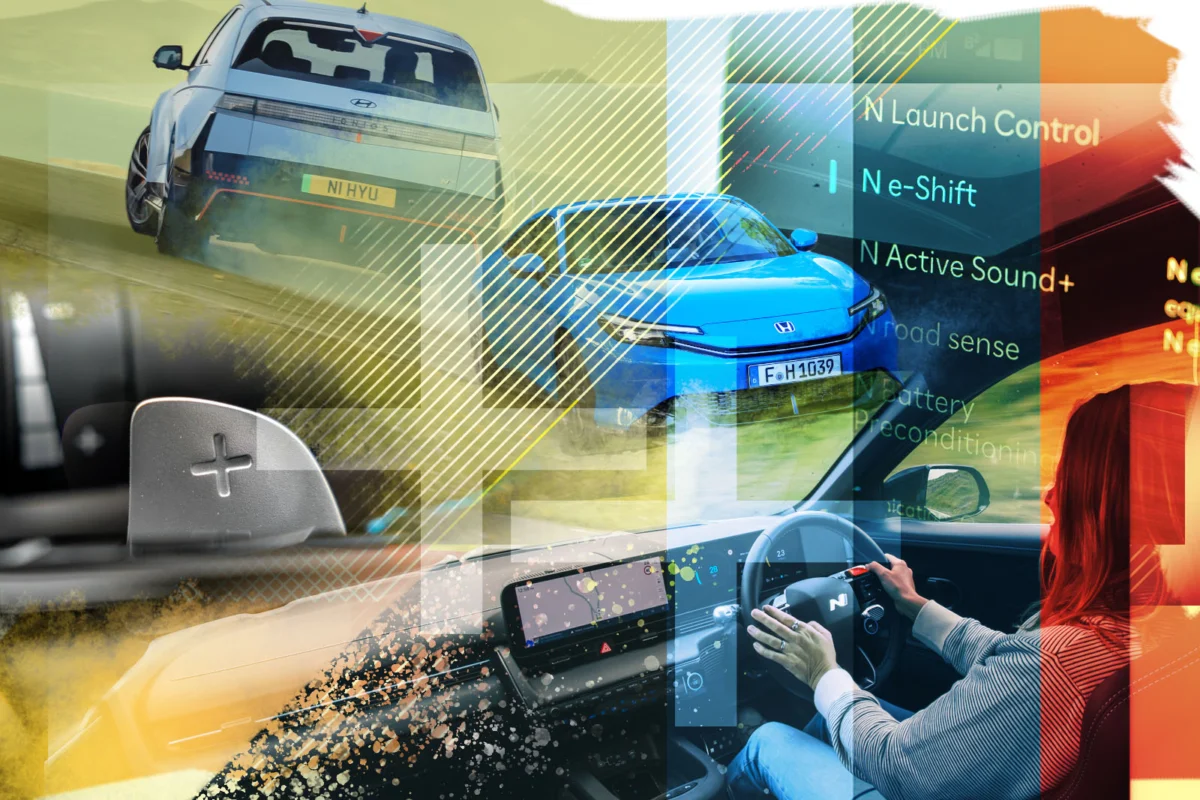
For over a century, the internal combustion engine (ICE) and the manual or dual-clutch transmission have existed in a symbiotic dance. The mechanical connection between a driver’s right foot, the engine’s RPMs, and the gear changes has been the bedrock of the driving experience. However, as the automotive industry pivots toward an all-electric future, the inherent "perfection" of electric motors—which provide instant, seamless torque without the need for traditional gear ratios—has left a void in the soul of the sports car.
Enter the "virtual gearbox." Pioneered most notably by Hyundai’s N division, this technology aims to reintroduce the friction, the engagement, and the visceral drama of shifting gears into the sanitized world of electric vehicles (EVs). It is a trend that asks a fundamental question: Is "fake" actually better if it makes the car feel more alive?
Main Facts: The Architecture of Illusion
The concept of a virtual gearbox, such as Hyundai’s N e-Shift, is an exercise in sophisticated sensory manipulation. In a traditional EV, power delivery is linear; the motor spins, and the wheels turn. There is no shift shock, no hesitation, and no mechanical crescendo.
The virtual gearbox disrupts this by utilizing software to control the electric motor’s torque output to mimic the power delivery curve of a combustion engine. When the driver pulls a paddle or shifts a virtual lever, the system momentarily interrupts torque, creating a "shift shock" that mimics the mechanical engagement of a dual-clutch transmission (DCT). It is paired with synthesized engine notes—ranging from the growl of a four-cylinder turbo to the scream of a high-revving flat-six—to complete the sensory feedback loop.
This is not merely a gimmick; it is an interface bridge. For enthusiasts who have spent decades perfecting the art of rev-matching and gear selection, the virtual gearbox provides a familiar tactile language in an otherwise alien environment.
Chronology: From Concept to Reality
The evolution of the virtual gearbox has been remarkably rapid, moving from niche software experiments to production-ready showroom features.
- 2021–2022: The Prototype Phase: As Hyundai and other performance-focused manufacturers began testing the limits of the E-GMP platform, engineers noted a common complaint from test drivers: the "disconnect." While the performance was objectively superior to ICE cars, the emotional connection was absent. Early simulations were developed in secret, focusing on synchronizing haptic feedback with motor pulse-width modulation.
- July 2023: The Global Debut: The Hyundai Ioniq 5 N was unveiled at the Goodwood Festival of Speed. While the specs—641bhp and a 0-62mph time of 3.4 seconds—were impressive, the headlines were dominated by "N e-Shift." It was the first mass-production EV to offer a simulated dual-clutch transmission experience.
- Late 2023–2024: Industry Adoption: Following the success of the Ioniq 5 N, other manufacturers began looking into similar systems. Toyota, in particular, announced patents and prototype testing for a manual transmission for EVs, complete with a physical clutch pedal that dictates torque delivery, signaling that the industry views "faking it" as a vital component of future sports car DNA.
Supporting Data: Why It Matters
The necessity of the virtual gearbox is supported by both psychological and performance data.
The Cognitive Load of Performance
Studies in automotive ergonomics suggest that "rhythm" is essential for high-performance driving. When a driver is navigating a technical circuit, the auditory and physical cues of a gear change act as cognitive markers. They help the driver judge speed, corner entry, and exit points. Without these markers, many drivers report feeling "disconnected" from the road, often leading to over-speeding or misjudging cornering limits because the car lacks the "mechanical heartbeat" they are accustomed to.
The Power Delivery Curve
In a standard EV, peak torque is available from 0 RPM. While efficient, this can make throttle modulation difficult for novices and boring for experts. By introducing a virtual gearbox, manufacturers can map torque to simulate a rising power curve. This adds a layer of difficulty and satisfaction to the driving experience. The data from Hyundai’s pilot programs indicates that users who engaged the virtual shift modes reported higher "satisfaction scores" on track days compared to those driving in the standard "linear" mode.
Official Responses and Engineering Philosophy
The reception from the automotive engineering community has been divided but largely positive.
Hyundai’s N Division Perspective:
"We didn’t create N e-Shift to mimic an ICE car because we think the ICE car is better," says a lead engineer at Hyundai’s Namyang R&D center. "We created it because we believe that driving should be an active experience, not a passive one. An EV should not just be a high-speed appliance. If we can use software to provide the engagement of a gearbox without the mechanical loss, we are giving the driver the best of both worlds."
The Skeptic’s View:
Conversely, some purists argue that virtual gearboxes are an affront to the simplicity of electric propulsion. They view the technology as a "crutch" for designers who haven’t yet figured out how to make a truly engaging EV that embraces its own identity. There is a fear that by focusing on "fake" gearboxes, manufacturers are merely delaying the inevitable transition to a new way of experiencing speed—a way that might eventually render the gear-change concept obsolete.
Implications: The Future of the Sports Car
The rise of the virtual gearbox has profound implications for the future of the automotive industry.
1. The Death of the "Generic" EV Experience
For years, the critique of the EV has been that "they all feel the same." By utilizing software-defined performance, manufacturers can now offer "character profiles." One day, your car could feel like a raw, high-revving naturally aspirated sports car; the next, it could adopt the smooth, relentless delivery of a luxury grand tourer. The virtual gearbox turns the car’s personality into a software update.
2. Retaining the Enthusiast Market
The biggest challenge for EVs is not performance—it’s retention. The transition from ICE to EV represents a generational shift that risks alienating those who love the "mechanical" nature of driving. If manufacturers can bridge this gap with haptic, auditory, and virtual gear-shifting technology, they can ensure that the sports car remains relevant in an electrified market.
3. The Democratization of Complex Driving
Virtual gearboxes can also be used as training tools. With software, a car can prevent a driver from stalling or mis-shifting, while still providing the feeling of having mastered a manual transmission. This could lead to a new generation of drivers who develop an appreciation for gear selection and engine braking without the steep learning curve and high maintenance costs of traditional mechanical transmissions.
4. Regulatory and Safety Considerations
As these systems become more prevalent, regulators may need to look at how "simulated sounds" affect pedestrian safety and how "simulated gear shifts" affect driver behavior. If a driver is conditioned to expect a specific sound or jolt when they hit a certain speed, what happens if the system glitches? The software-defined performance model requires an entirely new level of cybersecurity and reliability standards.
Conclusion: The "Fake" Paradox
Is the virtual gearbox a desperate attempt to cling to the past, or a brilliant innovation that secures the future of the sports car?
The answer likely lies in the word "engagement." A car is more than a tool for transportation; for the enthusiast, it is a partner. The mechanical complexities of an internal combustion engine, for all their faults, created a dialogue between machine and driver. By simulating this dialogue, Hyundai and its peers are not "faking it" in a dishonest sense; they are providing a translation layer.
As we move toward a future where efficiency is paramount, the virtual gearbox serves as a reminder that the most important component of any car is not the battery, the motor, or the chassis—it is the driver. If the virtual gearbox keeps the driver’s heart racing, the hands busy, and the senses heightened, then it is not an imitation. It is an evolution.
The industry is currently in the "early adopter" phase of this technology. We are seeing the first rudimentary iterations of what will likely become a highly customizable, deeply integrated part of the driving experience. In five years, we may look back at the Ioniq 5 N and realize that it didn’t just introduce a fake gearbox—it saved the soul of the sports car from being lost to the sterile efficiency of the electric revolution.
Whether you are a die-hard manual transmission devotee or a tech-forward EV early adopter, the rise of the virtual gearbox is a phenomenon that cannot be ignored. It is, perhaps, the most interesting intersection of nostalgia and innovation in the history of the automobile. The "fake" gears are, in every meaningful way, the most real thing about the future of performance.
