

When we talk about "big" engines in the automotive world, we typically point toward the quad-turbocharged 8.0-liter W16 of the Bugatti Tourbillon or the legendary 9.9-liter V8s of the past. Yet, these automotive powerhouses are merely toys compared to the gargantuan, room-sized machines that serve as the literal heartbeat of the global economy.
These are the world’s largest reciprocating piston engines. They are not merely machines; they are architectural feats of engineering where technicians literally use staircases to conduct routine maintenance, and where cylinder counts reach into the triple digits. These behemoths move the massive container ships that transport the goods, gadgets, and commodities that define modern life.
The Anatomy of Giants: Main Technical Facts
At this scale, the traditional concepts of "horsepower" and "torque" take on new, almost incomprehensible dimensions. Unlike high-revving car engines that rely on rapid movement to generate power, these engines are masters of low-rpm, high-torque output.
Most of these engines operate as two-stroke or four-stroke diesels, utilizing massive strokes and immense bore sizes to maximize thermal efficiency. Many of the largest examples, such as those produced by Wärtsilä or MAN, are modular in design, allowing them to scale from six to 14 or even 18 cylinders depending on the vessel’s power requirements. The fuel injection systems are highly sophisticated, often incorporating common-rail technology that allows these engines to run on everything from low-sulfur marine oil to liquefied natural gas (LNG).
A Chronological Evolution of Power
The quest for massive power has evolved significantly over the last century, transitioning from the experimental radial configurations of the mid-20th century to the hyper-efficient, multi-fuel giants powering today’s global shipping fleet.
The Era of Radial Ambition (1940s–1950s)
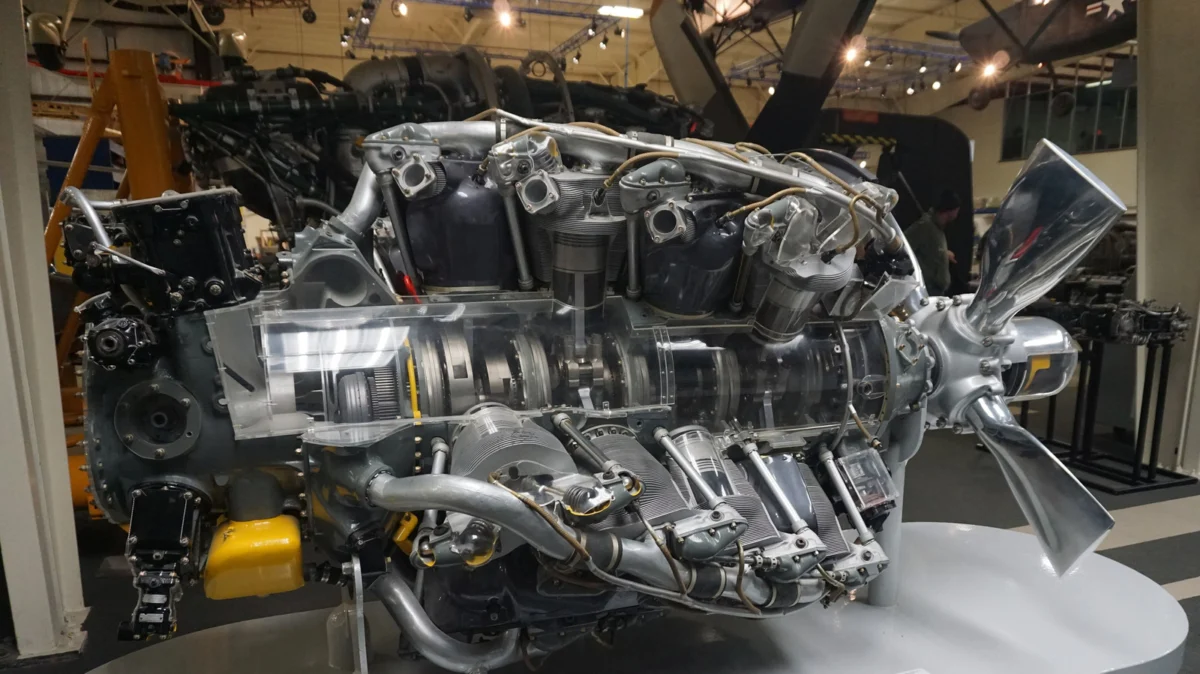
During and immediately after WWII, aircraft designers pushed the limits of radial engine architecture. The Pratt & Whitney R-4360 Wasp Major (71.5L, 28-cylinder) remains a landmark of this era. Its complex, helical "corncob" design, featuring four rows of seven cylinders, was necessary to solve the air-cooling nightmare inherent in such a dense configuration.
Soon after, Lycoming unveiled the XR-7755, a 127-liter, 36-cylinder monster. It was a marvel of the 1940s, featuring liquid cooling and nine overhead camshafts capable of variable valve timing—a technology that wouldn’t become standard in consumer vehicles for decades. The Soviet response, the Yakovlev/Zvezda M500 series, took this further, culminating in the M507: a 383-liter, 112-cylinder engine created by coupling two 56-cylinder blocks to a single gearbox.
The Shift to Industrial and Marine Dominance (1970s–Present)
As the gas turbine eclipsed the piston engine in aviation, the focus shifted to marine propulsion and stationary power generation.
- 1932: The Copenhagen Giant: The Burmeister & Wain 2000 remains a historic monument. Standing 41 feet tall and weighing 2.8 million pounds, this straight-eight diesel engine provided electricity for Copenhagen for decades. It remains operational today at the Diesel House museum.
- The Modern Era of Efficiency: In the 21st century, the focus has shifted to the Wärtsilä RT-flex96C and the MAN 11G95ME-C10.5. These engines represent the pinnacle of current maritime technology, utilizing common-rail electronic control systems to manage massive fuel loads while maintaining thermal efficiencies exceeding 50%.
Supporting Data: By the Numbers
| Engine Model | Displacement | Cylinder Count | Max Power | Key Application |
|---|---|---|---|---|
| Pratt & Whitney R-4360 | 71.5 L | 28 | 3,500 hp | B-36 Bomber |
| Cummins QSK95 | 95 L | 16 | 5,100 hp | Mining/Marine |
| Caterpillar C175-20 | 105.8 L | 20 | 4,000 hp | Mining Trucks |
| Wärtsilä 18V50DF | 2,050.2 L | 18 | 24,400 hp | Power/Marine |
| Wärtsilä RT-flex96C | 25,573.8 L | 14 | 108,920 hp | Container Ships |
| WinGD X92-B | 27,665 L | 12 | 103,795 hp | Container Ships |
Official Industry Perspectives
Manufacturers like Wärtsilä, MAN Energy Solutions, and WinGD emphasize that these engines are designed for a "lifecycle" approach. For example, the Cummins QSK95 is built to endure 1.7 million gallons of fuel consumption before requiring a major overhaul. This level of durability is non-negotiable for industrial clients.
Regarding the MAN 11G95ME-C10.5, the engineering focus has moved toward decarbonization. By incorporating dual-fuel capabilities (LNG and low-sulfur oil), these companies are responding to the International Maritime Organization’s (IMO) stringent emission standards. Engineers at MAN highlight that the transition to the MK10.5 platform was not about raw power, but about optimizing the combustion process through top-controlled exhaust valves to minimize CO2 output.
Implications for Global Logistics and Energy
The existence of these engines carries massive implications for our daily lives:
1. Global Trade Efficiency
Without the WinGD X92-B or the RT-flex96C, global shipping costs would skyrocket. These engines power ships like the HMM Algeciras, which can carry nearly 24,000 shipping containers. By maximizing thermal efficiency—often exceeding 50%—these engines minimize the environmental impact per ton of cargo moved.
2. The Power of Reliability
In remote mining sites or developing energy grids, these engines serve as critical, independent power sources. The Wärtsilä 18V50DF, for instance, can switch between natural gas and oil instantaneously if one supply line fails. This "fuel agility" is essential for grid stability, ensuring that cities or industrial complexes do not experience blackouts.
3. The Future of Propulsion
The industry is currently at a crossroads. While the two-stroke diesel engine remains the most efficient way to move millions of tons of steel across the ocean, the push toward "green" shipping is forcing a rethink. We are seeing the early development of engines capable of burning ammonia, methanol, and hydrogen. While these future engines may eventually replace the diesel behemoths listed here, the core engineering principles—massive scale, ultra-low RPM, and extreme durability—will undoubtedly remain the standard.
Conclusion
From the complex, helical geometry of the WWII-era Wasp Major to the 27,000-liter giants that currently drive the world’s largest container ships, these engines represent the pinnacle of human mechanical ambition. They are silent giants, tucked away in the hulls of ships or the halls of power stations, performing the heavy lifting that allows our modern, interconnected world to function. They remind us that while the future may be electric and digital, the physical world still relies on the raw, reciprocating power of the combustion engine.
