

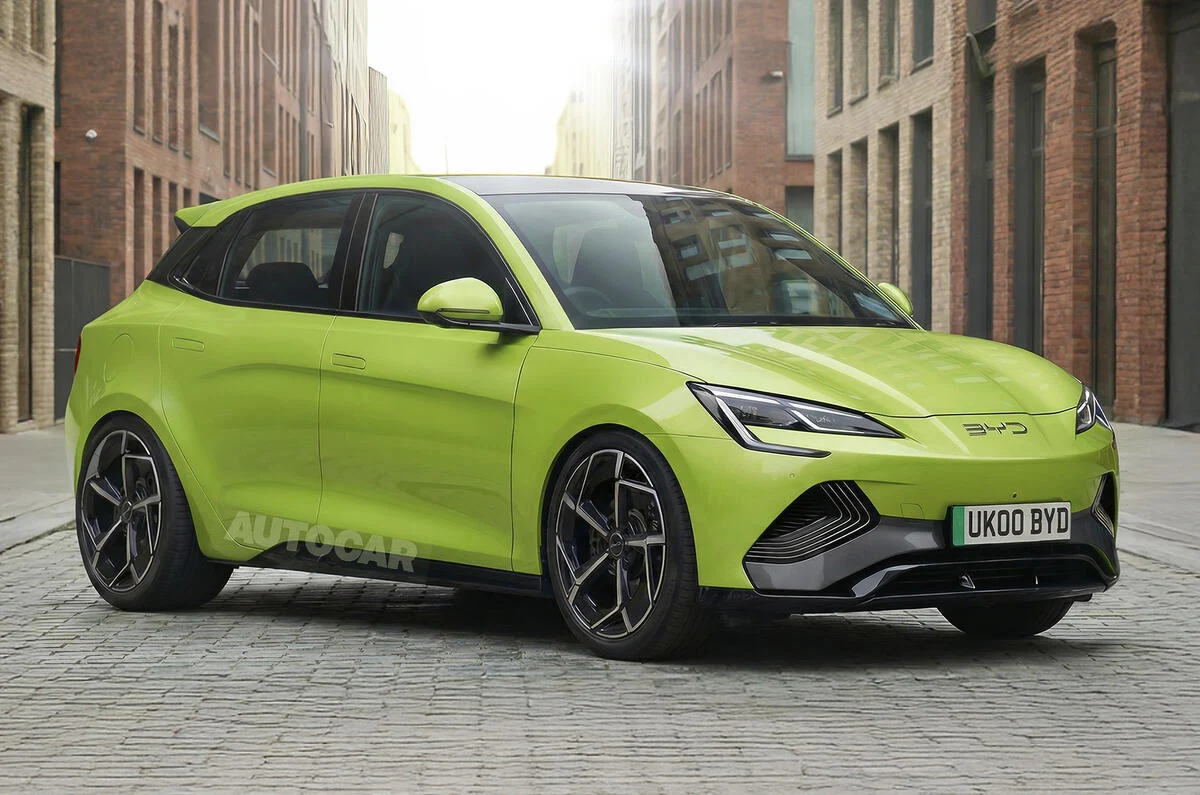
In a seismic shift for the global automotive industry, Chinese electric vehicle giant BYD has officially announced a fundamental change in its product strategy. No longer content with merely exporting its domestic portfolio to Western markets, the company has declared a three-year roadmap dedicated to designing, developing, and manufacturing vehicles specifically tailored for the unique infrastructure and consumer preferences of Europe.
The spearhead of this new strategy is the upcoming "Dolphin G," a plug-in hybrid (PHEV) supermini set to debut in the UK market next month. This vehicle marks a symbolic departure from the "one-size-fits-all" approach that has defined the initial wave of Chinese-made EVs arriving in Europe. By prioritizing local design and smaller form factors, BYD is attempting to shed its reputation as a foreign importer and instead establish itself as a localized European brand.
The Dolphin G: A Strategic Beachhead
The Dolphin G is more than just a new nameplate; it is a clinical response to a specific market void. While the electric version of the Dolphin—the Dolphin Surf—has already made inroads into the European EV segment, the G variant introduces a combustion-engined alternative designed to bridge the gap for buyers who are not yet ready to transition fully to battery-electric vehicles (BEVs).
Timeline of the Launch
- June 2024: Official unveiling of the Dolphin G.
- July 2024: Physical public debut at the prestigious Goodwood Festival of Speed in the UK.
- 2026: Full-scale market availability and potential integration into European production lines.
Positioned as the smallest PHEV currently available in the UK, the Dolphin G addresses a segment that has been largely neglected by manufacturers who have shifted their focus exclusively to larger, premium-priced SUVs.
The Philosophy of "European-First" Design
The driving force behind this strategic pivot is BYD’s Executive Vice-President, Stella Li. Speaking at a recent Financial Times event in London, Li articulated a clear vision: to have customers perceive BYD as a homegrown European entity rather than a foreign interloper.
Li’s rationale stems from an intimate understanding of the divergent paths currently taken by the Chinese and European automotive markets. In China, the appetite for oversized, tech-heavy vehicles continues to grow, with chassis dimensions expanding to accommodate domestic trends. However, Li acknowledges that this "bigger is better" philosophy is fundamentally incompatible with the historic streetscapes of Europe.
"You cannot have a bigger car running in Paris, in Milan, in Rome, in London," Li noted. "People there still prefer the smaller-sized cars."
The "4.3-Meter" Rule
Li’s directive to her engineering teams is explicit: for European-specific models, the total length must remain under 4.3 meters. This constraint is not merely aesthetic; it is a logistical necessity for navigating the narrow, centuries-old urban corridors of Europe’s capital cities. By enforcing these dimensions, BYD is signaling that it understands the constraints of the European driver far better than some of its domestic competitors who are simply dumping excess stock from China into the European market.
Regional Autonomy: Splitting the Roadmap
A central pillar of BYD’s new strategy is the "split-roadmap" approach. Moving forward, the company will decouple its research and development into two distinct streams: one for the Chinese market and one for the European market.
Why the Split Matters
- Regulatory Alignment: European standards for safety, emissions, and connectivity differ significantly from Chinese domestic standards.
- Cultural Ergonomics: European drivers prioritize driving dynamics and interior space efficiency, whereas Chinese consumers often prioritize rear-seat legroom and integrated digital entertainment suites.
- Infrastructure Synergy: By designing for Europe, BYD can optimize battery range and charging profiles to suit the specific grid capabilities and charging density of the European Union and the UK.
"No longer will China cars be shipped to here to share with Europe," Li stated. This declaration serves as a warning to legacy European manufacturers who have long relied on their home-turf advantage to protect their market share.
Localized Manufacturing: The Hungarian Connection
Crucial to the long-term success of this "European-for-Europe" strategy is the localization of production. Shipping vehicles across the globe is not only cost-prohibitive due to logistics and import tariffs but also leaves the company vulnerable to geopolitical trade tensions.
BYD is currently putting the finishing touches on its state-of-the-art manufacturing plant in Hungary. This facility is not merely an assembly line; it is a hub for BYD’s European operations.
What to Expect from Hungary:
- Dolphin Surf (EV): The first of the major models to roll off the Hungarian line.
- Atto 2: A compact crossover intended to compete directly with the Volvo EX30, targeting the growing segment of budget-conscious European EV buyers.
- Dolphin G: While production plans are still being finalized, it is highly probable that the European-designed PHEV will eventually move to the Hungarian facility to reduce lead times and shipping costs.
By producing in Europe, BYD is effectively insulating itself from the volatile tariff environment and reducing its carbon footprint—a key metric for European consumers who are increasingly sensitive to the environmental cost of vehicle transport.
Implications for the Competitive Landscape
The arrival of a localized, European-designed BYD model poses a significant challenge to the "Big Three" of the European automotive industry: Volkswagen, Stellantis, and Renault. These manufacturers have struggled to produce affordable small cars that generate sufficient profit margins.
Impact on Legacy Brands
For years, legacy manufacturers have argued that producing small, affordable cars in Europe is financially unsustainable due to labor costs and regulatory overhead. If BYD can successfully launch a 4.3-meter, European-designed vehicle that is both profitable and appealing, it will dismantle the excuse that "small cars cannot be made in Europe."
Furthermore, the introduction of a PHEV Dolphin G strikes at the heart of the "transition gap." While governments are pushing for full electrification, a significant portion of the European population remains hesitant due to range anxiety and the lack of widespread, reliable charging infrastructure. The Dolphin G provides a bridge, offering the capability of electric driving for city commutes with the peace of mind of a combustion engine for longer journeys.
Future Outlook: A Three-Year Horizon
Over the next 36 months, we can expect a flurry of activity from BYD. The shift will likely involve:
- Enhanced European R&D: The establishment of dedicated design studios in Europe to ensure the styling, ride, and handling meet local expectations.
- Aggressive Market Penetration: By utilizing the "European brand" identity, BYD will look to move away from being viewed as a "budget alternative" and instead position itself as a value-driven, high-quality, and culturally-attuned manufacturer.
- Supply Chain Localization: To qualify for various European incentives, BYD will likely source a higher percentage of its components—such as batteries and interior materials—from European suppliers.
Conclusion
BYD’s pivot is a masterclass in market adaptation. By recognizing that global success is not achieved through global products, but through localized excellence, the company is positioning itself to be a permanent, disruptive force in the European automotive sector.
The Dolphin G is the first tangible result of this philosophy. As it rolls onto the stage at the Goodwood Festival of Speed this July, it will carry the weight of a much larger mission: the transformation of a Chinese manufacturing giant into a household European name. For the incumbents, the message is clear: the era of simply exporting to Europe is over; the era of building for Europe has begun.
