

The automotive world stands at a precipice. As the era of the internal combustion engine faces unprecedented regulatory and environmental pressures, Bugatti has chosen not to retreat, but to reinvent. The Bugatti Tourbillon, unveiled in June 2024, represents more than just a successor to the Chiron; it is a mechanical manifesto. With an 1,800-hp plug-in hybrid powertrain anchored by a naturally aspirated V-16 engine, the Tourbillon is built to push the boundaries of what is physically possible on four wheels. However, power is merely a variable in a much larger equation. To truly unlock the potential of this engineering marvel, Bugatti has engaged in a relentless pursuit of aerodynamic perfection, ensuring that the Tourbillon is as slippery as it is savage.
The Core Philosophy: Balancing Power and Drag
The engineering objective for the Tourbillon was clear: surpass the aerodynamic efficiency of the Chiron. While the Chiron was a masterclass in stability and downforce, the Tourbillon demands a more nuanced approach to handle the immense output of its hybrid system.
Paul Burnham, the chief engineer for the Tourbillon, recently provided an inside look at the development process via a video series released on Bugatti’s official YouTube channel. According to Burnham, the primary goal was to minimize aerodynamic drag, a necessity for matching—and potentially shattering—the top-speed records that defined the Veyron and Chiron legacies.
To achieve this, the design team initiated a complete overhaul of the vehicle’s silhouette. A critical structural change involves a significantly reduced "greenhouse"—the upper portion of the car. By tightening the cabin architecture, engineers were able to shrink the vehicle’s frontal area, directly reducing the wind resistance the car encounters at high velocity. However, the true complexity lies in the micro-optimizations: the subtle sculpting of the bodywork, the management of air intake for the massive V-16, and the careful manipulation of airflow across the chassis to maintain high-speed stability without relying solely on aggressive, drag-inducing wings.
A Chronology of Innovation: From CFD to the Wind Tunnel
The road to the Tourbillon’s aerodynamic form was a meticulous 15-month odyssey of testing and iteration. Bugatti’s approach represents the modern gold standard of automotive development, blending high-speed computing with physical validation.
Phase 1: Digital Genesis (CFD)
Before a single physical component was cast, the Tourbillon existed as a complex matrix of data. Computational Fluid Dynamics (CFD) simulations allowed the engineering team to test thousands of variations in the car’s body shape. These simulations are capable of predicting how air behaves at speeds exceeding 250 mph, identifying turbulence points that could compromise the car’s top-end performance.
Phase 2: The Half-Scale Proof
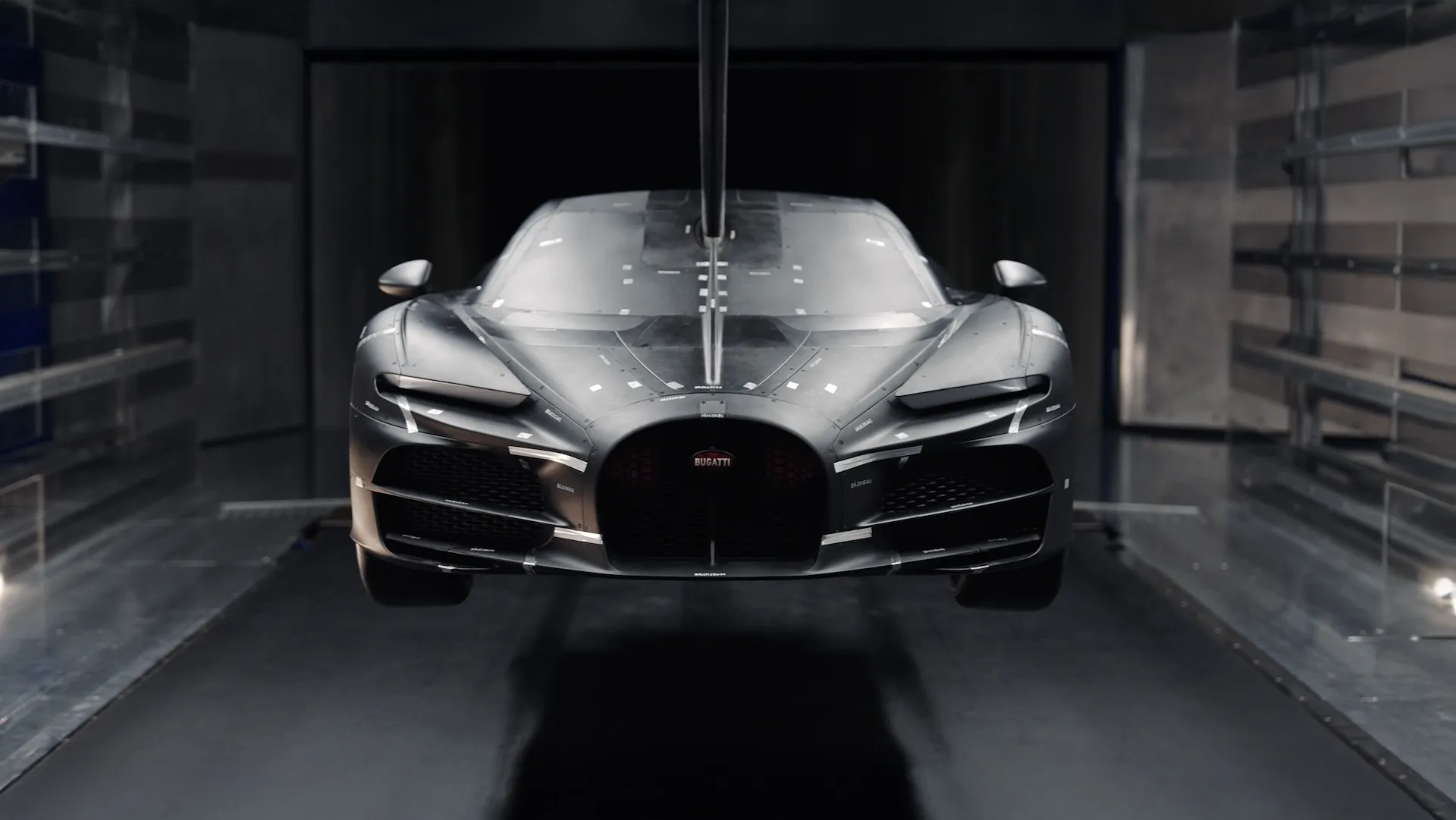
Approximately 15 months prior to the June 2024 unveiling, development moved from the digital screen to the wind tunnel. The team began with a half-scale model, a sophisticated piece of engineering in its own right. This model was constructed from over 250 3D-printed components and equipped with more than 100 pressure taps. These sensors allowed the team to measure airflow across the car’s surface with surgical precision, validating the CFD models and confirming that the "timeless" design was also aerodynamically sound.
Phase 3: Full-Scale Validation
By early 2024, the team transitioned to full-scale prototypes. According to Burnham, this stage was primarily for final verification. Because the CFD and half-scale testing had been so exhaustive, the full-scale tunnel sessions served to confirm that the real-world performance aligned perfectly with the virtual projections. This "measure twice, cut once" philosophy allowed Bugatti to finalize the production-ready bodywork with extreme confidence.
Supporting Data: A New Mechanical Architecture
The aerodynamic shell of the Tourbillon is draped over an entirely new, clean-sheet chassis. Unlike the Veyron and Chiron, which shared a common lineage, the Tourbillon is built from the ground up to accommodate a revolutionary powertrain.

- The V-16 Engine: The heart of the machine is a naturally aspirated 8.3-liter V-16 engine. By moving away from the quad-turbocharged W-16 layout of its predecessors, Bugatti has prioritized instant throttle response and a high-revving auditory experience.
- Hybrid Integration: This V-16 is paired with three high-performance electric motors and an 8-speed dual-clutch transmission. This setup provides a combined output of 1,800 hp.
- Performance Metrics: The result of this hybrid synergy is a projected 0-60 mph sprint of just 2.0 seconds.
The integration of these components required the chassis to be as lightweight and rigid as possible. The packaging of the electric motors—two on the front axle and one integrated into the transmission—demanded a sophisticated cooling strategy, which in turn influenced the aerodynamic design of the side intakes and underbody channels.
Official Perspectives: The Quest for Timelessness
Beyond the numbers, the Tourbillon is a design statement. Bugatti has explicitly avoided the "digital-first" design trend that dominates modern luxury vehicles. In an era where hypercars are often defined by massive touchscreens, the Tourbillon features an intricate, analog mechanical gauge cluster inspired by high-end Swiss watchmaking.
This design choice serves a dual purpose. First, it ensures that the interior remains relevant for decades; while software becomes obsolete, mechanical artistry remains perpetually beautiful. Second, it shifts the focus back to the driver’s connection with the machine. As Bugatti design leadership has emphasized, the goal was to create a car that feels as relevant in 2050 as it does today. The aerodynamic bodywork serves this same philosophy: it is sculpted to be functional, but its smooth, flowing lines avoid the busy, "faddish" vents and winglets found on many modern performance cars.
Implications: The Legacy of the Tourbillon
The implications of the Tourbillon’s design and engineering are profound. By successfully marrying a high-revving, naturally aspirated internal combustion engine with a cutting-edge electric powertrain, Bugatti has effectively mapped a path for the survival of the hypercar in a decarbonizing world.
The Market Context
With production limited to just 250 units, the Tourbillon is already a collector’s item. All planned examples have been spoken for, confirming that the market for ultra-high-end internal combustion performance remains robust, provided it is executed with the level of sophistication that Bugatti offers. With a starting price of approximately $4 million, the car is an exclusive tier of engineering excellence.
Technological Transfer
The aerodynamic breakthroughs and the integration of the triple-motor hybrid system are likely to influence the broader automotive industry. The methods used to balance the cooling requirements of a V-16 with the strict drag targets of a 300-mph vehicle provide a blueprint for other manufacturers aiming to push the limits of EV and hybrid efficiency.
Conclusion: A New Standard
The Bugatti Tourbillon is not merely a car; it is a masterclass in how to honor a legacy while simultaneously disrupting it. By focusing on the fundamentals—aerodynamic drag reduction, weight-optimized chassis design, and the emotional resonance of an analog interface—Bugatti has crafted a vehicle that transcends the limitations of its powertrain.
As we look toward the 2026 production start date, the Tourbillon serves as a reminder that the most exciting chapter of the automobile is not necessarily its last. Through the rigorous application of physics and an unwavering commitment to the "art of the machine," Bugatti has ensured that even as the world changes, the thrill of the ultimate driving experience remains perfectly, elegantly, and aerodynamically preserved.
