

The adage "you are only as old as you feel" has long been dismissed as a platitude, but in the realm of modern exercise science, it is increasingly viewed as a physiological reality. As we age, the gradual decline of physical functionality is not merely an inevitable part of the human condition; it is often a result of disuse. Without intentional, regular movement, basic daily tasks—rising from bed, carrying groceries, or climbing a flight of stairs—can shift from effortless actions to strenuous, injury-prone obstacles.
To help bridge the gap between chronological age and physical capacity, we sat down with Jacob Siwicki, founder of Siwicki Fitness, a nationally recognized expert in human performance. A former Dartmouth football player and a top-ranked personal trainer, Siwicki specializes in training individuals to maintain a "youthful" physiological profile long after their 60th birthday.
Siwicki identifies four specific movements that serve as diagnostic tools. If you can perform these, your body is functioning with the vitality of a younger person. If you struggle, these movements serve as the blueprint for your new training regimen.
The Philosophy of Biological Youth
According to Siwicki, the markers of aging are not found in cardiovascular endurance, which can be improved relatively quickly at any stage of life. Instead, true biological youth is measured by the systems that degrade most rapidly and take the longest to restore.
"Together, these four exercises measure the qualities that drop fastest with age and matter most for daily function: full-body strength, balance, proprioception, hip and shoulder mobility, coordination, and grip," Siwicki explains. "Endurance is intentionally absent from this list. You can build aerobic capacity in a matter of weeks, but these foundational physical markers take years to lose and years to rebuild. That is precisely why they are the best predictors of your biological age."
1. The Brazilian Sit-Rise Test: A Gold Standard for Mobility
The Brazilian Sit-Rise Test (SRT) is perhaps the most comprehensive diagnostic tool for assessing overall musculoskeletal health. It requires a combination of flexibility, balance, and core strength.
The Mechanics
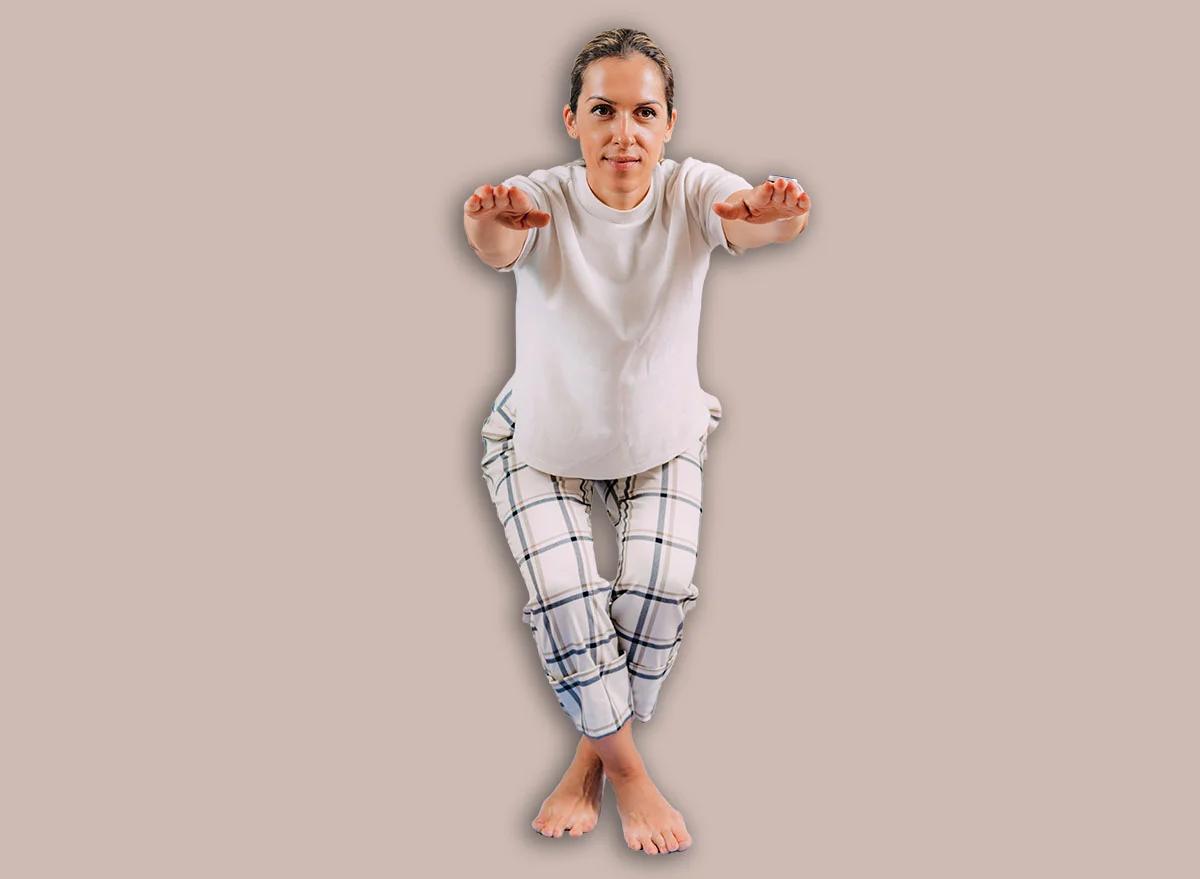
The goal is to sit down on the floor from a standing position without using your hands, knees, or elbows for support, and then rise back to a standing position using the same constraints.
Why It Matters
Siwicki notes that the scoring is revealing: "Anyone over 60 who scores an 8 or higher possesses a level of full-body mobility, coordination, and strength that most 30-year-olds have already lost."
This test highlights the "functional decay" that occurs when we spend too much time seated in chairs. By forcing the body to transition through various planes of motion without external support, the SRT challenges your joints to remain supple and your stabilizers to remain active.
2. Single-Leg Balance with Eyes Closed
Balance is often the first casualty of the aging process. Most people rely heavily on visual input to stay upright, but the inner ear (the vestibular system) and proprioception (the body’s ability to sense its position in space) are the true guardians of stability.
The Protocol
Stand on one leg with your eyes closed. The goal is to maintain your balance without placing the lifted foot down.
The Expert Perspective
"Closing the eyes removes the visual stabilizer and forces the inner ear and proprioception system to do all the work," says Siwicki. "Most 60-year-olds can only manage 5 to 10 seconds. However, if you can hold this for 30 seconds, it signifies that your nervous system is still calibrated to a much younger baseline."
Developing this skill is critical for fall prevention. In a world where distractions are everywhere, the ability to maintain equilibrium without visual cues is a vital survival mechanism.
3. Full Pushups: The Upper Body Integrity Check
While many modified versions of the pushup exist, Siwicki insists that the full, standard pushup is the only diagnostic variant that matters.
Diagnostic Criteria
"Full pushups are a true upper-body strength test," Siwicki states. "The variation matters significantly because knee pushups remove too much of the core demand to be truly diagnostic. To maintain a youthful body, you need to be able to support your own body weight through your arms and shoulders."
Implications for Daily Life
The pushup is not just about chest size; it is a compound movement that requires the engagement of the pectorals, deltoids, triceps, and, most importantly, the entire core. If you cannot perform a standard pushup, it often indicates a deficit in scapular stability and abdominal bracing, both of which are essential for preventing shoulder injuries and maintaining posture as you age.
4. The Dead Hang: Grip Strength and Longevity
Grip strength is frequently cited in clinical research as one of the most reliable predictors of all-cause mortality and long-term disability.
The Execution
Using a pull-up bar, hang with your arms fully extended. The objective is to maintain a secure grip for at least 30 seconds.
The Clinical Connection
Siwicki emphasizes the systemic benefits of this move: "The dead hang tests shoulder integrity, scapular stability, and core engagement under load. If someone can hang for 30 seconds at 65 or older, their upper body is functionally intact. It is a simple, low-impact way to ensure that your connective tissues, joints, and muscular chains remain resilient."
The Chronology of Decline vs. Resilience
To understand why these tests are so vital, one must look at the timeline of aging. Between the ages of 30 and 60, the average sedentary adult loses approximately 3% to 5% of their muscle mass per decade. This process, known as sarcopenia, is often silent until a person reaches their 60s, at which point the loss of "functional reserve" becomes apparent.
Supporting Data
- The Grip Factor: Research published in the British Medical Journal has suggested that grip strength is a stronger predictor of mortality than blood pressure.
- Proprioceptive Decline: Studies indicate that the ability to balance on one leg decreases by nearly 30% every decade after age 50, directly correlating with an increased risk of hip fractures.
- Mobility as Medicine: The European Journal of Preventive Cardiology found that participants who scored lower on the Brazilian Sit-Rise Test had a 5 to 6 times higher mortality risk than those who scored higher.
Official Responses and Implications
Medical professionals and physical therapists increasingly agree with Siwicki’s assessment. The shift in geriatric medicine has moved from "managing decline" to "optimizing function."
"We are no longer just looking at the absence of disease," says a lead physical therapist involved in senior mobility research. "We are looking at the presence of functional capability. If an individual can pass these four tests, they are far less likely to require assisted living, far more likely to maintain independence, and statistically more likely to enjoy a higher quality of life in their later years."
What This Means for You
If you are over 60 and found these tests difficult, do not be discouraged. The human body is remarkably plastic. By integrating these four movements into your daily routine, you can begin to reverse the symptoms of "functional aging."
- Start with the Hang: Begin by hanging for 10–15 seconds, working up to 30.
- Practice the Balance: Perform the eye-closed balance test near a wall for safety.
- Modify the Pushup: If a floor pushup is too difficult, use an incline (like a sturdy countertop) and slowly lower the angle over months.
- Prioritize the Sit-Rise: Work on squatting mechanics throughout the day to regain the mobility required for the floor transition.
In conclusion, maintaining a youthful body is not about expensive gym equipment or complicated supplements. It is about honoring the basic mechanics of human movement. By mastering these four tests, you are not just exercising; you are building a biological insurance policy for your future self.
Jacob Siwicki is a certified NCSF and AFAA professional. For more information on his training philosophy, visit Siwicki Fitness.
