


For many individuals over the age of 60, lower back pain is not merely a physical inconvenience—it is a life-altering condition that dictates daily choices. It is the single most common reason older adults seek out personal training, and, perhaps more tragically, it is often the one issue they believe is irreversible.
As a professional in the fitness industry for nearly four decades and the director of TRAINFITNESS, one of the UK’s premier training institutions, I have observed a consistent pattern: the vast majority of my clients are not suffering from structural decay. They are suffering from disuse. After decades of sedentary living, their muscles haven’t "broken down"; they have simply forgotten how to fire. When combined with the psychological weight of fear—the avoidance of movement to prevent a flare-up—this leads to a cycle of muscle atrophy and increased rigidity.
The good news? This decline is not an inevitable consequence of aging. By integrating four simple, chair-based exercises into your weekly routine, you can re-educate your muscles and reclaim your functional independence, often faster than you might imagine.

The Anatomy of the Struggle: Why the Back Fails at 60
To understand why the back becomes a source of chronic pain in our later years, we must look at the body’s kinetic chain. In a healthy, active state, the glutes, deep abdominals, and lower back work in a synchronized partnership. However, years of prolonged sitting cause the hip flexors to tighten and the glutes—the body’s largest and most powerful stabilizers—to become functionally dormant.
When the glutes are "asleep," the lower back is forced to compensate. It is suddenly asked to handle the heavy lifting, the stabilization, and the constant postural demands of walking and standing. These muscles were never designed to be the primary stabilizers for the entire torso. By age 60, after years of this physiological mismanagement, the lower back begins to "complain" through persistent ache and weakness.
This isn’t just about pain; it is about a measurable decline in capability. Many people in this demographic struggle to hold a simple plank for 30 seconds or lift a bag of groceries with proper form. The root cause is a lack of loading. Muscles that aren’t challenged will inevitably weaken, and a weak back is a vulnerable back.

Why Chairs Outperform Gym Machines
There is a pervasive myth that to fix your back, you need to visit a gym and use expensive, specialized machinery. In reality, the traditional back extension machine is often counterproductive. These machines isolate the lower back muscle, forcing it to work in a vacuum while the rest of the body is held rigid by pads and levers.
True back health, however, is not found in isolation. It is found in integration.
Chair exercises are superior because they train the back to do what it is actually required to do in real life: hold the trunk steady while the limbs move. Whether you are reaching for a jar on a high shelf, stepping out of a car, or carrying shopping bags, your back must stabilize the spine while your arms or legs execute the movement. By using a sturdy chair as your training partner, you are practicing the exact muscle patterns that protect your spine during daily activities.
Furthermore, the accessibility of a chair removes the barriers of entry. There is no travel time, no gym membership fee, and no intimidation factor. You can modify the range of motion easily, ensuring that you start exactly where your body is today, not where you wish it to be.
The Four Pillars of Back Resilience
Before starting these exercises, ensure you are using a sturdy, non-folding dining chair with a flat, firm seat. If you have any concerns about balance, place the chair against a wall.
1. Seated Pelvic Tilts: The Foundation
This movement is the "reset button" for your lower back. It mobilizes the spine and wakes up the deep core stabilizers that have been dormant for years.
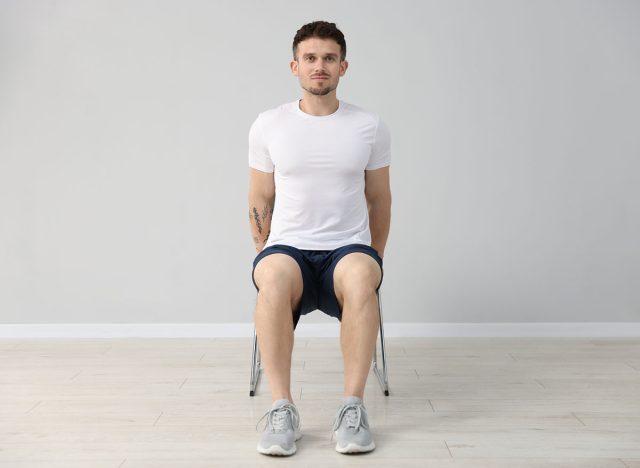
- The Movement: Sit tall with your feet flat on the floor. Gently rock your pelvis forward to create a slight arch in your lower back, then rock it backward to flatten your spine against the chair.
- The Goal: Focus on small, controlled movements. This prepares the nervous system for the more complex exercises that follow.
2. Seated Hip Hinge: The Protective Pattern
The hip hinge is the most important movement for anyone who wants to avoid back injury. It teaches you to keep the spine "long" and stable while the hips do the heavy lifting.
- The Movement: Keep your back straight as you lean forward from the hips, ensuring your spine doesn’t round. Use your glutes to pull your torso back to an upright position.
- The Goal: This is the mechanics of picking up a laundry basket or tying your shoes safely.
3. Sit-to-Stand: The Independence Builder
Physiotherapists frequently use the sit-to-stand movement as a benchmark for longevity and independence. It trains the entire posterior chain—the glutes, hamstrings, and lower back muscles—in unison.
- The Movement: Start sitting, then drive through your heels to stand up without using your hands if possible. Slowly reverse the motion to return to the seat.
- The Goal: To build the raw strength required to move through the world with confidence.
4. Standing Hip Extension: Waking the Glutes
Weak glutes are the primary culprit behind chronic lower back pain. This exercise forces the glutes to take over the workload that the back has been unfairly carrying.

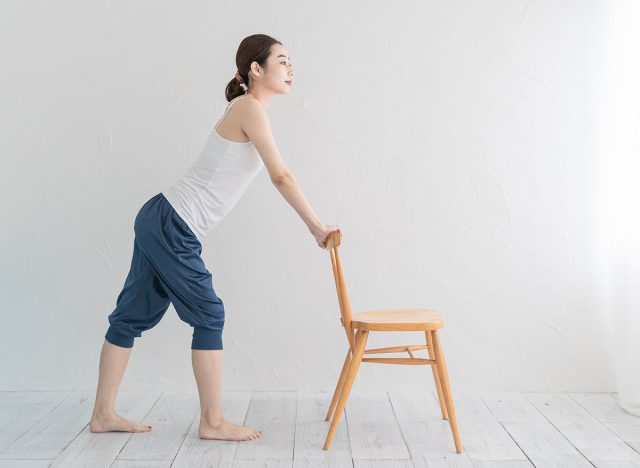
- The Movement: Holding onto the back of a chair for support, keep your leg straight and slowly lift it backward, squeezing your glute muscle at the top.
- The Goal: To teach the glutes to fire during hip movement, effectively offloading the lower back.
Chronology of Progress: What to Expect
The beauty of this program is that it provides a roadmap for long-term improvement.
- Weeks 1–2: Focus on mastering form. Do not worry about speed or weight. Most users will begin to notice that everyday tasks—such as lacing shoes or standing from a chair—feel less like a "production."
- Weeks 3–4: The persistent, low-level ache that plagues many over 60 often begins to subside. You may notice that you can walk longer distances with less fatigue, as your glutes are finally sharing the burden.
- Weeks 5–6: At this stage, real structural progress occurs. You should notice that you are standing taller and moving with more fluidity. Strength gains in the sit-to-stand motion typically increase by 30% to 50% by the six-week mark.
Supporting Data and Medical Precautions
While these exercises are designed to be safe and accessible, they are not a substitute for medical advice, especially for those with existing conditions.
When to consult a professional:
If you have been diagnosed with spinal stenosis, osteoporosis, or have undergone recent back surgery, you must consult your GP or a chartered physiotherapist before beginning.

Warning Signs:
- Nerve pain: Pain that shoots down a leg, especially past the knee, is a potential sign of nerve compression and requires professional diagnosis.
- Sharp, stabbing pain: While a "muscle burn" is expected during exercise, sharp or localized pain is a signal to stop immediately.
- Neurological symptoms: Any loss of bladder or bowel control is a medical emergency and requires immediate attention.
Implications for Longevity
The ultimate goal of this program is not just to reach a six-week milestone, but to adopt a new, permanent lifestyle. Strength is a "use it or lose it" commodity, especially after 60. By dedicating just 10 to 12 minutes, three to four times a week, you are making a small, high-yield investment in your future.
When you strengthen your back, you aren’t just building muscle; you are building the capacity to remain independent, to travel, to play with grandchildren, and to live without the constant, nagging distraction of pain. Your back was built to be strong and resilient—it is time to give it the opportunity to prove it.
