

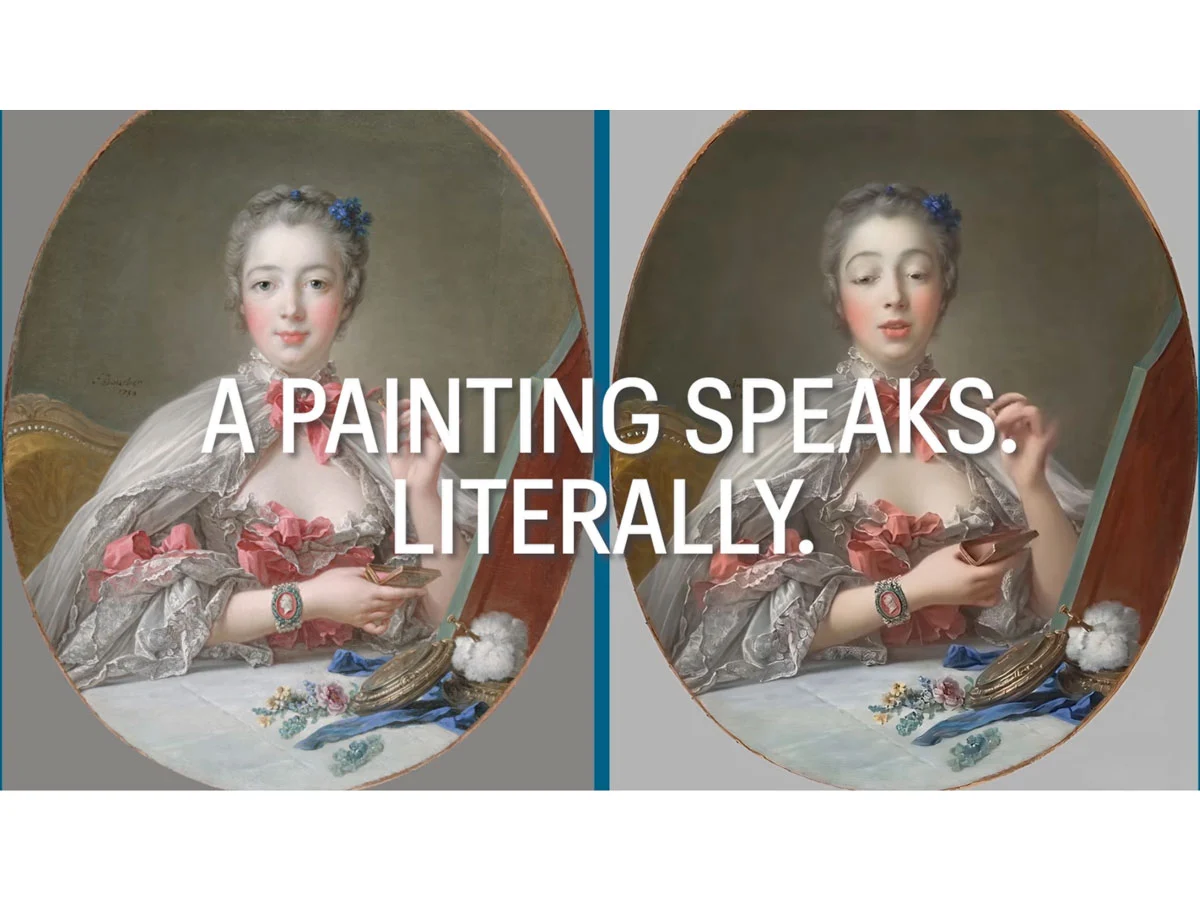
In the hallowed, hushed halls of the Harvard Art Museums, a quiet revolution is taking place—one that bridges the gap between the 18th century and the age of artificial intelligence. As cultural institutions worldwide grapple with the dual challenges of declining foot traffic and the need for modern relevance, the Cambridge-based consortium has launched an experimental marketing initiative that utilizes generative AI to quite literally bring its collection to life.
By animating the 1750 portrait Jeanne-Antoinette Poisson, Marquise de Pompadour by François Boucher, the museum is sparking a heated debate: Does technology act as a bridge to art, or does it threaten the sanctity of the original work?
The Core Experiment: Bridging Centuries with Code
The project, spearheaded by John Connolly, Director of Marketing for the Harvard Art Museums, and Julian De Freitas, an assistant professor at Harvard Business School, represents a bold foray into "living history." The initiative centerpieces an AI-driven animation of the Marquise de Pompadour—one of King Louis XV’s most influential mistresses—paired with a conversational chatbot.
This is not merely a visual gimmick. The technology allows visitors to engage in a dialogue with a digital facsimile of an 18th-century icon. As De Freitas notes, the goal is to dismantle the "stiff and unapproachable" aura that often surrounds classical portraiture, transforming a static image into a dynamic, interactive experience.
A Chronology of Innovation
The journey from concept to beta-testing reflects the measured pace of an institution deeply rooted in academic tradition.
- Initial Conception: Recognizing the need to evolve marketing strategies following the museum’s move to free admission—which removed the "exclusivity" of membership benefits—Connolly sought a way to rebrand the museum experience as accessible rather than "lesser."
- The Research Phase: De Freitas, whose academic work focuses on how consumers adopt and perceive AI, partnered with the museum to study the intersection of heritage and innovation.
- Internal Consultation: Before any pixels were animated, the team faced significant hurdles from within. Curators and conservators raised ethical red flags, fearing that artificial animation would compromise the integrity of the original canvas.
- Beta-Testing (2026): The museum conducted controlled, closed-group testing. Participants were split into cohorts, experiencing different iterations of the AI. While a public rollout has not been confirmed, the project has been documented in a Harvard Business Review case study.
- The "Open Call" Reveal: The project gained wider attention in July 2026, when Connolly and De Freitas appeared on the HBR podcast Open Call, hosted by Brian Kenny.
The Institutional Friction: Stewardship vs. Innovation
The resistance encountered by the project team serves as a microcosm of the wider tension in the art world. For many, the "de-skilling" of art appreciation is a primary concern.
Curators were naturally protective of the Boucher portrait, worried that a synthetic voice or movement would overwrite the artist’s original intent. Conservators, tasked with the physical preservation of the piece, viewed the digital manipulation as a violation of the object’s static, historical truth.
"This case is about far more than a marketing experiment," says Brian Kenny. "It’s about innovation versus stewardship, technology versus interpretation, and how institutions rooted in history navigate a rapidly changing future."
De Freitas acknowledges these concerns, noting that the project forced him to confront the "sensitivity" required when applying modern technology to historical artifacts. The team realized early on that if the AI felt like a cost-cutting measure or a hollow, performative act, it would inevitably fail to resonate with an audience that values authenticity above all else.
Understanding the Audience: Perception and Feedback
The beta-testing phase yielded a complex, often polarized, set of data. Connolly reports that feedback was a "mixed bag."
"There was some positive, and there was some negative," Connolly admitted on the Open Call podcast. "The negative feedback generally aligned with the broader societal anxieties surrounding AI."
However, a surprising trend emerged: many participants were "blown away" by the technical prowess of the project. A significant subset of the audience found the experience genuinely humorous—a factor that aligns with Connolly’s belief that art, while often a vessel for deep truth-telling, should also be inherently playful.

The data suggests that the success of such initiatives hinges on the "value-add." If the AI merely mimics, it is rejected. If it provides a layer of understanding that a viewer could not achieve on their own, it becomes a powerful educational tool.
The Strategic Imperative: Why Now?
The Harvard Art Museums, which house over 250,000 objects, face a unique set of circumstances. Since its 2014 renovation, which consolidated three institutions under one roof and eliminated admission fees, the museum has successfully democratized access. However, the elimination of fees created a marketing "vacuum."
"Price is a barrier," Connolly explains. "But when you remove that barrier, you face a new problem: the perception that ‘free’ equals ‘lesser.’ We were out there trying to beat the drum that we are not lesser."
In this context, the AI initiative is a strategic effort to rebrand the museum as a forward-thinking, welcoming, and vibrant space. By making the Marquise de Pompadour "speak," the museum is attempting to prove that it is not a "hushed environment" for the elite, but a living, breathing laboratory for cultural engagement.
The Broader Implications for the Museum Sector
The Harvard experiment signals a potential shift in the "museum experience." As institutions compete with the convenience of digital media, they are being forced to adopt the tools of their competitors.
1. The Democratization of Art
De Freitas argues that the use of AI, particularly in the form of conversational agents, democratizes the viewing experience. By removing the "stiff" distance between the viewer and the subject, the museum invites a new generation of visitors who are accustomed to interactive, personalized content.
2. The Risk of Performative Tech
The most critical takeaway for the sector is that AI cannot be a panacea. If a museum uses AI simply to "keep up with the times," the public will likely sense the lack of substance. The technology must be used to provide a deeper layer of interpretation that the human eye alone cannot reach.
3. Ethical Boundaries
The project raises a philosophical question: Who has the authority to speak for an artwork? When an AI generates a monologue for the Marquise, it is technically an act of historical fiction. Institutions must navigate this by being transparent about the nature of the technology, ensuring that the "digital ghost" does not permanently obscure the original artist’s brushstrokes.
Conclusion: A "Playful" Future
While the Harvard Art Museums have yet to launch a full-scale public deployment of the AI, the mere possibility—as teased by Connolly, who remarked that the project "could suddenly drop"—keeps the conversation alive.
The initiative serves as a reminder that the future of the museum lies in its ability to balance two seemingly contradictory poles: the rigid, careful stewardship of the past and the fluid, disruptive potential of the future. As Connolly noted, quoting Oscar Wilde, "Art should be playful." In the case of the Marquise de Pompadour, the playfulness of AI may be exactly what is needed to ensure that history continues to speak to the present.
Whether this leads to a permanent shift in how museums display their collections or remains a high-concept marketing experiment, the project has successfully forced a long-overdue dialogue about the role of the museum in an increasingly algorithmic world. The doors are open, the technology is ready, and the Marquise is waiting to tell her story—provided we are ready to listen.
