

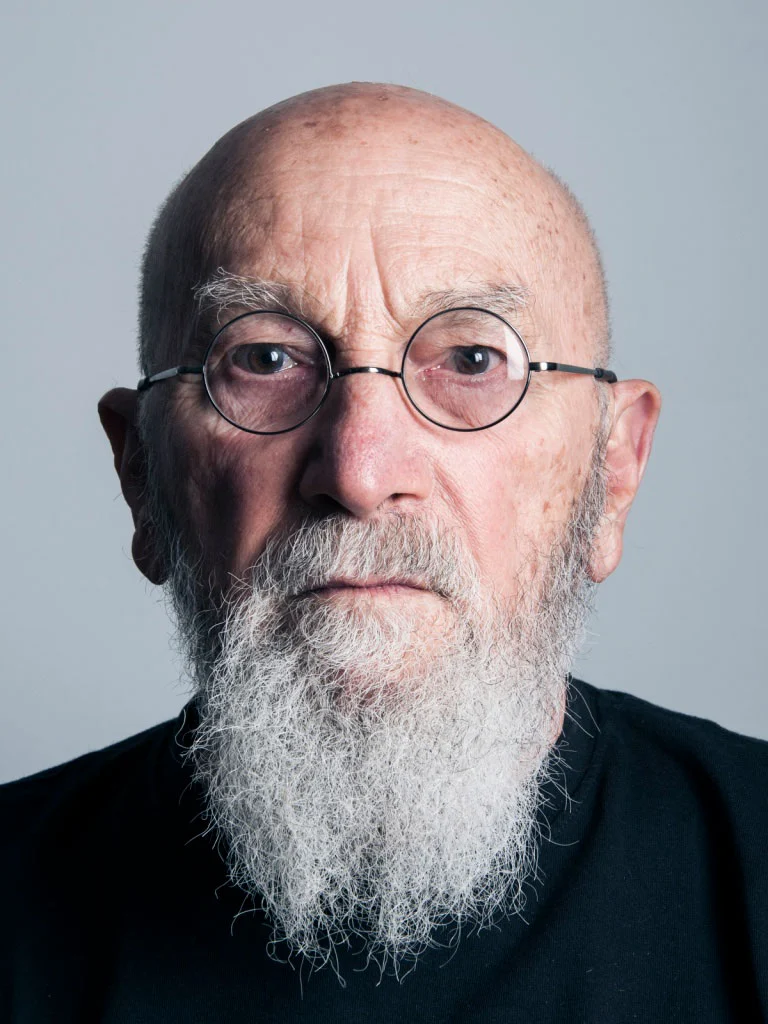
The art world is mourning the loss of a singular, uncompromising force: Rafael “Rafi” Ferrer, the Puerto Rican-born artist whose multifaceted career spanned the evolution of Conceptual art, post-Minimalism, and evocative, narrative-driven figurative painting. Ferrer, who passed away on September 27, was a man of intense convictions, a lifelong curmudgeon who viewed the world with a mixture of profound skepticism and aesthetic wonder.
His death marks the end of a long, peripatetic life that saw him traverse the jazz clubs of the 1950s, the radical surrealist circles of Paris, and the vanguard galleries of New York. To those who knew him, he was more than an artist; he was a bridge between the “golden age” of mid-century jazz subcultures and the shifting, often bewildering landscape of contemporary art.
A Life in Flux: The Formative Years
Rafael Ferrer’s trajectory was never linear. Born in Puerto Rico, his childhood was defined by a sense of displacement and rebellion. His upbringing was marked by a classic mid-century educational path—including a stint at the Staunton Military Academy in Virginia—that stood in stark contrast to his internal, creative yearnings.
During his youth, he found refuge in the subcultures of his time. As he often recounted, his formative years were shaped by the “marginal worlds” of jazz and Latin music. He was a drummer first, a visual artist second. In the 1940s and 50s, he found in the rhythm section an identity that was more authentic than the one prescribed by his family. His brother, the renowned actor José Ferrer, and his sister-in-law, the iconic singer Rosemary Clooney, provided a window into a world of glamour that served as both a comfort and a catalyst for his burgeoning need for autonomy.

By the time he enrolled at the University of Puerto Rico, he had already begun to shed his skin. It was here that he fell under the tutelage of the exiled Spanish Surrealist Eugenio Granell. Granell, a veteran of the Spanish Civil War and a member of the POUM (The Workers’ Party of Marxist Unification), was more than a teacher; he was a philosophical North Star. From Granell, Ferrer learned that art was not a “liberal activity” but a life-or-death commitment to truth, one that necessitated an acerbic rejection of hypocrisy—a lesson that would define Ferrer’s own artistic philosophy for the next seven decades.
Chronology of a Vanguard Career
Ferrer’s career is best understood through his refusal to be categorized. His evolution moved in waves, often contradicting the prevailing trends of the era:
- 1950s: The “Cutting Chops” era. Ferrer moved to New York to pursue a life as a musician, playing the Borscht Belt circuit in the Catskills. It was a period of grueling, disciplined work that he later credited with teaching him the necessity of “obsessive dedication.”
- 1969–1970: The Conceptual Breakout. Ferrer burst into the international spotlight with his radical, performative installations. By placing bushels of leaves or melting blocks of ice directly onto gallery floors, he challenged the permanence and sanctity of the art object. He became a fixture in the defining shows of the era, including When Attitudes Become Form in Bern and Information at MoMA.
- 1970s: The return to the handmade. Just as he was being crowned a Conceptualist, he pivoted to creating ramshackle boats and tents, exploring the tribal aesthetics of the Caribbean.
- 1980s–1990s: The turn toward the figurative. Influenced by the "School of London" painters like Francis Bacon and Lucian Freud, Ferrer embraced a gritty, honest form of painting that prioritized human observation over abstract dogma.
- 2000s–2024: The era of the "curmudgeon." In his later years, Ferrer became increasingly selective about his public output, viewing the rise of social media and the "stupidification" of the cultural sphere with disdain. He remained active in his Greenport, Long Island studio until the very end.
The Aesthetic of Resistance
Ferrer’s work was always a bulwark against what he perceived as a “culturally bereft era.” His humor was his most potent weapon. Whether he was creating a neon sign that read ARTFORHUM (a searing critique of the institutionalization of art) or skewering the pretensions of the music industry, his work was consistently underscored by a fierce, biting wit.
Perhaps the most consistent element of his work was his relationship with his birthplace. While he could laugh at the absurdities of the art world, the colonial status of Puerto Rico was the one subject he could never treat with irony. It was a wound that remained open, influencing his desire to paint the "drama of my country" rather than the "pseudo-Cuban" music of the nightclubs.

His shift toward figurative painting in the 80s, particularly his depictions of life in the Dominican Republic, drew some criticism—most notably from critic Roberta Smith, who questioned his focus. Ferrer’s response was characteristically blunt: “They can call the people in the paintings natives or they can call them inhabitants of this place or the other, but I call them neighbors.” This sentiment captures the essence of his late-career output: a desire to strip away the artifice of "style" to reveal the raw, lived reality of the human subject.
The Legacy of an Outsider
Rafi’s influence on the contemporary art world is profound, though often understated. He was a man who, in the words of his mentor Granell, understood that “in times of extreme upheaval, the Liberals will always fail you.” This distrust of the status quo made him an outsider even when he was at the center of the avant-garde.
The implications of his passing are significant for the art historical record. He represents a generation of artists for whom art was not a career, but a totalizing way of being. In an era where digital presence and networking often dictate an artist’s success, Ferrer’s commitment to the solitary, grueling, and often thankless work of the studio stands as a rebuke to the present day.
As we look back at his body of work—from the ephemeral ice installations to the dense, emotive monotypes of his later years—we see a man who never compromised. He remained, until his final days, a student of the craft and a sharp observer of the world’s decline.

Official Perspectives and Personal Reflections
The art world has responded to his death with a mix of reverence and melancholy. Colleagues remember a man whose conversation was a masterclass in the history of Modernism, literature, and the "golden age" of jazz. Barry Schwabsky, who corresponded with Ferrer extensively between 2015 and 2019, noted that while they had their disagreements—particularly regarding the political climate following the January 6 insurrection—their friendship endured because of their mutual respect for the power of the image.
Ferrer’s own words, shared in his final years, provide the best summary of his life’s work: “If it weren’t for art, life would be a big zero.” This was not just a quote he borrowed from George McNeil; it was his governing philosophy.
In the end, Rafael Ferrer left behind a legacy that defies simple classification. He was an artist who could not be bought, a musician who could not be silenced, and a man who remained, despite the increasing isolation of his final years, deeply in love with the act of creating. His absence leaves a void in the cultural landscape—a space where his scathing wit and his uncompromising vision once challenged us to see beyond the obvious.
For those who wish to understand the trajectory of American art from the late 1960s to the present, the life of Rafael Ferrer is essential reading. He was a reminder that true art, no matter how much the world changes, requires an uncompromising honesty and a relentless,, almost stubborn, dedication to one’s own vision. He may have felt the world was getting "stupider and stupider," but his own life was a testament to the enduring power of the intellect and the imagination.
