

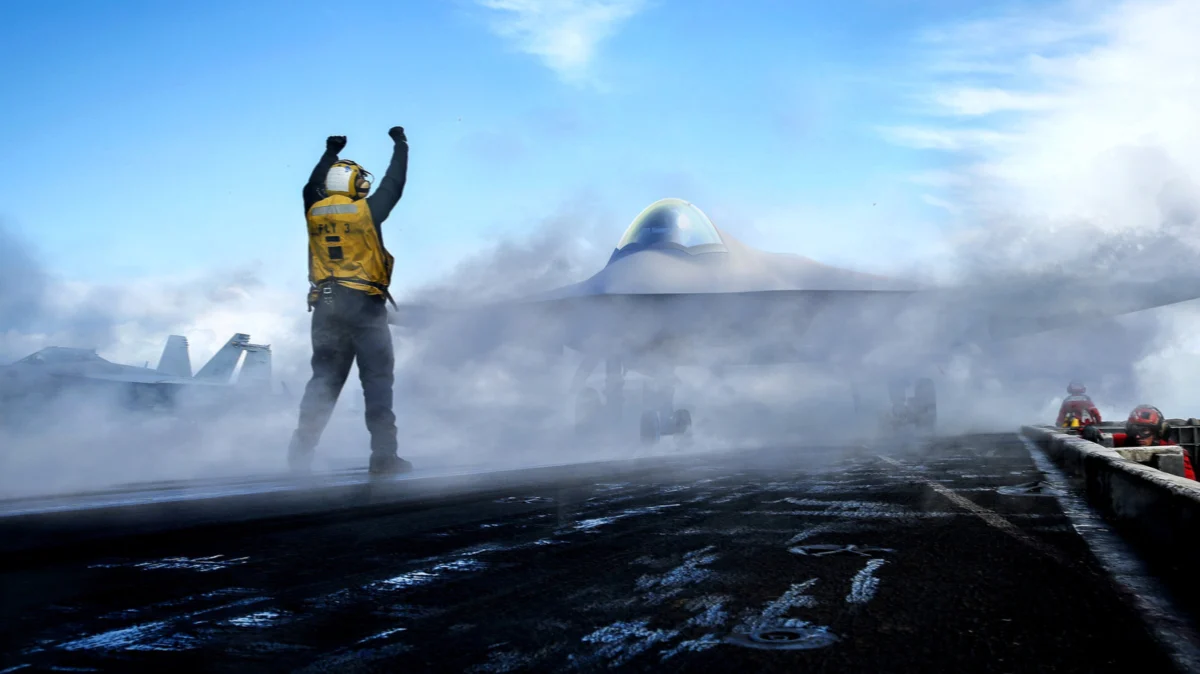
In a seismic shift for the American defense-industrial landscape, the U.S. Navy has officially selected Boeing to lead the development of the F/A-XX, the service’s highly anticipated sixth-generation carrier-based fighter. This decision, announced in late September 2026, completes a clean sweep for the aerospace giant, which was awarded the contract for the Air Force’s F-47 sixth-generation fighter in March 2025.
By securing both marquee contracts, Boeing has effectively established a monopoly over the future of American air superiority. This consolidation marks a dramatic departure from the era of the fifth generation, where Lockheed Martin held undisputed dominance as the primary contractor for both the F-22 Raptor and the F-35 Lightning II. As the Navy prepares to phase out its aging fleet of F/A-18 Super Hornets and EA-18G Growlers, the F/A-XX is poised to become the cornerstone of maritime power projection for the next half-century.
Chronology: A Path to Unification
The road to the F/A-XX contract was fraught with fiscal uncertainty and technical skepticism. For several years, the Pentagon grappled with the "industrial capacity dilemma." With the B-21 Raider stealth bomber program already stretching the manufacturing capabilities of Northrop Grumman, defense analysts questioned whether the U.S. could simultaneously sustain two distinct, highly complex sixth-generation fighter programs.
- 2023–2024: The U.S. Navy and Air Force refine the requirements for the Next Generation Air Dominance (NGAD) family of systems. Discussions regarding the feasibility of two separate, competing prime contractors intensify.
- March 2025: Boeing is awarded the contract for the Air Force’s F-47 program, signaling a major comeback for the company’s fighter division.
- Late 2025: Facing tightening budget constraints and concerns over supply chain fragmentation, the Department of Defense begins evaluating the benefits of a single-manufacturer strategy.
- September 2026: The Navy officially awards the F/A-XX contract to Boeing, citing the potential for shared technical knowledge and significant economies of scale as the primary justification for the move.
The logic is clear: by leveraging a common technological architecture across the F-47 and the F/A-XX, Boeing aims to streamline production, share software suites, and reduce the massive overhead costs that usually plague "clean-sheet" aircraft designs.
Supporting Data: Stealth, Range, and Connectivity
While the Pentagon remains tight-lipped regarding the specific performance metrics of the F/A-XX, public artist renderings and industry briefings suggest a design philosophy focused on two primary pillars: extreme stealth and long-range endurance.
The Power Projection Mandate
The aircraft carrier’s primary purpose is to project power into contested maritime regions. However, as adversaries have developed long-range, land-based anti-ship ballistic missiles, the "stand-off" distance for carrier strike groups has increased. The F/A-XX is designed to bridge this gap. By prioritizing internal fuel volume and aerodynamic efficiency, the aircraft is expected to possess an unrefueled combat radius significantly larger than the F/A-18 Super Hornet.
Multi-Role Integration
The F/A-XX will serve as a multi-mission platform. Most notably, it is slated to absorb the mission sets currently handled by the EA-18G Growler. This implies that the F/A-XX will be equipped with a cutting-edge electronic warfare (EW) suite, capable of suppressing enemy air defenses (SEAD) and conducting cyber-electronic attacks, effectively folding the "Growler" mission into a primary fighter airframe.
Collaborative Combat Aircraft (CCA)
Perhaps the most significant aspect of the F/A-XX is its role as the "quarterback" of the air. The platform is designed to operate in tandem with Collaborative Combat Aircraft (CCAs), such as the Boeing-built MQ-28 Ghost Bat. These autonomous, loyal wingmen drones will act as sensors, decoys, and kinetic strike assets. By managing a flight of these drones, the F/A-XX pilot can extend the reach of their sensors and the lethality of their weapons loadout without risking additional manned platforms.
Official Responses and Strategic Rationale
The Pentagon’s decision to consolidate the future of fighter aviation under a single contractor was not made lightly. In a briefing to stakeholders, Navy officials emphasized that the decision was driven by "production feasibility" rather than a desire to stifle competition.
"The goal is not to create a monopoly for the sake of profit," one Pentagon source noted, "but to ensure that the U.S. industrial base doesn’t collapse under the weight of too many disparate, high-complexity projects." By funneling the F-47 and F/A-XX programs into Boeing’s ecosystem, the Department of Defense expects to create a "common digital backbone" for its future fleet. This allows for rapid software updates and modular upgrades, which are essential for maintaining a technological edge against evolving threats.
Critics, however, have raised concerns about the lack of competitive pressure. Without a rival to force innovation, there is the risk of stagnation or price inflation. The Navy has countered this by asserting that the program will be subject to rigorous "fixed-price" incentives and milestone-based oversight, ensuring that Boeing remains accountable to strict budgetary and performance targets.
Implications: A New Era of Air Warfare
The transition from the F/A-18/EA-18G ecosystem to the F/A-XX represents more than just a hardware upgrade; it is a fundamental shift in how the Navy intends to fight.
The End of the "Traditional" Dogfighter
The F/A-XX represents a move away from the high-maneuverability requirements of the 20th century. While it will undoubtedly be capable in a dogfight, the philosophy of the sixth generation is "first-look, first-shot, first-kill." The aircraft’s design, characterized by the absence of vertical tail fins and advanced radar-absorbent materials, suggests that the priority is surviving in the most contested airspace on the planet.
The Future of the Carrier Air Wing
The Navy will continue to utilize the F-35C as a cornerstone of its carrier air wings. The F/A-XX is expected to operate in a high-low mix with the F-35, where the latter provides stealthy, sensor-rich reconnaissance, while the F/A-XX acts as the heavy-hitting, long-range interceptor and EW platform. This synergy will allow the Navy to keep its carriers further from danger while maintaining the ability to strike targets deep within enemy territory.
Industrial Base Consolidation
For the defense sector, this contract is a clarion call. The era of the "boutique" fighter program appears to be over. The sheer cost and technical complexity of sixth-generation technology mean that only the most robust aerospace entities—those capable of mastering advanced autonomy, high-speed networking, and stealth manufacturing at scale—can compete.
As we look toward the 2030s, the skies over the Pacific and beyond will be dominated by the silhouette of Boeing’s next-generation platforms. The U.S. Navy has placed a massive bet on the idea that a unified, integrated, and highly connected air wing is the only way to counter the sophisticated anti-access/area-denial (A2/AD) strategies of near-peer adversaries.
While the program is still in its infancy, the message from the Pentagon is clear: the future of air superiority is no longer about just the plane—it is about the ecosystem, the network, and the ability to project power from further away, faster, and with more intelligent support than ever before. Whether Boeing can deliver on this ambitious, monolithic vision remains the multi-billion-dollar question for the next decade.
