

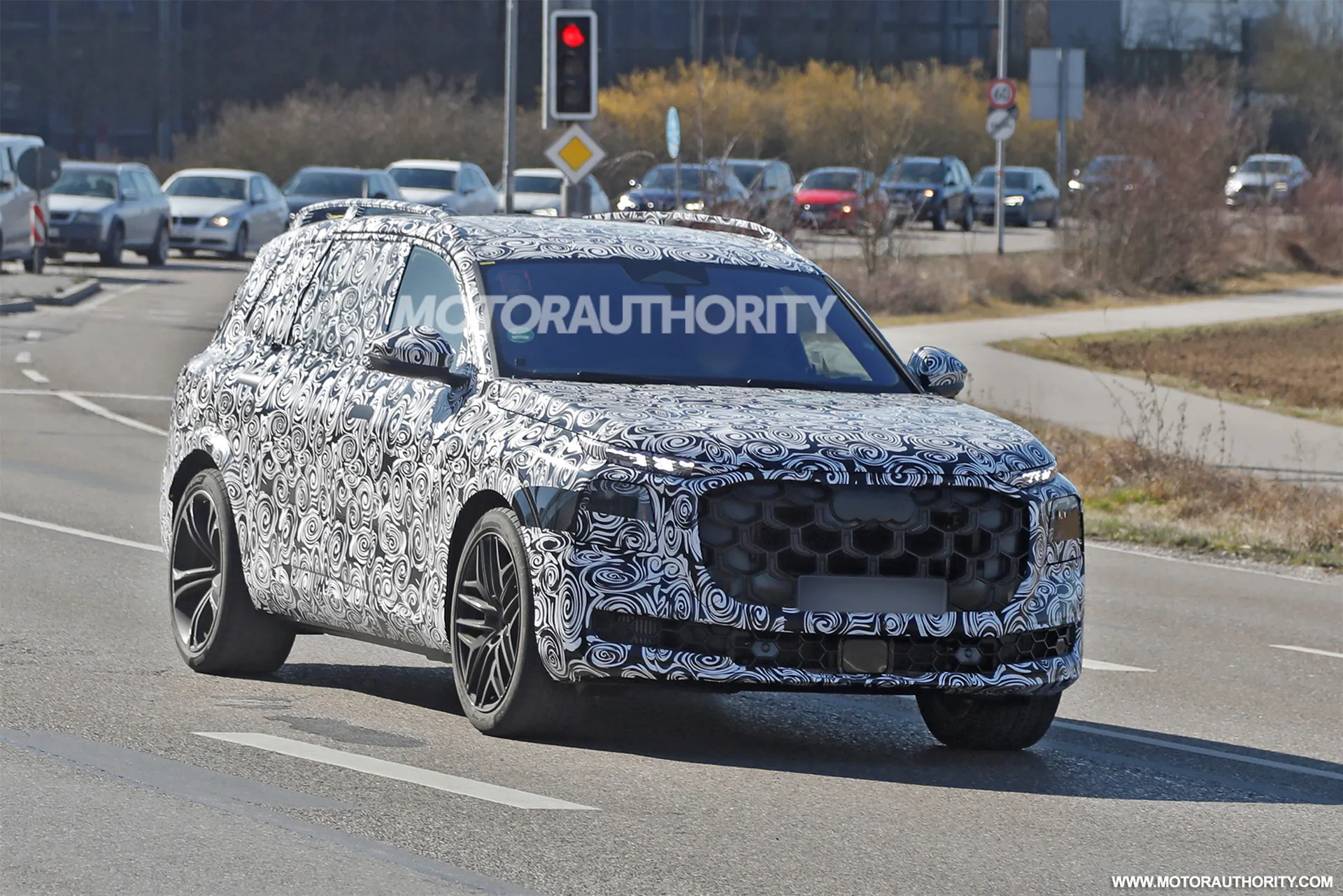
For years, the luxury automotive landscape has been dominated by a specific class of behemoths—vehicles that marry limousine-grade comfort with the commanding presence of an SUV. While Audi has long held its own with the Q7, it has notably lacked a true "full-size" flagship to go toe-to-toe with the titans of the segment, such as the BMW X7, the Mercedes-Benz GLS-Class, and the Cadillac Escalade. That silence is finally coming to an end. Recent spy photography has confirmed that Audi is deep into the development phase of the Q9, a sprawling, three-row luxury SUV designed to serve as the crown jewel of the brand’s internal combustion and hybrid portfolio.
Main Facts: The Emergence of the Q9 Prototype
The automotive world was set abuzz this week as a camouflaged prototype was spotted undergoing rigorous testing. While Audi has been notoriously tight-lipped regarding this project, the physical evidence suggests a vehicle that is not merely an extension of the Q7, but a ground-up reimagining of Audi’s SUV potential.
The prototype caught on camera displays the distinct, aggressive silhouette of a high-performance variant, widely believed to be the "SQ9." The most telling visual clue lies at the rear: a quartet of round exhaust tips—a hallmark of Audi’s "S" performance line. These exhaust signatures indicate that the SQ9 will likely prioritize a high-output powertrain, potentially a twin-turbocharged V8, to ensure it can compete with the M-tuned BMWs and AMG-powered Mercedes-Benz models that currently dominate the performance-SUV sector.
Beyond the badging and engine notes, the vehicle’s architecture tells a story of scale. Compared to the next-generation Q7 prototypes observed in similar testing environments, the Q9 features a noticeably elongated wheelbase. The stretched rear doors and the substantial rear overhang confirm that this vehicle is engineered specifically to prioritize interior volume. This design choice is aimed at solving the primary criticism of the current Q7: third-row habitability. The Q9 is expected to offer a genuine, adult-sized third row alongside a cavernous cargo area, effectively elevating it from a "mid-size plus" offering to a true full-size luxury hauler.
A Chronology of the Q9 Rumor Mill
The journey of the Audi Q9 from a speculative rumor to a metal-and-rubber reality has been a long, winding road.
- Early Speculation (2014–2018): Following the massive success of the Q7, industry analysts began suggesting that Audi needed a larger halo SUV to maintain its market share in the United States and China. During this period, the first whispers of a "Q9" emerged in trade journals, though Audi officials consistently deflected such inquiries.
- The Trademark Trail (2019–2021): The first concrete indicator of intent appeared in the form of trademark filings. Audi moved to secure the "Q9" nameplate across multiple global jurisdictions, a standard but definitive legal move that signaled the company was at least exploring the vehicle’s feasibility.
- Dealer Confirmations (2023): Perhaps the most significant milestone occurred within the last year, when reports surfaced that Audi had held private briefings with its U.S. dealer network. According to these reports, dealers were explicitly told that a full-size, three-row SUV was in the pipeline—a move intended to keep the network confident in the face of intense competition from domestic and German rivals.
- The Prototype Sighting (2024): The current development phase, marked by the recent spy shots, places the project on a firm timeline. With prototypes now hitting the road in "S" trim, the development is clearly in its final stages, pointing toward a global debut in early 2025 or 2026, with an expected arrival in the U.S. market as a 2027 model-year vehicle.
Supporting Data: Why the Market Demands the Q9
To understand why Audi is finally committing to the Q9, one must look at the data governing the luxury SUV segment. The full-size luxury SUV category remains one of the most profitable sectors in the automotive industry, particularly in North America and China.
In the United States, the Cadillac Escalade remains a cultural and financial juggernaut, regularly commanding six-figure price tags and maintaining high profit margins for General Motors. Simultaneously, the BMW X7 and Mercedes-Benz GLS have become essential pillars of their respective lineups, proving that buyers in this segment are willing to pay a premium for a vehicle that can carry seven passengers in absolute luxury without sacrificing driving dynamics.
Audi’s current lineup, while excellent, effectively caps out at the Q7. While the Q7 is a masterpiece of ergonomics and engineering, it is categorized as a mid-size SUV. By introducing the Q9, Audi is attempting to capture the "conquest" buyer—the customer who walks into an Audi showroom looking for a flagship experience and, finding no vehicle large enough to suit their needs, walks across the street to the BMW or Mercedes-Benz dealer. The Q9 acts as a retention tool, ensuring that Audi’s most loyal customers have a path to upgrade within the brand as their families grow or their space requirements evolve.

Official Responses and Strategic Ambiguity
Despite the mounting evidence, Audi has maintained a posture of "strategic ambiguity." When approached for comment regarding the prototype and the reported dealer briefings, Audi spokespeople have typically relied on standard corporate boilerplate: "Audi does not comment on future product plans."
This silence is not unusual for the Volkswagen Group. By refusing to confirm the Q9 officially, Audi protects the sales of the current Q7 and Q8 models. An early confirmation of a superior, larger model would inevitably cause "the innovator’s dilemma," where customers stop purchasing current models in anticipation of the new release. However, the presence of the vehicle in the wild—complete with testing equipment and manufacturer plates—speaks louder than any press release. The company is clearly walking a fine line between maintaining current sales momentum and generating the necessary hype for its upcoming flagship.
Implications: The Future of the Audi Brand
The introduction of the Q9 represents a significant shift in Audi’s corporate strategy. As the brand navigates its transition toward an electric-only lineup by 2033, the Q9 is likely one of the final, most ambitious internal combustion engine (ICE) vehicles the company will ever develop.
Performance and Engineering
The SQ9 prototype suggests that Audi intends to keep the internal combustion flame burning brightly for a few more years. Given the platform sharing within the VW Group, it is widely expected that the Q9 will leverage the latest iteration of the MLB Evo platform, potentially incorporating mild-hybrid (MHEV) or plug-in hybrid (PHEV) powertrains to satisfy both performance enthusiasts and emissions regulators. The use of air suspension with adaptive dampers, a staple of the S-line, ensures that despite its massive footprint, the Q9 will retain the "dynamic handling" identity that defines Audi.
The Design Language
The Q9 will be a litmus test for Audi’s evolving design language. While the spy shots show heavy camouflage, the proportions suggest a more upright, imposing front fascia compared to the sleek, sloping rooflines of the Q8. This is a functional necessity; the Q9 must project authority. We expect the production model to debut a new iteration of the "Singleframe" grille, likely with more integrated LED lighting signatures that push the boundaries of what is currently seen on the A8 or Q7.
Competitive Positioning
When the Q9 finally hits the market in 2027, it will enter a crowded room. The Cadillac Escalade will likely have just received a refresh or a full redesign, and the BMW X7 will be mid-cycle. The Q9’s success will hinge on whether Audi can deliver a "digital experience" that exceeds its rivals. This means a next-generation MMI (Multi Media Interface) system, deeper integration of autonomous driving aids, and, crucially, a level of interior material quality that justifies a price point likely to start well north of $100,000.
Conclusion: The Final Piece of the Puzzle
The Audi Q9 is more than just a new model; it is the final piece of a puzzle that Audi has been assembling for over a decade. By filling the gap at the top of its SUV hierarchy, Audi is signaling to the market that it is ready to challenge for total supremacy in the premium segment.
While the road to 2027 remains long, the emergence of the SQ9 prototype provides the clearest evidence yet that the wait is nearly over. For the enthusiast, it promises a high-performance, V8-powered behemoth. For the brand, it represents a crucial strategic pivot to secure its dominance in the most lucrative corner of the global automotive market. As we look toward the official unveiling, one thing is certain: the luxury SUV wars are about to get significantly more interesting.
